 Yesterday, Amity & Sorrow made it through all its copy edit queries and got moved into production by the good people at Little, Brown. This means that it moves from our much-marked Microsoft Word copy into mocked up pages that will be the proposed layout for the book. Then, these pages come to me for more looking at and worrying over, while a proofreader does stellar work in correcting all those things I’ve not managed to see or fix in all this editing. Books aren’t printed on presses like this anymore. This machine looks more a torture device, as if I mean to imply that edits are torturous. They aren’t, really. No, the press reminds me that we are making a book together, that paper will be printed that becomes the book I have written on this laptop in ephemeral drafts. The book, the bound thing, will last for as long as the paper does, for as long as we all value paper. Having a bound book will make me come over all Gutenberg. I can’t wait.
Author Archives: ukpr
War Art

Hurrah! The National Archives has made their collection of war art copyright free and available to everyone, thanks to a digitisation grant with Wikimedia Commons. Wars are won through propaganda. Who could resist such exhortations?
Laughing at the Enemy
 I have spent the last several weeks reading Home Office documents and scouring the magnificent – and exhaustively comprehensive – Hansard site for House of Commons speeches. On a sunny day like today, I felt in need of something lighter. I would imagine that audiences in the midst of war often felt the same – sure, you could hammer home to them the importance of the fight – but why not let them have a few laughs while they’re at it? Anti-nazi propaganda served the purpose of letting off war-steam and fear through laughter. Below are some examples I found and watched today:
Brainpickings introduced me to the animation of Jiri Trnka, whose “The Spring-man and the SS” brings to life the urban legend of the chimney sweep who became a nazi-fighting superhero. You can watch this on my Tumblr, The Victory Stitch:
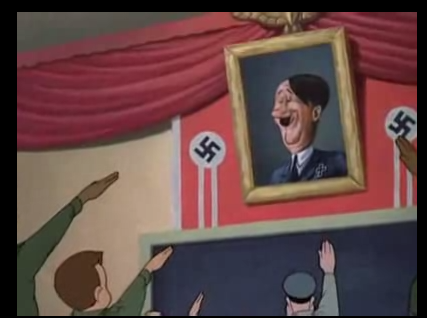
Walt Disney Studios made a number of war propaganda films following the financial flop that was Fantasia. Funded by the government, Disney was able to keep his artists on the payroll by making such films as “Four Methods of Flush Riveting” as well as animated shorts featuring dwarves, pigs and ducks. The only film I remember from this period is Donald Duck’s nervous breakdown film, Der Fuhrer’s Face, but today I came across the more earnest “Education for Death”, which seeks to answer the question: what makes a Nazi? In the film we see the education of young Hans from tender child to blinkered soldier, marching resolutely toward his own tombstone, marked with a swastika, topped with a helmet. Beyond Hitler being smothered in a Ring Cycle heroine’s bosom, there aren’t a lot of laughs here. For that, you have to turn to Popeye. “Spinach Fer Britain” bolsters the “special relationship”, while “You’re a Sap, Mr. Jap” would come to be banned – not unlike the more racist cartoons of Bugs Bunny and Tom & Jerry. In times of war, it’s easy to lose your racial perspective and it’s easy to see why. When we’re afraid we can make the enemy the Bogeyman and fear him in every closet, under every bed, or we can turn him into a clown and mock him, viciously. Is it better to fear Hitler or laugh at him? You decide. If you want to see Education for Death yourself, you can download it from this Wikipedia page – it’s public domain.

Tumblr
 I have banged on about Twitter and Pinterest here as well as, in my last post, Spotify – all great tools for sharing work, ideas, pictures and sounds within a community. I have recently begun to dabble in Tumblr, a micro-blog site that lets you add all of the above. So, why the need for another social network, you may ask. Is this yet another ploy to avoid writing?
No, I earnestly answer. The writing is going fine, thanks for asking – have topped 100K for the second draft of the second book (but who’s counting? Oh, yes, I am) and happily writing may way toward the end of the war. And what Tumblr offers is a space for “less” writing, as it were, than a blog. Here, you expect text. Here, sometimes the photos are a bit wonky, a bit hit-and-miss. Tumblr is fast. It isn’t a space for blogging. It’s for little thoughts, little ideas, little pictures, things that don’t merit a post, ragged bits of things that are flying about in the jumble of my head. If you’d like to have a visit, click here for my Tumblr and see what’s there. It’s called The Victory Stitch.
Are you listening?
 There are lots of ways to connect with people through social media. Writing can be a lonely old slog now and then, particularly in that gap of time between when you want to dance round the room at having received fresh galley proofs of your first novel and the deadline for your second. I’ll admit, I often look for ways to escape.
One is through Twitter, where you can be as social as you like. You can listen in on great conversations, follow streams of thought or word games with hashtags, or you can connect with lots of other writers, also heads down at their desks or, like you, seeking escape. Today on Twitter, I announced a new playlist for Amity & Sorrow, a great idea from my publicist at Tinder Press. I write to music; I probably use it as a form of self-hypnosis, if I’m honest. I haven’t put the tracks I actually wrote Amity & Sorrow to, tempting as it was, for fear of hypnotising all of you. No, on this Spotify playlist there are songs that, I hope, conjure up the feelings of the two sisters, Amity and Sorrow. You’ll have to guess which song is which sister’s. And if you want to win a galley of Amity & Sorrow, follow Tinder Press on Twitter with the book’s hashtag, #godsexfarming (Sorry – UK only!)
Inside the Blue House
 I write in a deluxe-shed at the bottom of the garden, painted blue. I have a desk and a huge piece of furniture with drawers that used to be in the kitchen in another house. I have an old chair and lots of shelves on the walls to hold up the books. There is an old dictionary on a music stand, which makes me stand up now and again, and a kettle, which makes me walk across the room. There is a Calor gas heater, a printer, and room enough on the floor to roll out a yoga mat. For me, it’s perfect and there’s nowhere else in the world I’d rather be.
My lovely British publishers, Tinder Press, have a Pinterest board for Tinder Places & Spaces, and the Blue House is mine. It’s just coming together, but why not have a visit and see some other Tinder places, for writing and for reading. (Don’t have a Pinterest account? Let me know and I’ll get you an invite!)
Sex and Weimar Berlin
 Prostitutes are a Weimar cliche’. Every Berlin book is full of them, leering from lampposts, shaking their boots and their whips. I find myself writing in Weimar Berlin in the midst of an economic crisis (thank goodness things like that don’t happen anymore), my character walking down these cliche’-ridden, prostitute-laden streets. I have to decide what she sees, what she hears, what she does.
Berlin between the wars is all jazz and destitution, and quite a lot of sex. I’m slowly working my way through the spate of Weimar history books and novels, trying to figure out how to avoid the many pitfalls that history opens up beneath my feet. See the children stacking worthless German marks like building blocks! Watch die Mutter pimp her daughter! What a wheeze.
It is, however, also the truth. In the worst economic times, women had nothing else to sell. And by the time the 20s turned from starving to roaring, Berlin was selling sex to the world. It remains a hub for sex tourism today, particularly, says the internet, Orienenstr. and Kurfurstenstr. where I recently visited the lovely Cafe Einstein, a former casino shut down by the Nazis. Today’s google brought me to the fascinating Cabinet Magazine, where a recent blog post offers “an inventory of the services offered by the various types of prostitutes working indoors and outdoors in Weimar Berlin.” It is an exhaustive, exhausting list, from Boot Girls to Medicine Girls, Munzis to Minettes . Why not join the tourists and take a look?
HHhH & writing a novel about history
 To mark 70 years since “Operation Anthropoid”, the assassination attempt on Reinhard Heydrich and the Nazi’s subsequent and brutal reprisals, The Wiener Library hosted an event with debut novelist Laurent Binet, author of a new history of Heydrich, “HHhH“. But is it history? And if so, why is he referred to as a novelist? In a room filled with mostly historians, attendees wanted to know how Binet labelled himself. “Your arms are tied by history,” he replied, but he acknowledged that the primary question when writing about historical subjects was to decide if you will be bound by the facts or if you will “fill in the blanks” of what you do not know. And, in doing so, do you “betray history”?
Historical fiction is big news. Since Hilary Mantel’s Booker Prize win for “Wolf Hall“, which tells the life of Thomas Cromwell in the present tense, fiction seems keen to cover history. The last Costa Prize winner was Andrew Miller for “Pure”, a first person present tense tale set in pre-Revolutionary Paris (The New York Times disputes it is historical fiction, saying Miller “plunders history”) while the recent Orange Prize winner, “The Song of Achilles”, is a story from the Iliad; debut author Madeline Miller was lauded for being “faithful to Homer” in its writing. This is not a new trend, of course – many of us got our Greek from Mary Renault and our Roman from Robert Graves – but it does seem that more literary writers are tackling historical subjects – as literature.
And why not? Binet employs a raft of literary devices to bring Heydrich and 1942 Prague to life. Historians in Binet’s audience acknowledged that they should be taught to write compelling narratives as well as to be accurate in their research. “But,” asked one, “isn’t your book just history with the research (i.e. the footnotes) left out?” Binet agreed, to a certain degree. He said that he invented a name for his writing: infra-novel. When pressed for a better translation he said, “You English already have a word for it. A non-fiction novel.” Binet also felt that his work was more in keeping with postmodern novels by American writers, from David Wallace Foster to Dave Eggers, who often insert themselves into the narrative, as the writer, or speak from the sidelines in judgement or self-mockery. “It is more honest to show who is talking,” Binet argued. “The habit of historians is to hide their subjectivity (and to be invisible in the writing process), but their subjectivity is still there.”
Binet is certainly present in “HHhH”, present in a way that Mantel and the two Millers are not. His search for Heydrich is a large part of the narrative; he is a character in the story, a narcissistic and obsessive writer searching for the truth – whatever it was. But his voice is filled with self-mockery in the grand tradition of French writers. “I had to show I was aware that I was ridiculous,” Binet laughed. “A writer trying to write a novel that is too big for me.” He chose not to “invent a Nazi” to tell the story from his point of view, setting himself apart from Jonathan Littell, whose French novel, “The Kindly Ones,” Binet refers to as “Nazi porn.” “I don’t want to speak about evil,” Binet said. “I don’t believe you will discover the roots of evil through a novel, by inventing a Nazi character. Littell gives Littell’s range of fantasy. I cannot dig in (Heydrich’s) mind or speak from within him. As a writer, I don’t buy it. I don’t believe it will work.”
But speaking from within the character is exactly what Mantel is doing – and with terrific success. I am halfway through the “Wolf Hall” sequel, “Bring Up the Bodies”, and it reads as if she has been inhabited by Cromwell; she writes as if possessed, staring out at the story through his eyes, though she is writing in third person. But, as she noted at this year’s Hay Festival, “I am not claiming that my picture of him has the force of truth. I know it is one line in a line of representations, one more copy of a copy. All I can offer is a suggestion: stand here. Turn at this angle. Look again. Then step through the glass into the portrait and behind those sharp eyes: now look out at a world transformed, where all certainties have dissolved and the future is still to play for.” Binet acknowledges this as well, when he said how no writer can hope to create the definitive story of any history. His Heydrich is only an addition to all the books that have come before and a stepping stone to those that will come after.
Perhaps that helps to take the pressure off a writer approaching history, as I am with my second novel? We shall see. I am learning from how other writers grapple with the facts, if they wear them lightly or as manacles. “I wanted literature to serve history,” Binet said, “not history to serve literature.” I am not writing history, but I am aware that I owe a debt to the history that I am writing as fiction; I am telling a story that is, for four thousand women, true. I cannot mis-tell their story, manipulate it in the name of story so that they themselves would no longer recognise it. But what of the gaps in their histories? What of the larger story? What of the ineluctable fact that history is not, in and of itself, a compelling story that can be written down and read? That is where I am, I suppose, staring at my stacks of books and maps and charts and timelines, telling myself the story and writing it down.
Hilary Mantel spoke recently on Front Row about the task of bringing Cromwell to life. “The problem is the shortage of material on his private life,” she says. “This is the challenge for a biographer. I can speculate on the basis of good evidence. I can work with what’s plausible, but the biographer has a greater burden of proof than that.” She offers great advice to writers in this wonderful half hour, such as this: Start with a real, specific detail, one that is better than you can invent, and put a scene around it. Or: look at how events in history stand together and may have affected one another – the connection between them can be the story. There is a certain comfort in knowing that the struggle between writing history and creating a story is both real and common. And with that, it’s back to the writing…
The stories are coming…

Very excited to share this on my blog – today is the launch of Tinder Press, the new imprint for Headline Publishing Group. Please visit the Tinder Press site to see a sneak peak of the book jacket for Amity & Sorrow – and to read the first chapter. Hurrah for Tinder Press!
Where’s The Victory Stitch?

I’m still ironing some kinks out in this new site. Like the Archive button, which leads to nowhere. It’s set as a default, but I don’t know where the archives are to link them. And maybe that’s OK. Let sleeping posts sleep on. You can still find things by searching for them via their categories or clicking through the Blog Post monthly folders. If I learn how to organise it better, I’ll do it.
The Victory Stitch was the name of this blog for quite a while, while I cut my teeth on WordPress and swam around in the first draft of my second novel. The picture above was taken during a community play I wrote and directed about the women’s internment camp on the Isle of Man, subject of my second novel. But time has marched on apace. Now, I’m in the midst of the second draft of the second novel, which will not be called The Victory Stitch, I hasten to add. Renaming this blog lets me back up from the initial brief on the blog, which was to blog research, and to deal with other matters, like my first novel, Amity & Sorrow.
So, this blog will continue to focus on research for my second novel and thoughts on writing in general, but it bears my name now. I’ve gone all dot.com. I hope you don’t mind the changes. In the meantime, I’ve had a good old clear out in the Blue House, where I write, as moving back to the second book seemed to require a massive spring clean, paint job, and repair of drooping foundations. I have all my research books back together, where they belong, and I’m leaping back into “the war”. Be on the look out for new posts – and maybe a little more news about my first novel, too – very soon!
 Peggy Riley