Almost there…

IMG_3450How many drafts does a novel take?  It depends on the novel and it depends on the writer.  I seem to be an eight draft kind of girl, so far.  Here are my eight drafts, each one started in Scrivener, exported to Word and tinkered with there.  Most drafts were typed over from scratch with the previous draft at my elbow, as a guide, a ghost, of what had come before.  There’s the Jigsaw Draft, which is a scrappy floor plan, unreadable to anyone but me.  There are three full drafts before the draft my agent read, then a draft from her notes that I sent out to my first readers, Beta readers, and then the draft that came from the reader’s notes.  There in the prettiest ribbon is a clean copy of the draft my editor read and, below, that same draft pulled apart and scrawled over, scavenged and cannibalized to incorporate her notes and thoughts and feelings.

I like to start over.  I like to abandon my words and keep looking at the nut of the thing inside them and behind them,coming at it from different angles, again and again, sure I can do better.  But, there comes a time when the brain says, Wait – what?  Again?

How many drafts will the brain allow?  I’m still scratching away at the story I want to tell, digging in, pushing back, so I’m not there yet.  But I’m close.  I’m almost there.  I can feel it.

The Shape of a Book

ImageThere are a lot of ways to write a book.  My shelves are filled with other people’s theories and lists.  There are a lot of good ideas in there, but they are other writers’ good ideas.  There is only one way to write a book – your way.  And each book has its own form, its own ideas, its own shape.  Today found me with the scissors and the Sharpies out, chopping apart my draft into chunks that I could hold, that I could see.  This is a big story.  Cutting it apart reminds me that I am in control of how the chunks work together, how the strands of story push and pull.  This pile of paper on the floor lets me see the shape of this second book, as well as what’s missing.

There is a cork board feature in my beloved Scrivener, but even I realise that a computer programme can’t do everything.  Sometimes, you have to get down on the floor on your hands and knees.

The Next Big Thing

We writers don’t play nearly enough. Perhaps that’s why someone invented Blog Tag. Called ‘the next big thing’ we are tagged by writers and go on to tag other writers, so that we get to talk about our own books – but even better, we get to meet and learn about other writers.  Headline’s Julia Crouch tagged me, so here I am, answering her questions.  To see who I tagged, scroll on down to the bottom:

What is the working title of your next book?  My first novel, Amity & Sorrow, is out next spring.

Where did the idea come from for the book?  I saw a couple of unconnected photographs, of a church on fire and of some women in ruffled prairie dresses, whom I learned were fundamentalist Mormons, leaving a city courthouse.  I started to ask questions of them, which led me to creating my own cult.

What genre does your book fall under?  Fiction that’s a little literary?

What actors would you choose to play the part of your characters in a movie rendition?  Ha! There is a Pinterest board for this that Tinder Press is having great fun with.  I would be exceptionally pleased if Jeff Bridges played patriarch and preacher Zachariah.

What is the one sentence synopsis of your book?  On the night they believe the world is ending, Amaranth takes her two daughters from their fundamentalist, polygamous compound and crashes into a farm in the Oklahoma Panhandle; once there, they begin build a new life with the farmer, but Sorrow will do anything to get back home.   It’s cheating to use a semicolon, isn’t it?

Will your book be self-published or represented by an agency?  It’s out with Little, Brown in the States and Tinder Press/Headline here in the UK, spring 2013.  I’m represented by Joy Harris.

How long did it take you to write the first draft of the manuscript?  The first draft took a year to write.  I’ve lost track of how many drafts I’ve done since then, truly.

What other books would you compare this story to within your genre?  Oh dear. That is the hardest question.  Can I duck out and say that Tinder Press says, “It’s Room meets Witness.”  I can’t top that.

Who or what inspired you to write this book?  Stubbornness, I think. I have been a playwright for many years and leaving London found me wanting to write something new, in a new way.  It was a big learning curve to move to prose, to learn to write fiction, but there’s no going back now.   I’m hooked.

What else about your book might pique the reader’s interest?  It’s about God, sex, and farming.  What more does a book need?

I’m delighted to be passing it on to three writers all with new books out in the spring:
To fellow Tinder Press author Brian Kimberling – tweeting @spypop22 – whose debut, Snapper, is all about love – and birdwatching
Colette McBeth – tweeting @colettemcbeth – whose debut, Precious Thing, is part of a two-book deal with Headline
And Jenn Ashworth – tweeting @jennashworth – whose third novel, The Friday Gospels, is out this spring with Sceptre.  As it’s about the Latter Day Saints, it’s dear to my heart.  Please visit all of them and give them a read!

The Arandora Star

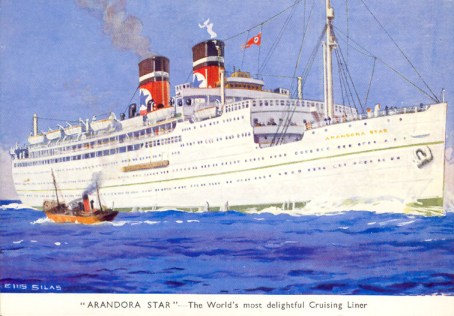
arandora_postcard_silasI’m on the third draft of my second novel. It is mostly set in the women’s internment camp on the Isle of Man, which held German and Jewish women – as well as 18b British fascists – from 1940 – 1945.  Today I need to rewrite the chapter about the sinking of the Arandora Star.  I am clearly avoiding doing so.  And in the light of comments last night about Turner Prize winner Elizabeth Price, whose piece, The Woolworths Choir of 1979, was discussed in off-the-cuff remarks from gallery visitors, maybe I am right to hesitate.  In the Channel 4 news coverage, several people questioned Price’s subject matter, a furniture store fire, and whether it was right for her to “profit” from others’ tragedies.  They shook their heads and tutted.  And I thought – hang on, isn’t that what we do, all of us, when we look at history, to write about it or to make art?  Am I right to write about this event, or any disastrous event in the first place – if it is not “mine”?

The SS Arandora Star was a Blue Star Line cruise ship pressed into service, as so many were, as a wartime transporter, evacuating troops from Norway and France.  It was also used to ship internees.  On 2 July 1940, the Arandora Star sailed from Liverpool toward Newfoundland, carrying nearly 1200 German and Italian interned men and prisoners of war.  The ship was struck by the torpedo of a U-boat off the coast of Ireland.  All power was lost and the ship sank in 35 minutes, killing more than 800.  Throughout the month of August, bodies washed onto Scottish and Irish shores.

“I could see hundreds of men clinging to the ship. They were like ants and then the ship went up at one end and slid rapidly down, taking the men with her… Many men had broken their necks jumping or diving into the water. Others injured themselves by landing on drifting wreckage and floating debris near the sinking ship”
— Sergeant Norman Price, speaking in a first-hand account of war at sea, edited by Ian Hawkins

News of the sinking was broadcast on the BBC, whose news report claimed that the death toll should be blamed on the Nazis on board who swept everyone aside in a rush for lifeboats.  There were not enough lifeboats and several had been damaged in the explosion.  The Daily Express stated that “the scramble for the boats was sickening”.  All reports at the time led the public to believe that  the Arandora Star had carried only Nazis and Italian Fascists, and it was the first that anyone had heard of the government deporting internees.

We now know that an unspecified – but significant – number of German internees onboard were actually Jewish refugees who had fled to Britain from Nazi oppression.  Some of these men were husbands to the women who were interned in the Isle of Man, women who had not received any information from or about their husbands since their own internments, women who did not know that their husbands had sailed or that they had been told that their wives would be following them to Newfoundland; in fact, the wives knew nothing of the transport or the deportation at all, and had certainly not been asked to follow them.  The news of the tragedy – and the government’s deceit – hit the camp and its women hard.  One internee is quoted as saying, “the whole camp grieved.”

In the aftermath of the sinking, events were discussed in the House of Commons.  On 9 July 1940, George Strauss, MP for Labour, asked, “Does the Minister of Shipping have any statement to make about the loss of the Arandora Star; whether the ship was convoyed and had ample lifeboat provision; how many of the Germans on board were known to be Nazis and how many came to this country as refugees; when will he 1075 be able to provide the friends and relatives in England with the names of the persons drowned; and whether it is proposed to send internees abroad without convoy?”  On 23 July, MPs were still asking for the full list of names of the internees on board, to confirm the missing as dead for their families; MPs continued to ask about the percentage of Germans onboard who were Jewish refugees and to query why initial reports suggested that all passengers were Nazis and fascists.  On 30 July, MPs were accusing the Minister of Shipping of having sent all survivors away so that they could not be questioned about the disaster or their treatment before, during, or after it.  The 586 survivors of the Arandora Star, only days later and still in shock, had all been placed on the SS Dunera and sent to Australia, where they would continue their internment.

In August it was decided by the Camp Commandant, Dame Joanna Cruickshank, that interned wives of men interned in camps across the Isle of Man should be allowed to meet their husbands, if only to discuss and decide whether they would agree to be deported.  Imagine the meeting – women putting on their finest things from the one bag they had been allowed to pack; the coach journey from Port Erin to Derby Castle in Douglas; the first glimpse of one another after two months of separation with no word, no letter, no contact.  Women smuggled in any food they had; records show one entire roast chicken was confiscated from a handbag.  Was there punch or dancing?  Were they allowed to canoodle?  There are no reports of that but, upon their return, not a single couple had agreed to be deported.  The practice itself was soon stopped, but it did mark a turning point in the policy of internment.

The event galvanised liberal MPs, from Colonel Wedgwood to MP Eleanor Rathbone, to fight all the harder for the rights of internees and refugees.  As for the internees themselves, never again would they be so trusting or so willing to give the government the benefit of the doubt, that all mistakes and oversights would be swiftly identified and rectified. The sinking of the Arandora Star taught the internees that it was every man – and woman for herself.  The bulk of the women in the internment camp were refugees themselves, having sat tribunals during “the phoney war” only to be arrested in the great panic over Fifth Columnists as country after country toppled to Nazi Germany in April and May 1940.  We are all so very afraid when a war begins and escalates.

World War Two is not “my war”, though I have been writing about it for years.  “My war” must be the one we are still somehow “fighting”, this “war on terror” which has suffered as much from the mistakes of racial profiling and internment as WW2.  Studying what happened in 1940 makes 2001, 2004, 2012 more clear for me.  I do not believe that writing about this event, or indeed any event from the internment camp or the war itself, is an attempt to “profit” from disaster.  How could I?  But am I kidding myself?

Artists and writers look at history and at world events.  Surely it is not solely for profit, but for art’s sake, in the very human endeavour of attempting to understand the world and its people.  We cannot help but look backward, to try to understand how we have moved forward – or not.  I believe that I am bearing witness to an internment camp that I have studied and whose former internees, as well as those who interned them, I have met and spoken with at length.  They want to understand what happened, as do I.  I do not believe I am attempting to profit from their pain, but perhaps I flatter myself that I can share it, that I can ease the burden by bringing it out of a hidden past and into the light.  And now, it really is time to rewrite that chapter.

Shedworking

I was introduced to the idea of shed working by writer, poet and garden lover, Sarah Salway.  She also organises Shedworking, a lifestyle blog about people who work in their sheds, whether grand or humble.  I write here in the Blue House and when Sarah came along, bearing cake, she took a few snaps of me and my shed-deluxe.  Visit Shed Working to see the Blue House and many other people, happily working in their sheds.

HHhH & writing a novel about history

To mark 70 years since “Operation Anthropoid”, the assassination attempt on Reinhard Heydrich and the Nazi’s subsequent and brutal reprisals, The Wiener Library hosted an event with debut novelist Laurent Binet, author of a new history of Heydrich, “HHhH“.  But is it history?  And if so, why is he referred to as a novelist?  In a room filled with mostly historians, attendees wanted to know how Binet labelled himself.  “Your arms are tied by history,” he replied, but he acknowledged that the primary question when writing about historical subjects was to decide if you will be bound by the facts or if you will “fill in the blanks” of what you do not know.  And, in doing so, do you “betray history”?

Historical fiction is big news.  Since Hilary Mantel’s Booker Prize win for “Wolf Hall“, which tells the life of Thomas Cromwell in the present tense, fiction seems keen to cover history.  The last Costa Prize winner was Andrew Miller for “Pure”, a first person present tense tale set in pre-Revolutionary Paris (The New York Times disputes it is historical fiction, saying Miller “plunders history”) while the recent Orange Prize winner, “The Song of Achilles”, is a story from the Iliad; debut author Madeline Miller was lauded for being “faithful to Homer” in its writing.  This is not a new trend, of course – many of us got our Greek from Mary Renault and our Roman from Robert Graves – but it does seem that more literary writers are tackling historical subjects – as literature.

And why not?  Binet employs a raft of literary devices to bring Heydrich and 1942 Prague to life.  Historians in Binet’s audience acknowledged that they should be taught to write compelling narratives as well as to be accurate in their research.  “But,” asked one, “isn’t your book just history with the research (i.e. the footnotes) left out?”  Binet agreed, to a certain degree.  He said that he invented a name for his writing:  infra-novel.  When pressed for a better translation he said, “You English already have a word for it.   A non-fiction novel.”  Binet also felt that his work was more in keeping with postmodern novels by American writers, from David Wallace Foster to Dave Eggers, who often insert themselves into the narrative, as the writer, or speak from the sidelines in judgement or self-mockery.  “It is more honest to show who is talking,” Binet argued.  “The habit of historians is to hide their subjectivity (and to be invisible in the writing process), but their subjectivity is still there.”

Binet is certainly present in “HHhH”, present in a way that Mantel and the two Millers are not.  His search for Heydrich is a large part of the narrative; he is a character in the story, a narcissistic and obsessive writer searching for the truth – whatever it was.  But his voice is filled with self-mockery in the grand tradition of French writers.  “I had to show I was aware that I was ridiculous,” Binet laughed.  “A writer trying to write a novel that is too big for me.”  He chose not to “invent a Nazi” to tell the story from his point of view, setting himself apart from Jonathan Littell, whose French novel, “The Kindly Ones,” Binet refers to as “Nazi porn.”  “I don’t want to speak about evil,” Binet said.  “I don’t believe you will discover the roots of evil through a novel, by inventing a Nazi character.  Littell gives Littell’s range of fantasy.  I cannot dig in (Heydrich’s) mind or speak from within him.  As a writer, I don’t buy it.  I don’t believe it will work.”

But speaking from within the character is exactly what Mantel is doing – and with terrific success.  I am halfway through the “Wolf Hall” sequel, “Bring Up the Bodies”, and it reads as if she has been inhabited by Cromwell; she writes as if possessed, staring out at the story through his eyes, though she is writing in third person.  But, as she noted at this year’s Hay Festival, “I am not claiming that my picture of him has the force of truth. I know it is one line in a line of representations, one more copy of a copy. All I can offer is a suggestion: stand here. Turn at this angle. Look again. Then step through the glass into the portrait and behind those sharp eyes: now look out at a world transformed, where all certainties have dissolved and the future is still to play for.”  Binet acknowledges this as well, when he said how no writer can hope to create the definitive story of any history.  His Heydrich is only an addition to all the books that have come before and a stepping stone to those that will come after.

Perhaps that helps to take the pressure off a writer approaching history, as I am with my second novel?  We shall see.  I am learning from how other writers grapple with the facts, if they wear them lightly or as manacles.  “I wanted literature to serve history,” Binet said, “not history to serve literature.”  I am not writing history, but I am aware that I owe a debt to the history that I am writing as fiction; I am telling a story that is, for four thousand women, true.  I cannot mis-tell their story, manipulate it in the name of story so that they themselves would no longer recognise it.  But what of the gaps in their histories?  What of the larger story?  What of the ineluctable fact that history is not, in and of itself, a compelling story that can be written down and read?  That is where I am, I suppose, staring at my stacks of books and maps and charts and timelines, telling myself the story and writing it down.

Hilary Mantel spoke recently on Front Row about the task of bringing Cromwell to life.  “The problem is the shortage of material on his private life,” she says.  “This is the challenge for a biographer.  I can speculate on the basis of good evidence.  I can work with what’s plausible, but the biographer has a greater burden of proof than that.”  She offers great advice to writers in this wonderful half hour, such as this: Start with a real, specific detail, one that is better than you can invent, and put a scene around it.  Or: look at how events in history stand together and may have affected one another – the connection between them can be the story.  There is a certain comfort in knowing that the struggle between writing history and creating a story is both real and common.  And with that, it’s back to the writing…

Where’s The Victory Stitch?


I’m still ironing some kinks out in this new site. Like the Archive button, which leads to nowhere. It’s set as a default, but I don’t know where the archives are to link them. And maybe that’s OK. Let sleeping posts sleep on.  You can still find things by searching for them via their categories or clicking through the Blog Post monthly folders.  If I learn how to organise it better, I’ll do it.

The Victory Stitch was the name of this blog for quite a while, while I cut my teeth on WordPress and swam around in the first draft of my second novel. The picture above was taken during a community play I wrote and directed about the women’s internment camp on the Isle of Man, subject of my second novel.  But time has marched on apace. Now, I’m in the midst of the second draft of the second novel, which will not be called The Victory Stitch, I hasten to add.  Renaming this blog lets me back up from the initial brief on the blog, which was to blog research, and to deal with other matters, like my first novel, Amity & Sorrow.

So, this blog will continue to focus on research for my second novel and thoughts on writing in general, but it bears my name now.  I’ve gone all dot.com.  I hope you don’t mind the changes.  In the meantime, I’ve had a good old clear out in the Blue House, where I write, as moving back to the second book seemed to require a massive spring clean, paint job, and repair of drooping foundations.  I have all my research books back together, where they belong, and I’m leaping back into “the war”.  Be on the look out for new posts – and maybe a little more news about my first novel, too – very soon!

Amity & Sorrow

This blog started as a place to keep research for my second novel, but my first novel has often taken me away from that. As such, when you’re here googling “Nazi fairy tales” (and many of you do!) you sometimes bump into blog posts about farming or polygamy. I have been squirrelling away on edits for my first novel since the new year and I’m delighted to say that the edits are approved and it’s moving into production. There are so many amazing steps on this journey from first idea to stack of paper that it’s all quite dizzying. I am one grateful writer.

AMITY & SORROW, my book about God, sex & farming, will be published in spring 2013 with Little, Brown (US) and Headline Review (UK). Foreign rights have sold with Orlando (Holland) and Presses de la Cite (France). I thought it was high time I changed my Twitter bio, too. Now, back to the war – and book two!