 My recent story, performed by White Rabbit in Ashford, has been accepted for Ether Books, a mobile publisher, “providing the very best short content direct to your mobile phone.” They say, “We publish short fiction, articles, poetry and serials from both bestselling and emerging contemporary writers.” Hurrah!
Category Archives: Uncategorized
Reauthoring
 In my other life, I’m a live lit producer. Or was. As that job has ended, I find myself a live lit artist. So, what is live lit?
Live literature is a funding strand and a way to explain spoken word or text-based installation/multimedia work. As that is a bit unwieldy, live lit has come to stand for many things for many people. It is spoken word work and performance poetry; it is an author in a room with readers doing something more dynamic than simply opening her book and reading from it. It is a process of engaging audiences with text – with words – in a way that brings the words their writer to life. Which is still rather unwieldy.
Maybe the easiest way to explain it is to invite you to see it. I am part of The Reauthoring Project happening at the upcoming Herne Bay Festival. There you will see the work of 5 Kent writers, including me and my new piece “Post”, a promenade journey through a life. You’ll be able to read Post here once I’ve done the piece live. But you wouldn’t want me to spoil it for you, would you? See you in Herne Bay!
10 Things I Love
Well, this isn’t the kind of thing I blog about at all. But when @52Betty challenged me, I felt compelled to answer with my list. Here is her list, so that you can check that I didn’t just copy hers.
1. Red Vine Licorice. It must be Red Vine; Twizzlers will not do. Red Vine Licorice isn’t even really licorice, in that there is no licorice flavour to it at all. It comes in a trim cardboard box, wrapped in cellophane. It tastes of sugar and wax and my childhood. It is the first thing I buy when I land in Los Angeles and it is often the last thing I buy at LAX when I leave.
 2. Chipotle peppers. Smoke-dried jalapeno peppers. When I open my last bag, procured from some Mexican grocery store, I begin to worry. They can be crumbled into food or soaked and chopped. They can be put in a blender with olive oil to make a lovely, smoky, chile paste. They are essential for enchiladas.
3. White sweet peas. Every year I put them in too late and every year I am disappointed when I get no blooms. But this year, I am feeling smug. This year I found two flats of them on-sale at a garden centre, about to be dumped for being “past their sell-by date”. Since when did plants have those? I put them in on time and I am rewarded, even as I type, with twenty-seven flowers. I feel invincible.
4. Old maps. Who can resist them? I came back from Berlin with a suitcase full. I love how names change, roads move, empty spaces fill up with people and buildings, then empty again. I do not love Google maps, however.
5. Sun salutations. I should do more of them. They stretch everything in you, in turns and all at once. They start slowly and mindfully, with stillness, and lead you to downward facing dog, which is a name that anyone could love. I currently have a sprained rotator cuff, and it finds downward facing dog rather a challenge. But soon, I will be back to it, saluting the sun with reckless abandon.
6. Louise Erdrich. Bookseller, poet, artist, German-Chippewa novelist. I don’t keep fiction in the Blue House, but I do keep Louise Erdrich there, sandwiched in and around the research books of the American west and the fundamentalist Mormons. Her books are what I turn to when I require comfort, on a tough day’s write. Her books are filled with people who love one another but do not understand one another. Her stories are filled with grace, humour, compassion, as well as ghosts and history and tiny bits of magic. I couldn’t possibly single one out, but start with Antelope Wife, if you don’t know her yet.
7. Sleeper trains. When I was little, we took sleeper trains to Albuquerque. I don’t remember much about them, but they must have seeped into me, because I adore them. I never sleep well on them, but sleeper trains aren’t designed for sleeping. They are designed to help you transition from place to place, slowly, moving between states of mind. I would much rather arrive somewhere new by sleeper train, dazed and scratchy-eyed, having prepared myself for it through many hours of darkness in a gently rocking room. On Amtrak, lovely men unhook and make your bed up for you while you sit in the dining car, rolling your way toward Portland or Sandpoint, Idaho. When planning my trip to Berlin, I knew I should have to arrive by sleeper train. The Man in Seat 61 made it possible.
8. Fleetwood Mac. I love the feel and the sound of them. I never tire of Second Hand News or The Chain. I love their tragic love stories, how they played them out through their soft rock, their bohemian costumery. I love everything about them except for Tusk. No Tusk, thank you.
9. Summerdown Peppermint Tea. I didn’t know that the English were historically famous mint producers, and Summerdown assures me that they still are. Black Mitcham peppermint tea is farmed in Hampshire and brewed daily, here in my kitchen.
 10. Turquoise. Really, I could have had a lot of Number 10s. What of clogs? What of folk music? What of Morris dancers, stopping traffic, stomping down high streets with their painted faces and trailing ribbons? Arbitrarily, I plump for turquoise. I wear a lot of turquoise, handed down by grandmothers. I am often told in airports that it is good luck for travel and that it protects the throat chakra. I like its weight and solidity, its age, its pits and pockets. Here’s me with my favourite stone.
Thank you for giving me time to think about things and love, Betty. If you want to share the things you love, why not add them here? Or add them to your own blog? Or tell Betty – she’d like to know, too, I’m sure she would.
Back up
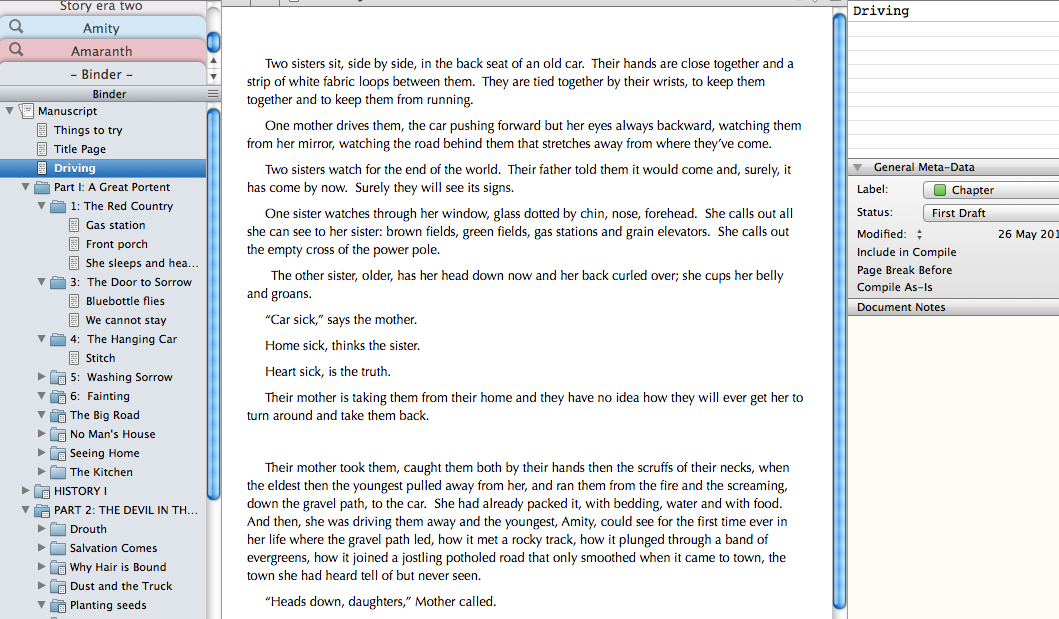 Back up has a lot of connotations for a writer. I might mean – back up your work! And it’s certainly good advice. Scrivener automatically saves and backs up to Dropbox every time I close it, so I don’t even have to remember to take this advice. But if you don’t have a back up system, do get one.
It could mean – back up from the screen. You’re sitting too close and you’re all hunched over. This is probably good advice, too, but I don’t take it. I really only push back from the computer to stumble to the dictionary or the kettle. I do try to sit up straight and I don’t have carpal tunnel syndrome yet, which must surely mean something. It could mean – back up and start over, which I’m currently doing, writing what I hope will be the final draft of my first novel. So I am backing up now, going back and back, over and over. But what I really mean today, and how I started this morning, was to back up from my characters, back up and look over the top of my story.
For beginning fiction writers (and as a recovering playwright I still include myself in this category) the thorny issue of point of view must be grasped. In drama, every character is equal. It could be anyone’s play, anyone’s story, at any time. At any moment, a character can charge downstage and say something so remarkable and so personal that the play spins on its axis and moves off in an entirely new direction. This can happen in fiction as well, of course, but someone will only say that your point of view is inconsistent. And that’s after you’ve made the initial decisions in the first place: whose book is it? do they speak first person from “I” or third person from “she”? Is there a narrator who is also a character or not and how much do they know?
As I was figuring out the structure of my first novel, I tried every tense and point of view going, every draft. I learned a lot. I learned I’m much more comfortable writing third person looking through a character’s eyes, in present tense. Not everyone’s cup of tea, but it is mine, and writing this way helps me stay out of my own way so that I can just get the words down, just tell the story. First person makes me feel like I’m writing monologues, and a narrator felt too – I don’t know – omniscient. I kept thinking, who is that person talking if they aren’t a character? Who is that and how do they know so much and why is she just talking to the reader – does she know the reader is there? Was it as basic as asking if a play has a fourth wall or not? Are they aware of the audience or not? Does a book tell its own story, over and over if no one is reading it? And then I felt I had to understand who individual characters were talking to when they were in scenes or chapters. Were they aware of the reader so that the reader became a character for them, either in their story or in a sense of needing to explain or justify or apologise to them? And this was problematic because the intent changes what they say and how they say it, as in drama. In a book, I suddenly realised, it makes every character slightly unreliable. As Laurence Olivier might say, “Perhaps you should just try writing, dear.”
I knew my characters had a stranglehold over me, in terms of what they were doing and saying. By writing and looking through their eyes, they were each constantly justifying themselves. It was very hard to get any information that was “clean.” By backing up from them and allowing myself to sometimes use a third person voice that was not looking through them, but rather looking at them, I feel I have found a way to see them better and show them better, and allow the reader to make up her own mind about what the truth of the story is and who’s “the good guy.”
That’s today’s revelation anyway. I’m quite looking forward to writing tomorrow, actually.
Going back to the start
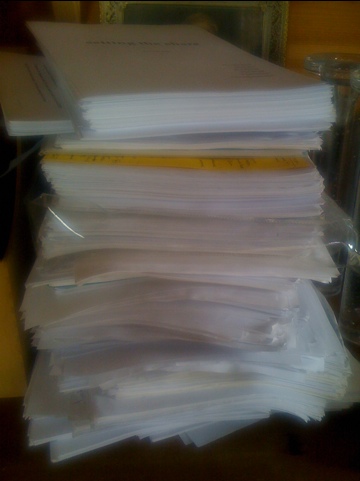
Having finished the first draft of the second novel, I now return to the last draft of the first. Having felled copious trees and emptied two ink cartridges, I add the latest draft to the pile of drafts I have written, to be read tomorrow and pulled apart, rewritten and reassembled. When I’m finished reading and finish rewriting, no doubt I will ask myself the same question I asked last post. Am I done yet?
The answer will still be no. There will still be drafts and rewrites ahead of me, drafts that come from the comments of readers or editors. There will still be many drafts ahead. But the thing of it is, I know I’m getting closer to seeing the story I mean to write. It is clear now, even if my photo is blurry. I can picture any moment in the book like a still or moving image. I can move forward or backward from that moment. I can change perspective, change point of view. The story itself and the characters who live in it are as clear to me and dear to me as flesh. And after the wading through a first draft of a new project, that surety is a comfort. It is like sitting down with an old friend after a long absence. An old friend who you can see more clearly, perhaps, after spending time with new people. You can see, perhaps, how you both have changed. It is somehow, a little like going home.
Another new desk and a letter
Today, I am sitting at another new desk. It’s still in Toronto. It’s even in the same building. But it’s a new flat three floors up and five doors over from the last one. The desk is much the same, so I’ll not trouble you with a picture. It’s blonde wood instead of dark and it still has a fax machine, a lamp, and a pile of paperwork. Still, it felt like moving, with all its associated upheaval.
We have been living out of suitcases since November. So, what’s one more bout of packing? It truly makes you realise how little you need. Aside from my rather fetching new parka, the only things we buy here are groceries, so we packed those. We have pretty much been wearing the same clothes since November as well – sorry, Toronto – so we packed those, too. I stuffed the few books I’ve bought into my handbag and picked up the computer. It was easy to go, easy to arrive.
I suppose I’m thinking about how little we need when we’re travelling, because I’m writing about people who are travelling. But whereas we can choose our circumstances – at the risk of libel I will say we moved due to neighbours who were under the mistaken impression that we were all sharing student housing – they cannot. The women interned during WW2 had one day’s notice, if they were listening to the radio at 1pm on 27 May 1940. Some women did, so they had time to pack and to worry. Others did not, particularly women who had been given a Class B in their Tribunal, which restricted their movements, placed a curfew on them, and dictated what they could not have in their possession, namely maps, cameras, and radios. For these women, the news was sudden. Pack one bag and bring your coat. It was hot in May 1940. Being asked to bring a coat had implications.
The bag could be no more than one hundred pounds. As there were no porters for this move, I imagine women packed far more than they could carry. I would. They would then have to shed items, the further they had to walk. What would I have done with my one case, jammed full of books and nothing to wear for a stay that would last months? Years? I don’t suppose I would cope any better than the women did who became the internees of Rushen Camp in the Isle of Man.
 I interviewed several former internees while conducting research for a play about the Camp. This was several years ago, and I asked very different questions than I would now. I have piles of transcripts and recordings, and it is from these that I am picking my way through the story and creating my own, but there is no way to ask them questions, really. To do that, you have to go to the source. And years have passed. The camp has been closed now for 66 years. But sometimes, fate intervenes.
I recently had a letter from a former internee, now living in Hamburg. Somehow, she found me, having moved away from London, having travelled since the end of last year. I quickly wrote her back – by hand, as I have no printer – and have to trust that she can read my scrawl when it says that I would love to see her. And so I would. Perhaps a trip to Hamburg is in my future. For there are many different questions I would ask her now.
Packing
 I am packing again. This is a big pack, not a little pack. Little packs aren’t so hard. They say you’re going into London for a couple of days for work, or not work. They say you’re off on a small adventure. They say there might even be a holiday in the offering. Big packs are harder. They require consideration and selection. They require planning and imagination, ripe with the question: what will I want in February? In March?
Clothes aren’t so hard. We only have so many extremities we need to cover in the pursuit of modesty. Even when the extremities will be subjected both to arctic snow and to southwestern sun, it is only a matter of choosing. Shoes are harder, but what girl wouldn’t say that? And shoes aren’t so heavy, an important consideration when the airline limits you to 20kg.
No, what is hard is the books. The packing of books, which are heavy. The choosing of books, to just take one or two, say, which is nigh impossible. As I leap back into the first draft of my second novel, I know where I left my character and I know where she is headed. I know enough to get started and to get back into the writing. What I don’t know yet is what I don’t know. What will I need to know? What will I want to look up and to read? For the last pack I had a mighty basket of books for research. To be fair, I didn’t use many of them. Knowing they were there, I suppose, meant I didn’t panic over needing them. But what if they are not there? What on earth will I do? Just the thought makes me toy with packing only books – modesty be damned!
But I will not be packing books, I guess. I will make what notes I can digital. I can photograph the prompts and props I have relied on. And what else? I can trust that, despite having books I have yet to read, I know enough already. I know enough to write this story right now. And anything I don’t know? Well, that can wait. Books will always wait for us to want them – need them – again.
On not writing
I have not written a post in ages. Ages! What can I say? It is due to the finishing of many things.
I say finishing. It is, of course, only a furlough. The furlough, being, a bit of a holiday from obligation. A week of sloth and sun, reading the juicy books that feel too long for home: Byatt’s The Children’s Book, Faber’s The Crimson Petal and the White, Mantel’s Wolf Hall, now at the beginning of Kingsolver’s The Lacuna. Rich, epic journeys all, and my holiday was/is much the richer for them. But Monday will find me back at my desk, back at the research and the writing.
The editing and rewriting of the first novel that I hope are done are not, of course, really done and the “work” I had and finished will begin again, then increase in earnest when the schools reopen. There are autumn events to plan, a schedule to make for the rest of this year, the beginning of next.
There is a hope that I can go back to where I left the second novel, when the rewriting took over, and find something there…but I probably will simply begin again. I probably will have to. I imagine I will read what I have left and think – no, that’s not it at all. The first scratchings away at character and voice are so tentative – like parting clouds, like shaping mist. What will I find when I read what I left?
But that’s for Monday. Today it is raining in Liverpool. There is a book to be read, there are catch-ups of Masterchef to be watched. It is still a holiday, even as “real life” reminds you it is waiting for you…
like a ghost
I am shaking off the red dirt of Oklahoma. I am shrugging out of the clutches of religious extremism and the heavy gaze of God. I am trying to get a book out of my system. Perhaps I do not believe that it can leave me entirely, while it is still in the process of being “sold”. But I must get out from under it, if I am to move on. I must stop following polygamy trials quite so closely. I must stop reading the Oklahoma farm reports daily. But I cannot give up, entirely, on either of them. These polygamists and farmers matter to me now. It matters how these men of “privilege” will be sentenced, and it matters how the canola is doing this year, when wheat is down.
The map of Oklahoma has come down and pinned in its place is one of Port Erin, a village at the southern end of the Isle of Man. The images of the long lines of women in their prairie-period-costumes is replaced with the photos of internment, May 1940, when all B class and some C class “enemy aliens” were arrested, held in cells and public places, then shipped to the Isle of Man. They took whatever they could carry. And you cannot help but think of the journeys they had already made to come to Britain, for roughly 85% of these women were Jewish. Refugees. Some had come on the Kindertransport. And it makes me think of polygamous pioneers, trudging across plain land, not knowing what the west was, or how it would change them. There are always strange links between ideas, as each attempt at a new piece is still a scratch at an old, deep place we are trying to reach or to excavate.
It took me a long time to get the internees out of my system when I first researched their stories, but I did. I went on to write about oyster girls, aviatrixes, young offenders, evil carnivals, and, finally, polygamists and farmers. All of them are still with me. Never truly written out of my system. A story can haunt you like that. Like a ghost.
 Peggy Riley