Tumblr

I have banged on about Twitter and Pinterest here as well as, in my last post, Spotify – all great tools for sharing work, ideas, pictures and sounds within a community.  I have recently begun to dabble in Tumblr, a micro-blog site that lets you add all of the above.  So, why the need for another social network, you may ask.  Is this yet another ploy to avoid writing?

No, I earnestly answer.  The writing is going fine, thanks for asking – have topped 100K for the second draft of the second book (but who’s counting? Oh, yes, I am) and happily writing may way toward the end of the war.  And what Tumblr offers is a space for “less” writing, as it were, than a blog.  Here, you expect text.  Here, sometimes the photos are a bit wonky, a bit hit-and-miss.  Tumblr is fast.  It isn’t a space for blogging.  It’s for little thoughts, little ideas, little pictures, things that don’t merit a post, ragged bits of things that are flying about in the jumble of my head.  If you’d like to have a visit, click here for my Tumblr and see what’s there.  It’s called The Victory Stitch.

Are you listening?

There are lots of ways to connect with people through social media. Writing can be a lonely old slog now and then, particularly in that gap of time between when you want to dance round the room at having received fresh galley proofs of your first novel and the deadline for your second. I’ll admit, I often look for ways to escape.

One is through Twitter, where you can be as social as you like. You can listen in on great conversations, follow streams of thought or word games with hashtags, or you can connect with lots of other writers, also heads down at their desks or, like you, seeking escape. Today on Twitter, I announced a new playlist for Amity & Sorrow, a great idea from my publicist at Tinder Press. I write to music; I probably use it as a form of self-hypnosis, if I’m honest. I haven’t put the tracks I actually wrote Amity & Sorrow to, tempting as it was, for fear of hypnotising all of you. No, on this Spotify playlist there are songs that, I hope, conjure up the feelings of the two sisters, Amity and Sorrow. You’ll have to guess which song is which sister’s.  And if you want to win a galley of Amity & Sorrow, follow Tinder Press on Twitter with the book’s hashtag, #godsexfarming (Sorry – UK only!)

Inside the Blue House

I write in a deluxe-shed at the bottom of the garden, painted blue.  I have a desk and a huge piece of furniture with drawers that used to be in the kitchen in another house.  I have an old chair and lots of shelves on the walls to hold up the books.  There is an old dictionary on a music stand, which makes me stand up now and again, and a kettle, which makes me walk across the room.  There is a Calor gas heater, a printer, and room enough on the floor to roll out a yoga mat.  For me, it’s perfect and there’s nowhere else in the world I’d rather be.

My lovely British publishers, Tinder Press, have a Pinterest board for Tinder Places & Spaces, and the Blue House is mine.  It’s just coming together, but why not have a visit and see some other Tinder places, for writing and for reading.  (Don’t have a Pinterest account? Let me know and I’ll get you an invite!)

Sex and Weimar Berlin

Prostitutes are a Weimar cliche’.  Every Berlin book is full of them, leering from lampposts, shaking their boots and their whips.  I find myself writing in Weimar Berlin in the midst of an economic crisis (thank goodness things like that don’t happen anymore), my character walking down these cliche’-ridden, prostitute-laden streets.  I have to decide what she sees, what she hears, what she does.

Berlin between the wars is all jazz and destitution, and quite a lot of sex.  I’m slowly working my way through the spate of Weimar history books and novels, trying to figure out how to avoid the many pitfalls that history opens up beneath my feet.  See the children stacking worthless German marks like building blocks!  Watch die Mutter pimp her daughter!  What a wheeze.

It is, however, also the truth.  In the worst economic times, women had nothing else to sell.  And by the time the 20s turned from starving to roaring, Berlin was selling sex to the world.  It remains a hub for sex tourism today, particularly, says the internet, Orienenstr. and Kurfurstenstr. where I recently visited the lovely Cafe Einstein, a former casino shut down by the Nazis.  Today’s google brought me to the fascinating Cabinet Magazine, where a recent blog post offers “an inventory of the services offered by the various types of prostitutes working indoors and outdoors in Weimar Berlin.”  It is an exhaustive, exhausting list, from Boot Girls to Medicine Girls, Munzis to Minettes .  Why not join the tourists and take a look?

On Editing

You are editing.  That is all that you are doing.  You are editing a novel.  You are drawing red lines through sentences and words and double-checking tenses and strands of story and holding your breath each time you press save in MS Word, for fear of crashing.  You are thanking the MacBook God for the screen save command and the force quit buttons.

Editing is no walk in the park.  You knew it wouldn’t be, but you somehow thought this edit would be the easiest, this last or nearly-so draft.  You have tested your plot and characters.  You feel confident about what you have.  You have editors now, brilliant people who can see your book, because you suspect you can no longer see it.  You are walking through it, arms out, editing by touch, by sense, by gut.  You are trusting your story, and yet… yet…

All you are doing is editing.  You are looking so carefully at what you have done and telling yourself you do not have to unpick the whole of the thing and put it together again, because that is how you tend to edit.  You are trying to look hard and fast at the thing and to trust it. Trust the work you have done and also to know when it is not your best.  And to make it your best.  And when you find a whole chapter that you do not need, even after all these drafts, all this looking, you are not worried when you press delete.  You are thanking the MS Word God of track changes, too.  Look at how the universe conspires to help you.  Go, red pen, go.   You are only editing.

Big Love

The bulk of this blog is about my second novel, but I hope today you’ll forgive a post on my first.  It is very much on my mind these days, happily.  One of today’s bits of “work” was watching the final episode of the HBO series Big Love, which followed the plural marriages of DIY mogul-turned-senator Bill Henrickson and his three wives: the long-suffering first wife, Barbara, who was not raised as a polygamist; Nikki, daughter to the prophet of notorious fundamentalist compound Juniper Creek; and Margene who, in series five, threatened to bring all the marriages down through her youth and inexperience.

I am fascinated by polygamy and by indigenous American faiths like Mormonism.  There is polygamy in my first novel.  It is about the first wife of fifty, and her two daughters, Amity and Sorrow.  It has little to do with Big Love, I suppose, but Big Love is only one way that popular culture is currently looking at the concept of polygamy, as well as how much government anyone wants in her faith.  For most handmade faiths, like Mormonism, the answer is – not a lot.  The history of polygamy in the Mormon church sprang from the revelations of founder Joseph Smith.  His wife was less keen on his revelations and never accepted that her husband should take other wives, but take them he did.  It was polygamous Mormons who walked the Nauvoo trail to the great Salt Lake after his murder.  And it was polygamous Mormons who renounced the practice when the US government gave them an ultimatum:  did they want their faith to remain polygamous or did they want their Utah to become a state?  The majority became monogamous while a small percentage remained true to Smith’s revelations, becoming Fundamentalist Mormons or FLDS.  Mormons “proper”, the Latter Day Saints or LDS church, may not acknowledge them as Mormons but there are at least 40,000 practicing polygamous Mormons in Utah alone, roughly 2% of the population, as well as polygamists in Arizona, Texas, Colorado, Idaho, Mexico and Canada.  And if polygamists have been in hiding since their 1890 criminalisation, they have been out and proud in the new Millennium.  There have been a handful of novels, from  The 19th Wife, a Richard & Judy book, to Betty Webb’s popular mystery series whose plots of revolve around such themes. There are also a number of nonfiction books available, from reprints circa-Joseph Smith to more recent follow ons from Carolyn Jessop’s compelling Escape, including the recent memoir published by the polygamous Darger family, Love Times Three.  Is it polygamy’s time to shine or are we simply, in the words of  Brady Udall, who published The Lonely Polygamist, only interested in polygamy because of, ” one word, sex”?

Big Love was not about sex, which probably proved a great disappointment to many a HBO viewer.  Big Love was always more interested in how the characters interacted, pulling together, pulling apart, grappling over matters of faith and responsibility vs. the right to choose.  It was always more interested in how the three wives, who would not be likely friends in the real world, found a way to be married to each other than to how any of the women spent the night with their shared husband.  Big Love was also interested in faith and, in the later series, how the Mormon faith, fundamentalist or no, would serve its women, its wives.  FLDS members argue that the early church afforded great rights for women; it was Utah who granted the right to vote to its women fifty years before the rest of America.  Fundamentalist chapels might be choked with wives, but you do not see them on the dais; you do not see them in charge.  This despite a Mormon doctrine on “the Mother in Heaven” that is perhaps only second to pagans and Wiccans for “goddess worship.”  Again, this doctrine is disputed by the LDS, though feminist Mormons are quietly aware.  

What fascinated me most by Big Love and what my novel is also interested in is the conflict between the duties of a family and the rights of an individual.  Does having a wife (or many wives) afford a woman more individual freedom to pursue personal interests?  Or does being part of a plural marriage only serve to heap on the guilt and obligation in some kind of familial perfection?  Does having several mothers for your children help you to care for them better?  Or is a mother incapable of treating a sister wife’s child as her own?  In the final episode, husband Bill has his day in court, pursuing the reformation of polygamy and the legalisation of plural marriage.  But before the issue can be resolved, there is a shocking and tragic incident (no spoilers here) and we are reminded that the series is not about political activities either.  It ends, as it begins, with three women trying to be family to one another, trying to be wives to one another.

In a side note, because whenever I write about one book I find a strange parallel in the other, Nazi Germany also flirted with polygamy.  Bormann and Himmler argued that there would be a surplus of women after the war, due to the loss of soldiers.  Decorated soldiers should, therefore, have the right to marry and make children with these excess women.  Hitler said, “The greatest fighter deserves the most beautiful woman … If the German man is to be unreservedly ready to die as a soldier, he must have the freedom to love unreservedly. For struggle and love belong together.”

Hitler aside, it seems to me that modern polygamists are only interested in big love.  There are laws about the age a woman should be at marriage and they are there to halt the greed of men like the imprisoned president of the FLDS, for child sexual assault.  But when the adults are of the age and mental capacity to give consent, I cannot see how it serves a government, or a church, to say who may be in love.  We are all in unorthodox families these days, families often crafted from those we choose rather than those to whom we are born.  Who is to say that our choices are any better than anyone else’s?  Does it harm me for someone to have more than one wife – or more than one husband?  No.  But as my character was, ultimately, imperiled in her marriage, do I also think a plural wife has the right to leave without fear?  Absolutely.  But I would expect that for any woman in a monogamous marriage, too.

If you’re intrigued to learn more about the state of the polygamy debate today visit The Polygamy Blog for the Salt Lake Tribune and the now archived The Polygamy File, whose writer left to work on Love Times Three.  Those blogs were not part of my research, but it didn’t stop me from being endlessly fascinated with the twists and turns of the numerous cases against Warren Jeffs, whose reality is far stranger than my fiction.  And even now, working on book two, I can’t help but continue to watch and wonder.
Happy News

Today’s happy news was listed this afternoon in Publisher’s Weekly:

Clain Makes First Buy at Little, Brown 

Dec 13, 2011

“In her first acquisition as editor-in-chief of Little, Brown, Judy Clain pre-empted world rights to the debut novel from Peggy Riley, Amity and Sorrow. Joy Harris at the Joy Harris Literary Agency brokered the deal. An LB rep said the book is about a mother who escapes a polygamous cult, with her two daughters, and winds up at the Oklahoma farm of a man caring for his ill father. Clain likened the book to titles like Kim Edwards’s The Memory Keeper’s Daughter and The Girls by Lori Larsens; Amity and Sorrow is scheduled for 2013.The deal also marks another first–the first deal made by a female editor in chief at Little, Brown. The LB rep noted that Clain is the first woman to hold the position at the Hachette division.”
As for me, I am over the moon, thrilled and delighted.  I felt lucky enough to have a champion in the book with my new agent, Joy Harris, and now doubly lucky to have found a home for it with Little, Brown and Judy Clain.  I am one happy, grateful writer.

The Bridport Prize

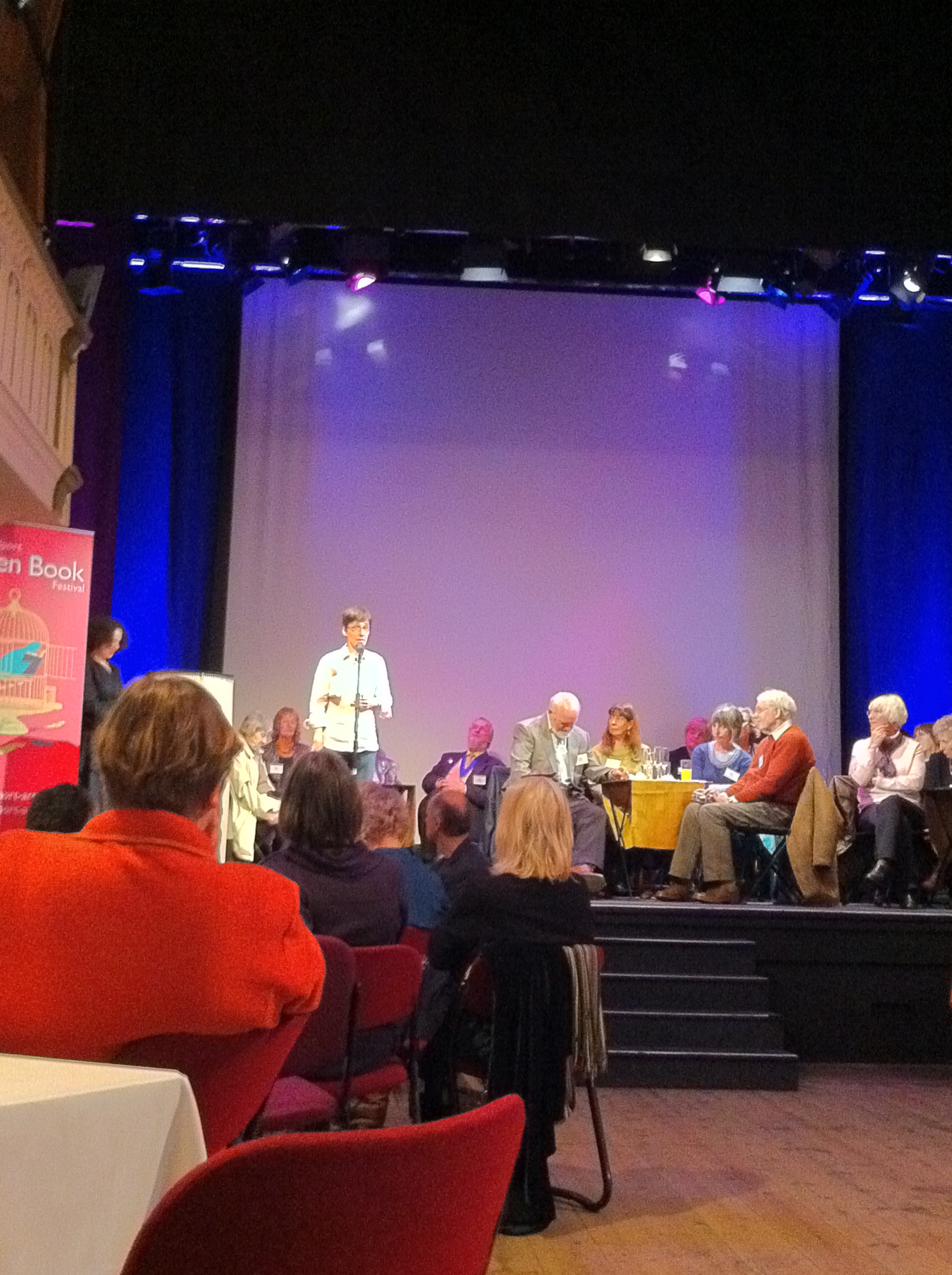
I have not done a blog post for a month now.  And what a month it has been!  I last blogged from New York City, crouched on a dining room chair in the one room that husband and I lived in while he rehearsed and I rewrote what I hoped would be the final draft of my first novel.  One month later, I am back in the UK, and back from the pleasures of the Bridport Open Book Festival and the Bridport Prize.  I was told that I was a winner a couple of months ago, but they swear you to secrecy.  I am nothing if not obedient, where writing prizes are concerned.  The lovely folks at the Bridport prize kept sending back edited copies of my short story, Methlahem, which would be published in their anthology.  I am not known for my photographs and, sadly, this is the best of the ones I took.  Here is writer and judge AL Kennedy being lovely and generous about each and every winning piece of fiction and flash fiction.  She announced that my story had broken her heart which, promptly, broke mine.  I gambolled up to shake her hand and managed not to fall back down the stairs.  There was an elegant lunch and glasses with bubbles in.  I even had a date, my lovely friend Jo, winner of Bridport’s Dorset Prize – twice!

But I don’t want you to think it was all seriousness and glamour.  There was also quite a lot of fun:  an evening of readings by past Bridport winners Vanessa Gebbie, Judith Allnatt and Adam Marek, a fantastic flash fiction workshop/workout by Vanessa and Tania Hershman, and one of the best live literature performances I’ve ever seen, AL Kennedy and the magic of words.  Meanwhile, there were line edits to do.  Having finished the New York rewrites, I staggered through jet lag, combing my own words in between the words of others.  I have not felt so full in a long time.  It wasn’t just the indulgent breakfasts at The Bull Hotel, scoffed while crossing out and changing tenses.  It was being full of words, full of writing, full of the company of fine, fine writers.  In what other world would we wish to live?  The people who run The Bridport Prize, the new festival, and the marvellous arts centre are wholly wonderful, gracious and careful, thorough and hospitable.  I’m already thinking I need to write more short fiction, just in the hope that I can go to more of their wonderful events.  I also need to point out the generosity of Canterbury Council, who gave me a grant toward the costs of my travel and accommodation.  I feel utterly supported and very, very fortunate.  Thank you.

The anthology has been published.  My copy is still by my bedside, lest it vanish like a dream.  You can pre-order it in places like Amazon, when it will be available 8 December.  In the meantime, Vanessa did a round-up of her Bridport adventure over on her blog – why not pop over?  And, while you’re at it, why not start on a story of your own for next year’s Bridport?  The deadline is in six months time and the 2012 judge is Patrick Gale.

As for the rest of my last month, my new agent is happy with the rewrites and I am trying not to hold my breath until I learn if the line edits are OK.  And then there will be a whole new and different kind of waiting ahead.  I can’t wait!  Well, I can, actually.  I can wait for as long as it takes.

If I were reading…

I am not reading much these days.  Which is a pity.  I would imagine that most writers are writers because they so love to read.  But sometimes, the writing gets in the way.  I’m reading plenty of research.  I’m reading blogs and, it must be said, Twitter.  I am reading far too much of my own writing, while I edit.  None of that reading is really for pleasure.

So, it was a pleasure to find today, on Twitter, that November is German Literature Month, a terrific initiative by @BeautyandtheCat via today’s blog, 14 German Women Writers You Shouldn’t Miss.  I’ll say.  This post is a whistle-stop tour through the history of German women writers and a terrific introduction to many new names – at least for me.  If I were reading, I would be adding Anna SeghersIrmgard Keun, and Judith Hermann  straightaway.  I am a devoted fan of Hans Fallada, Heinrich Boll and Jenny Erpenbeck, but I know that I don’t read enough German writers – especially women.  Three cheers to German Literature Month’s initiative to get us all reading.  Maybe, even me.

Click here to visit more German Literature Month participants and to get involved in some of their group reads.