Last weekend’s first Kent Festival of Writing, organised with WhitLit, offered a full day of workshops about different aspects of writing, from Julie Cohen’s on plotting with Pixar and building a character from a coin toss, to mine on the perils of editing. (I’ll blog more about that soon.) The day culminated in a panel with agents – and what it was that they were looking for. Below is an edited version of their talk:
Moderator Dr. Jeremy Scott, lecturer at Kent University, introduced us to the participating agents: Alex Holley at Michelle Kass Associates & Jessie Botterill at Janklow & Nesbit, and asked how agents work. 
ALEX HOLLEY said, early on, she became, “seduced by the variety of being an agent. You’re in at the very beginning, working really closely with writers (to ensure) it’s as good as it can be before you go to an editor.” Being an agent is, for her, “a mixture of talent scouting, building relationships with writers, going into battle for writers, nagging publishers, and feeding back.”
JESSIE BOTTERILL said that Janklow & Nesbit are the UK arm of a larger US company. As such, they take on very few writers, but, “We can work very, very closely with the (ones they do). We have an emphasis on editorial; we might work for a year together before we think about sending to an editor. I love editing. It’s really difficult to get a publishing deal, and I want to make sure my authors have their best chance. We work on their manuscript until it’s right. I love storytelling, I love great voices. I love to be on the side line, cheering them on.”
DR. SCOTT asked how much of an agent’s job was editing?
JESSIE said, “It is almost all my job. Most people only get one chance to show work to publishers. There’s so much material out there, you really have to nail the book on the first attempt.”
ALEX said, “Our attitude is that we’re investing for the long term. We’re falling in love with a voice. It’s more common to have a great idea poorly executed than to have a wonderful voice.” She said, “Everyone in our agency reads everything. We work as a team with all completely different backgrounds and tastes. There’s a team to catch things.”
DR. SCOTT asked how writers should best approach them.
ALEX said, “For our agency, we have a quick chat on the phone. We don’t take unsolicited material.” After the initial phone conversation, she invites a writer to send in a letter which will serve “as a memory prompt for a conversation we’ve already had.” Agents have the opportunity to see potential, she says. “Editors say if the writing isn’t tip-top, they don’t have to take it. Agents have the time to help make things great.”
JESSIE said, “Janklow invites everyone to submit. For agents, this is our bread and butter. The first hour of every day, I open every submission email. The cover letter is the shop window for your writing. I’m looking for myself, but I’m very aware of the tastes of the others. It’s a compliment when a writer picks us out of other agents to work with us. I feel I’ve been targeted, and if I think it’s the right book for me, I’ll think you’re very smart. When you’re thinking about submitting, really nail your cover letter. We take our job very seriously. A jokey or sarcastic cover letter might put us off. Be professional. Make sure your work is clean. Don’t cc in emails when you submit. It’s a small world. We all know each other.”
 ALEX added, “Yes, is it professionally written? Have you researched what we do? Have you researched other authors represented by the agents or the companies? If someone were to pick up your book, what other books would be in their shopping basket? We want to know what you’re like.” She encouraged writers to add in their letter if they’ve done courses or workshops, to tell agents that they’re treating their writing seriously. She’s looking for “a really compelling concept, a sense that you have lots of good ideas. Do you have a writer’s brain? Can you think on your feet? The best part of the job is getting to know everyone’s writing style and editorial style. What enables a writer to make the best draft possible?” But, “Make sure you’ve edited your book before you submit it. A lot of being an author is editing yourself. You want to be open to help from others, but no one can do it for you.”
JESSIE: “An agent’s job isn’t only to sell your book. We’re your champion for the rest of your writing life. Middleman between you and publisher, all you don’t want to say. Negotiating terms of your contract, making sure you’re protected and getting enough money for your rights. We’re constantly thinking about you and your writing, the life of the book that you’re writing.”
ALEX: “We really want to find you. We’ll read everything. It’s a real labour of love. Sometimes it takes a while, because existing clients have delivered books or there’s some crisis, some contract. We read new manuscripts on our own time. On the train, on holiday, weekends and evenings. We love reading submissions, but sometimes it takes a bit of time.” Understanding that it is hard for writers to wait for feedback on their submissions, she said, “It’s fine to nudge an agent if you haven’t heard in 4 weeks, just to check in, but not every week.”
DR. SCOTT asked how writers could best help agents.
JESSIE encouraged writers to have strong ideas about the market. “You’re not writing into a vacuum. It’s a business.” Telling an agent where a writer sees her book on the shelves of Waterstones, for example, helps an agent understand how the writer sees her work. “Who is your ideal reader?”
ALEX sang the praises of her client, local writer Julie Wassmer and, specifically, her approach to marketing. “She has lots of ideas about how to do events, how to write extra material from characters’ POVs for publishers. You don’t have to have a Twitter feed or a blog, but if you’re engaged in that, it’s exciting to think about how your book might spin out. Could you write short stories based in the same world, to use as a marketing tool? Can you open up the world?”
DR. SCOTT asked what it was the two agents were looking for, specifically.
 JESSIE said, “I work on the commercial side. I have to have a lot of plot in my books, so a lot of my work is full of twists. I like really dark, gory, nasty books. When I’m thinking about books, I’m thinking about trends in crime, young adult, etc. I’m led by what the markets are looking for. I like strategy and finding books that will feed into the mass market.”
ALEX said that, aside from great voices and multi-layered writing, she is interested in cross-platform work, “speculative fiction, twitter stories – spores (where) you put out the seed of something and it’s open to interpretation.” She cited work by authors who create stories in 100 tweets or works that can be opened up and expanded across different platforms, such as games or live action role play. It’s all, she said, “an interesting way of creating a splash. If your book is the sun, other work can be the rest of the constellation around it.”
Jessie: “The best writing is honest and genuine. If it’s what you want to do, be confident. Confidence is an alluring thing.”
ALEX: “It’s really seductive to feel like a writer is having fun, not only trying to fit a genre. Trust yourself.”
DR. SCOTT opened the floor to questions from the audience. One of the first was a question about potential in a writer. Was there a natural bias, then, towards younger writers?
ALEX said no. “It depends on the personality. Younger writers might not have the story depth or the ability to write complex characters. Novels teach us to empathise with all different kinds of characters. Life experience is crucial in this. No one puts their age on a covering letter. It doesn’t matter what age you are. It would be great to see more diversity.”
Another question: what happens when agents change agencies?
JESSIE said, “Editors move around a lot. Agents tend to stay where they are. It’s a conversation to have with a writer – do they want to stay with the agent or the agency for future projects? There will be a clause in the contract for deals – revenue will continue to go to the agency, not the agent. It’s a really personal relationship. It’s an emotional journey.”
A last question was about how agents sell work and what the success rates are.
ALEX said, “If we’re not selling your book, we’re not doing the job for you. All the work we do before it’s sold is speculative, not knowing if there is going to be a pay off.” But agents work until the pay off comes.
JESSIE said, “What percentage of our agented authors get published? 100% You don’t take anyone on unless you believe they can get published. We have 100% success rate.” But she said it may not be in the first round of submissions; she told the story of one author who took seven years to sell her first book. But it did sell, and she’s gone on to write and sell much more, which offered much encouragement.
Many thanks to the Kent Festival of Writing, Dr. Scott, Alex Holley & Jessie Botterill for giving a roomful of writers a little insight on their process and a great deal of hope.
Where did I go?
This morning I ran beside a rough green sea. The sun was out, which made it easy, and the wind was sharp, which did not. It blew at me so hard it seemed I would never get to the place where I tend to turn, the arbitrary yellow line drawn on the pavement that means I’ve reached the halfway point.
When I started to run, it was in the woods. Two years ago, I had a long residency at Yaddo in upper state New York, and I ran around its lake, dodging ice and snow and watched as spring came slowly, slowly. (Here’s a post I wrote about starting late as a runner, and all the things Yaddo taught me that I’ve tried to keep, with differing degrees of success.) One year ago, I was running pretty well, thinking every year I’d get that little bit better, that little bit stronger and faster – and then a bit of news changed every direction I had set for myself and changed all the courses.
One year and one week ago, I landed in LA to sit with my mother in the hospital, to walk beside her metal bed as it wheeled down the corridor for the first of her 10 radiation treatments, and to be with her for her first round of chemotherapy; there were meant to be 3. A radiologist said she “had months” and the oncologist wanted to “find the source” so that they could best treat it, though no one seemed to be under any illusion that they could “cure” her. At 83 with cancer in her bones, they were only looking to give her a little more time to get ready. As it was, she lasted 30 days. Some of those days I missed, thinking we had those “months” ahead. I flew back to file my taxes, for goodness sake, and for other commitments that, with hindsight, I could have cancelled easily. You cannot know what is coming, even when someone tells you there will be time. And, all of a sudden, it has been a year.


Where did I go? I have not been here. I have been somewhere far away, deep inside my head, but today the sun was out and I felt as if I were back in my skin. It’s new skin now. Rawer and thinner. The wind can blow right throw me. My body is full of new and surprising sources of pain, as is my heart. (My back went out at the end of December, a little past the halfway point of last year, when I should have been turning around and running back. It taught me a lesson. There is nothing like lying on the floor with your knickers around your news to remind you that, sometimes, you have to ask for help to get back up.)
I have asked for a lot of help this year. Not enough, maybe, but far more than I am accustomed to. I’m made of Puritan stock; we endure. I benefitted from asking for help from old friends, distant cousins, chiropractors and psychotherapists. The School of Life taught me artful lessons in calm and resilience. (What I thought was resilience was endurance. We should not seek to endure, I have learned, but to thrive. I have learned how resilent I am.) I am grateful for wise teachers, generous writer-friends, and kind people able to overlook my crazy – or to sit with my crazy and let it be.
At the halfway point today, I turned around and found the wind was at my back. And suddenly, it was warm and calm, and the run for home was light. And I felt nothing but gratitude for being on my feet. And I don’t know where I’ve been for the last year, but I feel as if, right now, I’m here.
Coming Out
My writing life is quiet. Most days I’m found trudging up and down the garden path from the house to the Blue House, my little writing hut. For me, writing happens when nobody is watching. It is the silence behind social media. It is the dark side of the moon. But sometimes, even a quiet writer like me is coaxed back out and into the light.
Recently, I had the great fortune of travelling to do some writing with my favourite group of writers, The Prime Writers, at the wonderfully monastic Gladstone’s Library. Accustomed to workshops as I am, I know the power of writing in good company, but we were not there to share work. We were simply there, in silent companionship, each of us battling away at our own works-in-progress. Here’s what a few of us have had to say about the life-giving power of retreats.


 I was also very pleased to be invited to read my Costa Short Story Award shortlisted story, The Night Office, at our local university for World Book Day. It is very public to share work, to read out, and it is such a joy to do so after so much silence, particularly as my story tells that of a cloistered nun who is screaming inside.
 Lastly, I was included in a new Popaganda podcast from Portland, Oregon, a throwback to talking about cults in the way I did, a lot, when Amity & Sorrow was first published.
(You can also listen to interviews on cults in popular culture and a tea cult – no, really!) I’m two books away from those bound sisters now, in my busy head, but it was a luxury to remember how they started, how I started, and to feel how far I’ve come, even though, most of the time, nobody can see it.
Library Love
My favourite library is always changing. When I was small, it vacillated between the hushed dark of the Sierra Madre Public Library, with its polished wood shelves and its stern librarians, and the tiny, mobile library at the edge of the parking lot in a small town in the High Desert, where I most found myself. There was no hush here. You could hardly fit more than one or two readers inside. The air was filled with sand dust and the librarians let me take out a shopping bag full of books at a time, when they realised I could come in only once a week or so. It is not a huge achievement to say that I read the entire children’s section, and then moved on to consume their gothics – it is thanks to the librarians of Lucerne Valley that I found Mary Stewart, Phyllis Whitney — and Charlotte Bronte – and then on to their thrillers, their mysteries. They did not censor reading. They encouraged experimentation, even though their stock was extremely limited, and they often thanked me for “rotating” what stock their way, by checking things that that, perhaps, few had. It’s long gone now, but libraries will always be my safe place. Here, in London, it is still the same.
 Here in London, my favourite library is a far cry from a dusty desert. Whenever I can, I trundle in to the wonderful Wellcome Collection, to stare at their collections, which include “medical oddities and artefacts”, gape at the magnificent new Reading Room, and then plug myself in at a long table in the Wellcome Library. Here’s a little more about it, on The Prime Writers site:

Three cheers for libraries – hip hip!
Costa Short Story Award 2015
Pleased as punch to be on the shortlist for this year’s Costa Short Story Award, which is judged anonymously and voted on by the public. We’ve all been under strict instructions to keep it a secret, but here’s the news in The Bookseller and The Guardian:

C ongratulations to all of the shortlist: Rupert Thomson, Annalisa Crawford, Erin Soros, Niall Bourke and Danny Murphy. Voting is closed now, but if you’d like to take a look or a listen to all of our short stories, here’s a link (scroll all the way down to the bottom to find mine, The Night Office, read by the lovely Kate Dyson.)
Now, as the invitation to the swank awards ceremony states Dress: Formal the really big issue is – what is a writer to wear?!?
Thanks to any of you who voted!
Writing Resolutions
 Have you made your writing resolution yet? Yes, I know we’re well into the new year. Ical says we’re nearly halfway through this month of resolutions called January, and the fab Prime Writers have been posting one writer’s resolution every day. While many have been pledging to stand up more, to leave our desks and live a little, today’s resolution is mine. Want to know what I plan to do more of? Pop on over to The Prime Writers and see! You’ll also find a great new two-part blog on finding more time for writing – another great resolution.
On resilience and gratitude
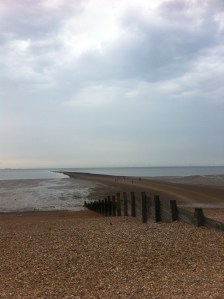 Today is a good day. It started with a cup of tea and a good, long run by the sea. I haven’t been much of a runner lately, because I have been so tasked with editing. And because I haven’t run in so long, my iPod ran out of juice two songs down the road. Disaster! Typically, I run and write to music, the same music, again and again, as if I can conjure some spell to keep me going, keeping my fingers and my feet in constant motion. Today, there was nothing but my own huffing and puffing and the scud of my feet, until I realised I could also hear the sea, grey waves on the shingle, sounds ordinarily shielded by Elvis and the Doobie Brothers in my ear. The wind was still, the sun was bright, the dogs were curious. And maybe the silence made room for thankfulness, for instead of chanting along to Genesis, I was thinking about the long hard run we do as writers. How easy it is to lose momentum, lose our footing. We stumble, we run out of steam. Today reminded me how thankful I am for the running, for one foot in front of the other, and for the writing, one word after the other, even when the running and writing are hard. We trip up. We fall.
This fall I have been working on resilience, getting back up on my feet. I have been talking classes and talking to people about how to bounce back/bounce forward and, initially, to look for ways to thicken my skin. Of late, it has felt far too thin. Any wind could blow right through me. blow me down. I realise I’m more fish skin than leather, when this industry requires we wear vinyl, Teflon, bubble wrap, aluminium, chain mail, Kevlar. The other day, I was told that I’m porous and, now, I think that’s no bad thing. Most humans are, when they’re vulnerable. Writers (and humans) have to be porous enough to let all the feelings pass through, to turn soft bellies out to the world even at the risk of being kicked. Today, I’m thankful for thin skin and flexibility. Knees that bend, fingers that type, wrists and hips and feet and limbs that take me where I want to go, even when the road and the writing are hard. The seasons change, and so do we. Today, instead of turkey eating, I’m sitting down to write with a cup of tea, as I would on any ordinary, but wonderful, day.
The Writes of Women
If you don’t know Writes of Women, the fabulous blog by Naomi Frisby, or @Frizbot on Twitter, you are in for such a treat. These thoroughly comprehensive collections of the best writing by women in the media are my go-to source for news. A celebration of book reviews of women writers, LGBTQIA, women of colour, women in translation, working class voices – this blog really does have it all. Naomi is a tireless champion of women’s voices, and this week I’m very pleased to be there, too, as I was on Rebecca Mascull’s site. Here’s the link – give her a read, won’t you?
True Grit
 I’m a Prime Writer. This past month, I’ve been the guest curator for The Prime Writers, a lovely collection of writers who are all “in their prime”, meaning we all published our first novels over the age of 40. So what? Age is just a number, and we are a nice contrast to all those “best of” lists for those under 40 or 30 or 12. (The Telegraph’s even in on the act, citing Mary Wesley – and the Prime Writers.)
In today’s blog post, I wrapped up a series on “what made a difference” – what were the most important steps that got our writers from aspiring to published. Was it pursuing an MA that led them to an agent? Was it a professional course that got them to an editor? There are links to the whole month’s worth of blog posts about all the different ways we got to where we wanted to be, but, in this last post, we also talk about maybe the most important writing tool of all – grit: the ability to keep going, even when it looks like you’ll never finish your book or find the team who can help you realise your papery dreams. True grit.
Writing in Residence
 Want to know what it’s like to go to prison? I served a four year sentence – as writer-in-residence at a young offender prison here in the UK. I’ve never really written about it, and it was lovely to get the chance to do so for Women Writers, a terrifically supportive site. Follow me in through the big wooden gate…
 Peggy Riley