Which came first?

There is a whole lot of information on how to write a synopsis.  Go on, google it.  I dare you.

See what I mean?  YouTube videos, DVDs for sale, virtual racks of books, tweets galore from the #amwriting strand.  What is the point of synopses, really?  I’ve been to a bunch of panels with agents.  I’ll bet you have, too.  Agents have different takes on them.

At the first panel I attended, an agent said a synopsis was to check that the writer had finished the book.  Clever!  At a later panel, an agent said that it was to see if there was an ending, and what the ending was.  Note to those whose synopses end in ellipses!  But many a writer is told off for having, indeed, submitted their finished book – hurrah – with a synopsis that does not match it, a synopsis that tales a different tale.  Which comes first – the book you write or the book you want to write… or the book you meant to write?

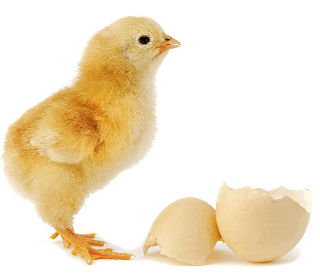
Well, the book is the egg, of course, but sometimes there’s a chicken of a synopsis impelling you to write it.  I had a reading of my first draft from The Literary Consultancy.  To learn more about what they do for you, why not visit my professional development blog for East Kent Live Lit, where they spoke at a recent networking event.)  OK, advert over.  The reading I received, from the generous Sara Maitland, told me that my draft did not match my synopsis and that without said synopsis she wouldn’t have actually known what happened at the end.  Seems I sank under the weight of my own imagery there in the final chapters… Come on, it happens to the best of us!

Now that I’m a few drafts older, it’s time to square up to the old synopsis and slap it around a bit.  But maybe, actually, I should buy my synopsis a drink.  That was Meg Davis’ advice, anyway, from MBA.  (Another from that link above)  She said a synopsis should feel like the writer is at the pub just telling the story.  That’s all it is.  Just tell the story.  What happens, then what happens next.  Easy, right?  You’ve written the book.  You know what your story is… don’t you?

Sometimes the story changes in the writing of it.  Make sure your synopsis keeps up with it.  Then, just tell the story.

Well, that’s the plan, anyway!

On rejection…

No one ever said this would be easy.  I’m editing the first novel, in the process of finding a home for it, and wishing I were writing the second novel.  Which is greedy.  The cat cries for tuna when he has a bowl full of dried food and I tell him – what’s the problem?  You’ve got food.  But, it isn’t the food he wants.

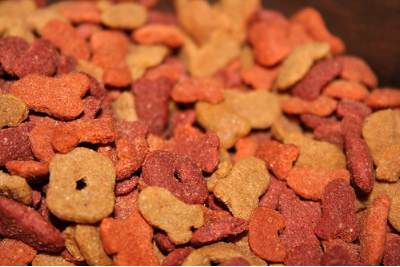
Editing is like dried cat food.  It just sits there until you finish it.  Going stale.  New projects are tuna, full of juice, when anything is possible.  With dried food… not so much.  And the longer you leave the new project, the fear you’ll lose the juice that you know is there, if only you had more heads.

I got my first “no” on my first novel today.  Ouch.  Still, I’m grateful for the agent’s time in reading it, and grateful to be told “no” rather than being ignored. Bubble Cow told us today that “every rejection is a step closer to publication.” Today, I’m not feeling it.  Still, my butt’s in the chair and I’m – well, I’m blogging, you can see that – but I’m squaring up to that dry bowl of pages to be edited, to prune and polish until they shine.  Until they cannot be refused.

No one ever said it would be easy.  Some books and sites say there is a magic formula.  We’re smarter than that.  We know there is not.  There is only this screen, this chair, this cup of tea, these words…

Fear of wallpaper…

Editing my first novel after receiving some much-needed feedback, I was happily scribbling with red ink until I came to page 73 and my character entered a kitchen for a first time.  What is it with kitchens?  I ground to a halt. Suddenly, my vague descriptions of enamelware stove and tin sink seemed scanty. It seemed more judgmental than descriptive; it got in my way and I just couldn’t picture it.  I can see my own mother’s avocado green kitchen from the early 70s with no problem, even though it’s cream now; it’s a real place in history I can describe that would tell you something about my mother or about me. But what was I trying to say about this kitchen in this book, 21st century Oklahoma in an old house still on propane?  Because when an appliance is bought, is says something about how and what the characters are doing, and that means charting their financial history as much as anything.

The family in the Panhandle has been in this house since before the Dust Bowl. So, the appliances could be as old as the mid-Twenties, say, bought on credit when banks finally started financing farming in “no man’s land”. But an old stove would have been expensive to maintain, if I still wanted it in the kitchen and working, and what the family doesn’t have is money. So, when did they have enough money to re-do their kitchen? And why? Back to flow charts of wheat prices.  Good rain in the Panhandle meant wheat prices went up in the 40s, but drought in the 50s saw them plummet. So, there’s a stove-buying window there, but it feels too early – the stove from the 20s would have been fine. But it can’t be too recently, certainly not after the matriarch died, because the male characters wouldn’t have changed any appliance, even after it stopped working. So, another decision to make, and a stove is now making me decide how young my male character is when he lost his mother.

Does any of this really matter when you’re writing?  Is it just some excuse to stop editing and start googling?  Well, yes and no.  When I first started writing fiction I had this fear of wallpaper. Did I really have to send a character into the room and describe the wallpaper?  As a playwright, you described wallpaper – or any less than crucial scenic element – at your peril. (And for goodness sake, don’t put anybody in a bed or a car! In my book, characters are lucky to get out of their beds or their cars, or their kitchens…) But make characters keep wandering into empty black boxes of locations and the reading experience is less than rich. So, what’s the important detail when you’re writing fiction? How do you know when to take a closer look – and when you’re just stalling for time?

Ironically, my first book is stuffed full of wallpaper, as well as linens and tapestries and cloths of different textures. Because textiles are important to my main character, a practical woman who comes from a handmade community, but is very sensual. She “feels” things. There is a difference between cheesecloth and kettle cloth and she would notice it. Likewise, domestic details are ones she would notice: surfaces, trimmings, how things are put together and treated. And she notices appliances because she needs to use them – she needs to get the best out of everything that she can while she can. So, she would notice the state and the age of the stove, not commenting on whether it’s clean or chipped particularly, but whether it’s being used – whether it can be used – whether she can use it. Because her need makes her sharp and desperate.

On page 73 I have her in 3 kitchens in her head: the Oklahoma kitchen she is seeing for the first time, her mother’s old kitchen which she hasn’t seen for 20-some-odd years, and the kitchen she has just fled from. So, again, the details matter. How are these kitchens alike? In what ways do they differ? Which feels most like “home” and why? And does it matter?

Yes, because it is how you can reveal memory. It is how you can give insight into a character who might seem difficult to like. It’s how you can punctuate all the places that have made her her. And it all goes back to a stove. Similarly, making decisions such as these can lead to new scenes, to help you dig deeper. Because if the family has been there since the 20s and replaced their stove in, say, the late 60s, then the old stove is sitting somewhere on the land, and I haven’t written it in. It should be there, discarded, and perhaps another character interacts with it in a way that is meaningful – or maybe it’s just a potent details that says something about a family that never gets rid of anything, in case it’s needed again. And it’s those details that make the whole thing feel somehow more authentic – for the reader, hopefully – but mostly for me – to test the limits of this world I am making, one image, one decision at a time.  If the stove is right, it serves the story. And hopefully the stove, the wallpaper won’t mind too much when a character gets right close up and has a good old look at them.

No Berlin Today

I almost went to Berlin.  Nearly.  I was so close I could taste it, and for a vegetarian that’s a big admission.  But I was scuppered by life and schedules and all those things that serve to scupper.

Had I gone to Berlin, I would have gone to Berghain, a Berlin nightclub in what was once a power plant, behind a rail station on the border between Kreuzbert and Friedrichshain – its name a blend of the last syllable of each.  Berghain professes to be the current world capital of Techno music.  Its Panorama bar features not a panorama of anything, but instead panorama-sized saucy photos by Wolfgang Tillmans.

But I was not Berlin-bound for its Techno, fine though it may be.  Berghain is being developed as a concert hall and it is dabbling in opera.  My sister-in-law was in one such opera there, and it would have been a treat to mooch along and see it.  But no dice.  It was recorded and will soon be a DVD, so that I can see her in a blue rubber prom dress and Rapunzel hair.

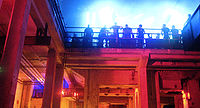
Here’s a photo of Berghain’s insides, with lovely lighting.  I would have enjoyed the opera, to be sure, and would have enjoyed having a peek around such a notorious night spot, without having to queue and worry about what to wear.  But what I wanted most was to see if it was “real.”

Writing about Berlin is a bit like chasing a ghost.  A ghost that has been in an awful lot of popular culture.  Each piece about Berlin feels like a checklist.  Nazis, check.  Boot girls, check.  Unter den Linden, check. Decadence, debauchery, check and check.  Do modern spaces capture this spirit of “old Berlin” better than the kinds of sites and books that offer up maps of ghost buildings?  And if I go there – no, when I go there – will I be able to find any ghosts of my own?

Makes a change…

Well, this makes a change from all that war!

My first novel is looking for a home and I was really pleased to receive some very positive feedback this week.  But positive feedback always means more work, dunnit?  So, I’m straddling two worlds in my head – slipping out of the research I’ve been doing on the second novel (and now a proud 22K in) – and staring at the great lump of pages of the first novel that need to be edited.  And edited.  And edited.

The books couldn’t be more different.  But then I looked at two photos that have compelled me through two books.  Can you spot the difference?  And, more interestingly, can you spot the similarities?

Peculiar Pageantry

One of my characters is most certainly a Nazi.  There is no need for her to be coy about it.  From where she’s standing, she’s in the majority.  Everyone she knows is a Nazi.  For a time.  So, knowing I want to write about a young Nazi girl, I set her in Munich and make her the right age to grow up as a Hitler Youth girl, a BDM – Bundes Deutscher Madel.  Perhaps I have her born at the very instant that the Fuhrer-to-come is yelling in a beer hall Putsch.

She’s probably not old enough to have taken part in The Night of the Amazons festivities that I came across today.  I should say that one particular problem with doing Nazi research is also stumbling into modern fascist sites.  If we ever lose our Freedom of Googling right, I fear for my Cookies.  Anyway.  The Night of the Amazons was a pageant which various sites say is based on the Bread Riots of the French Revolution, but in seeking out footage of this pageant, that didn’t seem to be the story to me.

You can watch footage of the event on the DVD “The Nazis: A Warning from History” as well as various spots on Youtube.  And the audience are certainly dressed for Versailles.  But the performers are nubile young women in various states of undress, jostling on cart and horseback, some with their dignity tucked behind a frond.  A lucky few are clothed; above they look like cocktail waitresses at a Jolly Rogers, while others are veiled to spin as dervishes or wearing a fetching helmut and nappy ensemble.  More remarkable than their nudity, for that shouldn’t be a shock where a Nazi celebration of beauty is concerned, is that the women are costumed for a world of cultures.  There are Indians, Amazons, and slaves of every race.  The woman painted gold is dancing in a vaguely Chinese-fashion; women bang ribboned tambourines in a manic tarantella that brings to mind the gypsies their party was already persecuting.  Freakish, bizarre and, it must be said, strangely intriguing.  These are a people who like their pageantry, however peculiar.

One cultural group is noticeable in its absence.  Perhaps their representation was a step too far, even for Nazis ready to party.

Prostitution in Berlin

One of my characters may have been a Weimar prostitute.  She is cagey on this issue and certainly wouldn’t confirm or deny in a public place like this.  My friend Jo had told me about the colour coding of boot laces in Weimar, and how the colour signalled what you would or wouldn’t do.  It seems a strange twin to the coloured-taxonomy that was to come, when a pink triangle or yellow star spoke volumes.

So, Weimar prostitute – so far, so expected.  But in contemplating prostitution in Weimar, you have to know what you’re looking for.  What kind of prostitute then?  Is there life after Sally Bowles?  There would appear to be 16 types of prostitutes, according to Mel Gordon, whose Voluptuous Panic surveys Weimar erotica.  “Grasshoppers” performed oral sex in the Tiergarten, while “gravelstones” were the physically-deformed sex workers of north Berlin.  “Telephone girls” were children who could be selected by their attributes to modern film stars and ordered by phone.  “Nice girls” were “demi-castors” (Franco-slang for “half-beaver”) who merely hooked part-time to feed their families.

Why so many prostitutes?  This from the book:  Germany’s recent defeat in World War I did its part, encouraging general disillusionment and leaving behind thousands of war widows in Berlin’s populace of 4 million with no means of realistically supporting themselves other than by prostitution. Gone were the Kaiser and the old morality, and in their place was a new liberal republic. And then there was the general economic collapse and inflation. In October 1923, German currency traded at the astronomical rate of 4.2 billion marks to the U.S. dollar. Gordon points out that “the most exquisite blow job” to be had in Berlin never cost an American tourist more than 30 cents.

Tolerated since the Middle Ages as a “necessary evil” and condoned by the police since the 19th century, prostitution even found the Nazis in the pimping business, with women servicing, however unwillingly, every camp.  Having seen this list, I will certainly look at SS boots with fresh eyes….  And it’s certainly legal in Germany now.  Prostitutes even pay income tax and charge VAT.  Wikipedia, every googlers first port of call, cites the German population of prostitutes at 200,000.  That’s a lot of laces.  If you’re so inclined, you can find prostitutes in the bars, Eros centres, apartments, massage parlours, as well as partner-swapping and sauna clubs of Berlin.  None of which strike me as particularly Weimar.  With Weimar we want glamour and decadence, trans-gender chorus dancers, bobbed hair and whips.  How to square any of that with the elegant woman disembarking on the Isle of Man in my third chapter?  Well, that’s the fun part.  Figuring it out.

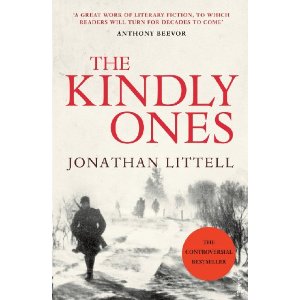
the kindly ones – part 1

And really, a book like this can only be tackled in parts, in great chunks that could each be a stand-alone book.

“Oh my human brothers, let me tell you how it happened.”  So the book begins with Toccata, meaning a baroque musical composition usually for keyboard, perhaps the German klavier.  The opening chapter is as full-chorded and rhythmically free as any toccata, taking us from a lace factory in post-war France back through the memories of its owner, a former SS intelligence officer.  This flourish of a overture leads us into chapter Allemandes I & II.

An allemandes is an instrumental Barque dance, a slow partnered dance of the 17th and 18th centuries, a piece of music following the prelude in a classical suite; it is also a German folk dance in triple meter, similar to the landler, for the Sound of Music fans among you.    Allemandes I & II is set in the Eastern Front.  In the dance, a line of couples extended their paired hands forward and paraded back and forth the length of the ballroom. Perhaps the ballroom of war was the Eastern Front, which the Nazis hoped to capture in the quick-step of their folk dance, seemingly surprised that the classic dance form took them backwards as often as forwards.  Or is this all a metaphor too far?  It is also the French name for German.

The protagonist, Dr. Max Aue, has a series of changing partners through Allemandes, a number of officers, academics and under-staff who become the objects of his desire, intellectual appreciation and/or lust.  Aue justifies his sexual proclivities by telling us that all officers and soldiers are at it – even in the trenches – and that from the Greeks onward all warriors were encouraged to strengthen the bonds of camaraderie through sexual coupling, as you would be unlikely to leave your lover on the battlefield.  There are dreams, memories and activities aplenty here for the staunchest SS-fetishist.  But I’m not writing about the SS or the Eastern Front.  Really, I’m not even writing about men.

But I am writing about Nazis and I am reading to understand their mindset.  We all have our racist moments, however we justify or explain them away.  Dr. Aue is no different.  Indeed, all of German academia was busy explaining their racism through the new science of Eugenics, while Aue’s colleague, Dr. Voss, attempts to prove who is Jewish and who is not along the Eastern Front through a study of their languages.  “Take German, for instance,” says Voss, “For centuries, even before Martin Luther, people claimed it was an original language under the pretext that it had no recourse to roots of foreign origin, unlike the Romance languages… Some theologians…even went so far as to claim that German was the language of Adam and Eve, and that Hebrew later derived from it.  But that’s a completely illusory claim, since even if the roots are ‘native’ – actually all derived directly from the languages of Indo-European nomads – our grammar is entirely structured by Latin. …”

SPOILER ALERT:  After Dr. Voss’s death, Aue is left to fight his corner in a discussion of a mountain people who are to be executed and and whether their language might prove that they are not acclimatized Jews.  While a female Nazi doctor asserts that no assimilation is ever entire, “Open the pinstripe pants of a Jewish industrialist and you’ll find a circumcised penis,” Aue is able to cast enough doubt on the peoples’ origins and migration patterns to delay the decision, so saving them.  And what are we to make of that?  Did Nazi intellectual SS officers really argue the fine points of their fascist philosophies to save people? To justify their actions?  To soothe their guilty consciences?  Certainly, Dr. Aue is awash with mysterious bouts of vomiting and he witnesses a number of SS and Wehrmacht officers coming unhinged at unmitigated violence.  Can Littell humanize the Nazi experience and belief system through Dr. Aue so that we can come to like him?  Understand him?  Or even forgive him?  Dr. Aue hasn’t actually murdered anyone himself… yet.  What will happen when he does?  Will there still be an attempt at justification?  The rules of war do not apply when the “enemy” isn’t armed.  WWII changed all the rules of war anyway.

I am hoping to understand the arguments used to justify racism and fascism.  I am from a city that is no longer a “white” majority and while it certainly doesn’t bother me, I wonder if it bothers others – others that I know.  People I would consider to be liberal.  Because it’s one thing to hold a liberal belief system; it’s another to live through such an economic downturn that you lose all perspective and you begin to fear “the other” – because bad things must be someone’s fault.  Our present crunch isn’t a patch on pre-Nazi Germany, but… you can see how public opinion responds to fear.  It always does.  Both sides interned their enemies during WWII out of fear; I grew up not far from a race track that housed interned Japanese-Americans – or anyone who “looked Asian.”  But less familiar, less understandable now, is that fear that the “otherness” of someone is a mystery, that you need to measure someone’s head or nose or pick apart their language to get to the root of who they are, as opposed to who they believe themselves to be.  Like a male terrorist hiding in a burka, WWII Nazis feared a Jew in Everyman, the Jew who “looked” German, who was “pretending” to be German, even if they had been there  for generations.  And this is where Littell’s book is relevant for me, when every woman in the internment camp is arrested for being German but there is no system for unpicking who is Austrian, who is Jewish, and who is acclimatized, who actually sees herself as British.  The fear was that every German was a potential Fifth Columnist, a potential spy, a Nazi, but none of this is straight-forward, and the fears shifted as often as the alliances as the war ground on.  And still we intern, even in our own “modern” war.
when the story is too big

I’m having trouble knuckling down today with this book.  The chest infection and day jobs have kept me away and distracted.  Now I’m having trouble rekindling that first flame.  Worse, at only 11K in, I’m looking at what I have and thinking – no, that’s not it at all.

What to do when the story is so big and you feel certain you are too small to tell it?

Think small.  Work on the details.  Create tiny little moments that will somehow stitch together into the big picture you can see in your mind but your fingers won’t interpret.  When the story is too big, make it small enough to deal with.  If the choice is between narrowing your field and focus, or sitting slumped in the chair overwhelmed, the choice is easy.  Little thoughts, little words, little steps.  That is how a novel gets written.