A new milestone

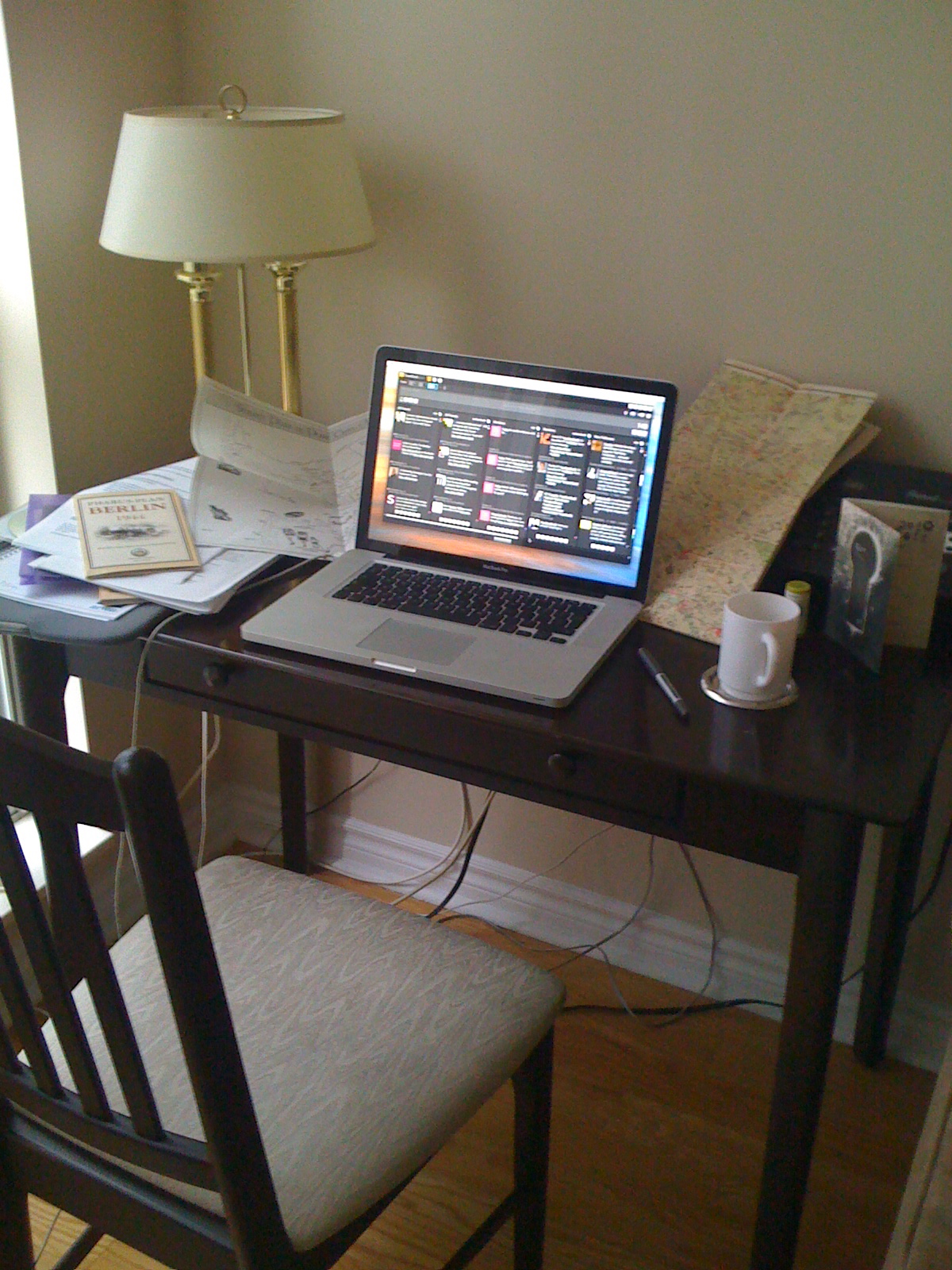
Another big hinge for a first draft is hitting the magic 85.  85k worth of words.  At this point, you officially have enough words to just stop.  You’re long enough for a novel. Hurrah!  But, of course, you don’t stop, because at 85k you’re probably nowhere near the end of the story.  You are dealing with volume of words in novel writing, but you are also telling a story and I never know how long a story will take to tell, though I’m sure other writers do.  So here, at 85k, I can pause again, look up from my desk and my appalling cup of tea and be assured that I have story enough for my novel.  At 85k I’m roughly 2/3 through my story and there’s no stopping me now!

While I am still mindful of word count, to make sure I’m being productive at my desk rather than just noodling around, my new goal is to get to 1944 and Berlin by the time I leave this desk in Toronto and head back for my own desk in Whitstable.  The countdown begins.

Can I do it?  Why not?  You have to set a goal if you have any hope of reaching it.  And if I don’t reach it, only I will know.  Except, now I’ve told you, too.  Oh dear.

Another new desk and a letter

Today, I am sitting at another new desk.  It’s still in Toronto.  It’s even in the same building.  But it’s a new flat three floors up and five doors over from the last one.  The desk is much the same, so I’ll not trouble you with a picture.  It’s blonde wood instead of dark and it still has a fax machine, a lamp, and a pile of paperwork.  Still, it felt like moving, with all its associated upheaval.

We have been living out of suitcases since November.  So, what’s one more bout of packing?  It truly makes you realise how little you need.  Aside from my rather fetching new parka, the only things we buy here are groceries, so we packed those.  We have pretty much been wearing the same clothes since November as well – sorry, Toronto – so we packed those, too.  I stuffed the few books I’ve bought into my handbag and picked up the computer.  It was easy to go, easy to arrive.

I suppose I’m thinking about how little we need when we’re travelling, because I’m writing about people who are travelling.  But whereas we can choose our circumstances – at the risk of libel I will say we moved due to neighbours who were under the mistaken impression that we were all sharing student housing – they cannot.  The women interned during WW2 had one day’s notice, if they were listening to the radio at 1pm on 27 May 1940.  Some women did, so they had time to pack and to worry.  Others did not, particularly women who had been given a Class B in their Tribunal, which restricted their movements, placed a curfew on them, and dictated what they could not have in their possession, namely maps, cameras, and radios.  For these women, the news was sudden.  Pack one bag and bring your coat.  It was hot in May 1940.  Being asked to bring a coat had implications.

The bag could be no more than one hundred pounds.  As there were no porters for this move, I imagine women packed far more than they could carry.  I would.  They would then have to shed items, the further they had to walk.  What would I have done with my one case, jammed full of books and nothing to wear for a stay that would last months?  Years?  I don’t suppose I would cope any better than the women did who became the internees of Rushen Camp in the Isle of Man.

I interviewed several former internees while conducting research for a play about the Camp.  This was several years ago, and I asked very different questions than I would now.  I have piles of transcripts and recordings, and it is from these that I am picking my way through the story and creating my own, but there is no way to ask them questions, really.  To do that, you have to go to the source.  And years have passed.  The camp has been closed now for 66 years.  But sometimes, fate intervenes.

I recently had a letter from a former internee, now living in Hamburg.  Somehow, she found me, having moved away from London, having travelled since the end of last year.  I quickly wrote her back – by hand, as I have no printer – and have to trust that she can read my scrawl when it says that I would love to see her.  And so I would.  Perhaps a trip to Hamburg is in my future.  For there are many different questions I would ask her now.

Stringtown. OK?

You never know where your research will lead you.

You will know, if you read this blog, that my first novel is set in the Oklahoma Panhandle.  I’ve never actually been there, but I won’t let a little thing like that get in my way.  My second novel is set during WW2 in the Isle of Man and Berlin.  I’ve been to both, lucky old me, but I haven’t lived through the war.  That doesn’t stop me either but it just mean I hunt and peck facts on the internet.  Sometimes, my two worlds collide, such as in this click, which led me to the Records of the Immigration and Naturalisation Service, INS.  Or La Migra, as we called them back home.  It was here I found a WW2 internment camp in Oklahoma, in Stringtown, Oklahoma.

Stringtown is a small place in the southeast of Oklahoma.  In the 2000 census their population was 396.  166 households.  I don’t suppose it will have gone up for 2010.  In fact, the population is steadily going down now that Stringtown can no longer raise funds by being a speed trap.  Its major employer, says Wikipedia, is the Mack Alford State Penitentiary, a spillover since 1933 to ease overcrowding at the Oklahoma State Penitentiary.  It also served as an internment camp for mostly German men, though it did hold some Italians and Japanese, during WW2 with the same system of racial profiling that created the network of Japanese-American internment camps across the US as well as the women’s internment camp on the Isle of Man that is at the centre of my book.

The nifty German American Internee Coalition provides information on internment camps.  The photo comes from this site, as well as the information about how the camps were run.  Apparently, the camp commander ran a tight ship.  Attempted escapes were a cause for shooting.  Internees were housed in the prison cells and sought to keep them “as clean as possible” as well as “engage in meaningful hobbies.”  As with the women’s internment camp, “there was a small, vocal Nazi element at Stringtown, estimated to be less than 3% of the general population. This element had an unsettling effect on the atmosphere of the camp, especially for the few German Jews who were interned there.”  Nazi women were about 10% of Rushen Camp at its opening, 29 May 1940, but as Jewish internees were released and more Nazi women moved to Rushen from Holloway Prison, the percentage was soon much higher.   It is reported that two German internees died at the camp and are buried at Ft. Reno.

Springtown was an internment camp for little more than a year.  Then, the men were transferred elsewhere and the site was reserved for German prisoners of war, captured all around the world.  Previously, Bonnie & Clyde started their crime spree from a dance hall in Springtown and afterward a tornado set down in the middle of town, destroying a community centre.  Springtown hasn’t had an easy ride of it.  But I’m glad to know about it, nevertheless.  And as the birthplace of Reba McIntyre, it’s not all bad news.  Unless you don’t like Reba.  And then there’s probably not a lot to recommend it to you.

New desk

So, we’ve arrived in Toronto, which you’ll know if you also follow me on Twitter.  We arrived after a “big chill” of minus 27 and we are promised the next “big chill” is on its way.  I am watching snow race diagonally across large picture windows and watching the man across the street spill salt from a little rolling cart onto the pavement.  So that’s how they keep their sidewalks clear!

I’ve already had a good old moan about not being able to pack books and so far it hasn’t mattered.  I really have all I need here.  A good solid desk with a lamp and a chair.  My maps of Berlin at 1930 and 1940, and my handmade map of the Isle of Man in 1940, open and at the ready.  A mug of tea, shamefully small.  A pen.  There is also a fax machine here, which is reassuring in an old-fashioned way.  If a fax ever comes I’ll surely fly out this picture window beside me.

I have written for the last 2 days here and cracked 56K this morning.  55K is a big hinge in a novel, it’s the first place where you can look up from your writing, take a breath and say to yourself, OK, what I’m dealing with here is a novel.  If, in fact, you are at 55K and you have plenty of story left to tell, you know you have enough material to be book-length.  It doesn’t mean it will work or that you won’t get lost somewhere and lose track of where you’re going, but it just means that you have enough to write with.  And really, halfway through a book, that is enough.  Husband is off today, so we go off to explore, me with a tiny little bubble of accomplishment percolating under goose pimples.  And tomorrow?  To write the book past 56K – after all, there’s still another 50K to go, or so, and then all those drafts ahead…

Packing

I am packing again.  This is a big pack, not a little pack.  Little packs aren’t so hard.  They say you’re going into London for a couple of days for work, or not work.  They say you’re off on a small adventure.  They say there might even be a holiday in the offering.  Big packs are harder.  They require consideration and selection.  They require planning and imagination, ripe with the question: what will I want in February? In March?

Clothes aren’t so hard.  We only have so many extremities we need to cover in the pursuit of modesty.  Even when the extremities will be subjected both to arctic snow and to southwestern sun, it is only a matter of choosing.  Shoes are harder, but what girl wouldn’t say that?  And shoes aren’t so heavy, an important consideration when the airline limits you to 20kg.

No, what is hard is the books.  The packing of books, which are heavy.  The choosing of books, to just take one or two, say, which is nigh impossible.  As I leap back into the first draft of my second novel, I know where I left my character and I know where she is headed.  I know enough to get started and to get back into the writing.  What I don’t know yet is what I don’t know.  What will I need to know?  What will I want to look up and to read?  For the last pack I had a mighty basket of books for research.  To be fair, I didn’t use many of them.  Knowing they were there, I suppose, meant I didn’t panic over needing them.  But what if they are not there?  What on earth will I do?  Just the thought makes me toy with packing only books – modesty be damned!

But I will not be packing books, I guess.  I will make what notes I can digital.  I can photograph the prompts and props I have relied on.  And what else?  I can trust that, despite having books I have yet to read, I know enough already.  I know enough to write this story right now.  And anything I don’t know?  Well, that can wait.  Books will always wait for us to want them – need them – again.


Berlin’s Degenerate Art

Early 20th century Germany is well known for its art – both how it was celebrated and how it was persecuted.  I have blogged earlier about the social realist work of Kathe Kollwitz, whose spectacular house museum I visited in Berlin.  The modern art museum, Neue Nationalgalerie, also featured a number of artists, among them George Grosz, Max Ernst and Hannah Hoch, who were visible yesterday at Another World, the Surrealism exhibition at the Dean Gallery here in Edinburgh.  Strangely, I never thought of such artists as surrealists, but the exhibition was brilliant for putting the work of artists into context with global art trends, as well as showing the links between artists who inspired and were inspired across countries and art forms.

Dada seems to have originated in Zurich, where the term was coined and the first venue, Cabaret Voltaire, began publishing and producing the irrational and nonsensical art that responded to the  irrational and nonsensical First World War.  Dada was launched in Berlin in 1917 at Club Dada, founded by George Grosz, John Heartfield, and Hannah Hoch.  Other Dada groups emerged across Germany, with such artists as Max Ernst and Kurt Schwitters. But by the early 1920s the work was already shifting towards sur-realism from Paris, defined by Andre Breton as “pure psychic automatism by which it is intended to express, either verbally or in writing, the true functioning of thought.”  Where Dada was created from the anarchic and ridiculous, Surrealism sought to delve into the intellectual and psychic realms of dreams and chance.  Germany’s modern artists responded to Dada and Surrealism in a variety of ways and methods, and their artwork would be more openly political and satirical than any other city’s, particularly in the New Objectivity movement.

George Grosz’s sharp and satirical cartoons of post WWI life in Berlin have made his artwork, alongside the work of Otto Dix, synonymous with the Weimar period, but it was the first world war itself that first honed his draughtsmanship and his politics, following his discharge from active service and a brief stay in a mental hospital.  His line drawing, Fit for Active Service, shows a doctor approving a new recruit – a skeleton.  Grosz’s early intention was to become the German Hogarth; Hogarth’s paintings of the perils of gin would be echoed in such works of Grosz’s as Dedication to Oskar Panizza, or The Funeral.   Grosz also created a number of collage “corrected masterpieces,” pasting photographs onto old masterworks to lampoon politicians and figures of authority.  Grosz introduced Otto Dix to Dada, and both would, in turn, start the Neue Sachlichkeit (New Objectivity) movement, a form of post-Expressionism in the 1920s and the leading Weimar art form that would fall only in 1933, when the Nazi party rose to power.

Hannah Hoch is best known for her collages, created while she worked as a designer of crochet, knitting and embroidery pattern books.  Some of her collages feature the embroidery mesh used in her designs.  She also created photomontages as in the collection From an Ethnographic Museum, which places the head of an African sculpture onto the body of a child, along with a giant woman’s eye.

Max Ernst would continue to use Dada forms such as collage, in both his art work and in his published “collage novels”, but would also develop a new interest in chance and the natural world in his “frottage” work, a kind of brass rubbing on rough surfaces from wood to stone. A lovely example of his transitioning between Cubist, Dada and Surrealist work is “Woman With an Umbrella”, a painting using pre-existing advertisement images on card.  He also worked with frottage in his paintings, but found the canvas too thick to use for rubbing.  Subsequent paintings would incorporate “grattage”, using forks and sticks to scrape through heavy paint, relying on chance, rather than technique, to make the painting.  His work is always diverse, but I am drawn to it for the themes running through, from the romantic notion of German forests to the cut-and-paste fairytale picture books he made from conventional 19th century engravings, where giant birds embrace bustled maidens and streams run through domestic lounges.  Kurt Schwitters is known for his collage work, incorporating strips and snips of newspaper, ticket stubs, feathers, found objects and textiles. He also created “sound poems”, aural collages, and 3D wooden collages.

The spookiest example of German surrealist work has to be Hans Bellmer, whose life-sized, articulated dolls, all trunk, appendages and genitalia, most often sans heads.  He ritualistically posed and photographed his dolls in woodland settings.  The work was made in the mid 1930s, but I defy anyone to look at it and not think about the horrific experiments upon bodies that were to follow, come the war.

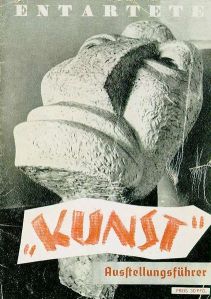
Berlin lost most of its modern artists with the rise of the Nazi party, with artists arrested, interned, or forced into exile.  But, ironically, the most interesting exhibition of all of this work would be put on show by the Nazis themselves in the infamous Degenerate Art Exhibit in Munich, 1937.  Designed to turn audiences off modern art altogether, the Nazis rounded up and displayed over 5000 pieces from Germany’s museums and galleries that they found most offensive, work that did not match the rural “blood and soil” paintings and landscapes favoured by Hitler and his crew.  After four months the show had attracted over 2 million viewers.  “Degenerate artists” included George Grosz, Max Ernst, Kurt Schwitters and Otto Dix.  The works displayed were destroyed, of course.  But a mock-up, in dollhouse form, can be seen at Deutsches Historisches Museum, and my very poor quality photo.

I am not writing about Weimar per se.  We meet my main character in 1940.  But just as history begets history, characters are formed from their histories and the choices they make based on past experiences and the ghosts they bring with them.  I am working on my character’s ghosts, of which she has many.  But the biggest ghost of all is Berlin itself.  Of course.

Domestics

Britain has been rediscovering its love affair with domestic dramas featuring domestics.  Recently we have enjoyed the spectacular Downton Abbey, which ended on the brink of war with Germany, and the recent updated version of Upstairs Downstairs, which finds a penniless debutante flirting with Mosley, Ribbentrop, and Nazism.  BBC4 even did a survey of this history of fascination in last night’s “Maid in Britain”, exploring the differences between lives of domestics on and off TV.  For me, currently writing about German domestics, fascism, and racism in wartime Britain, this is right up my street.  Maybe it’s a little too close to my street.

Novelist Amanda Craig tweeted today about “Maid in Britain” and commented that domestic servants were still working in Britain, but that now they were all immigrants.  Of course, there have always been immigrant domestics.  Upstairs Downstairs offered us a Jewish parlour maid who was previously a lecturer in Frankfurt, made unemployed by the antisemitic Nuremberg laws and unmarried by the politically-motivated arrest of her husband.  (She soon comes to a sad and convenient end once she begins to notice all the fascists in the house)  My book is set in the women’s internment camp during WW2, when thousands of German women were arrested for being – German.  It didn’t matter how long they had been in Britain or why they were here, but one was more likely to be arrested if living near a coast or working as a domestic servant.  Due to the notorious fear of “Fifth Columnists”, the Daily Mail whipped Britain into a fearful frenzy, convincing all that Hitler had planted plaited Nazi girls into service throughout the land.  At his signal, each German maid would whip off her apron and show her true colours.  At the time, I’m sure it seemed a realistic fear.  War makes us all fearful of our enemies.  Perhaps having someone live in your house and do your work who is not family will always make for a nerve-wracking relationship, especially if war is declared and they are suddenly your enemy.  Whether or not the wholesale internment of a race was justified would be debated in the House of Commons throughout the war, and rightly so.

The other side of the story is that these German domestics were also sometimes Jewish, as in Upstairs Downstairs.  Tribunals in 1939 had tried to process and assess German women, but their categorisation was often based on who vouched for the woman in question and what the judge’s own biases were. The mother of one former internee recalls the judge in her mother’s trial saying to her, “Aren’t you a little bit Jewish?” so that he could say that she was a “genuine refugee from Nazi persecution” on her ID.  Simply being Austrian, Catholic, and anti-Nazi wasn’t enough.  These women were interned as well, and housed alongside Aryan German women.  And so, my book begins.

Bloomsbury House in London is well known as a source of support for refugees arriving in Britain. They also published a variety of manuals to ease the transition.  My personal favourite is  “Mistress and Maid.”  It featured helpful chapters such as “Make Yourself Familiar with English Ways” and “Rules for the Home,” detailing the types of uniform that maids should expect to wear and offering tips like, “You will notice that the Mistress usually states her requirements in the form of a request.  These are not requests, and should be carried out as orders.  It is not correct to argue with the Mistress.”  This is in the 1930s.  To be fair, the Mistress of the house was also given guidebooks to help her work more effectively with her new bewildered staff.  Her booklet was entitled, “Entertaining our Refugee Guests.”  Which makes it all sound quite charitable until the question of who was a refugee and who was not made relationships far more complex.  For more on the history and economics domestic servants, there is a new book Migration and Domestic Work by Helma Lutz.  But I wouldn’t advocate googling “German maid.” It leads to some quite nasty pop-ups.

We are still at war

And I think I forget that.  I say, quite off-hand, “Oh, I’m writing about the war,” as if there is only my war, my book war:  World War 2.  Of course, there is not.  We are at war.

But, no war stands alone.  Each war is the horrible child of a war that came before it, however far back.  There is no egg or chicken.  We have, somehow, always been at war.  As I get to grips with my war history, I am constantly thrust back to WWI, which planted the seeds of resentment alongside the economic environment that made Germany ripe for Nazism and made the British begin to question their “special relationship” with Germany.  When I began this project, writing a community play on the Isle of Man about women’s internment, I was pretty sure how I felt about “the war” – it was a good war that needed fighting.  I was proud that both my home country and my adopted country fought against Nazi Germany, albeit in different years.  The propaganda for WW2 is particularly fantastic.  I adore the artwork and the iconography, though I do giggle a bit at such sentiments as, “Children are safer in the country: Leave them there,” and “To dress extravagantly in war time is worse than Bad Form – it is Unpatriotic.”

The more I learn about “my war” the more I learn that nothing is as simple as I thought.  But then, when we started our current war I still saw things quite simply.  I waited for Hans Blix to tell me what was the right thing to do.  It was never about Tony or George for me, but I did believe that some wars had to be fought and if Hans Blix said we needed to go to war, that was good enough for me.  I can see now that I was blind-sided.  I bought the white wash.  I bought the propaganda.  Shame on me.

If you follow me on Twitter, you will know how struck I was by watching John Pilger’s film, The War You Don’t See.  Truly harrowing viewing, but essential, if only to bear witness.  There were a number of arresting statistics in the film, but this one in particular has stuck with me:  In WWI civilians were 10% of total deaths.  For WW2 it was 50%.  Vietnam, 70%.  This war, now:  90%.  I’m no good at maths, but even I know that figure is obscene.

John Pilger has also been in the news discussing Julian Assange while he was being held in HMP Wandsworth and hoping for bail; Assange features in Pilger’s film as well, for it is Wiki Leaks who is attempting to poke a pin in the rhetoric and justification of this war and to show the truth lurking behind the propaganda.  If there is any form of Wiki Leaks for WW2 it is Nicholson Baker’s “Human Smoke: the Beginnings of World War II/The End of Civilization” published in 2008.  Using primary resources, Baker juxtaposes newspaper and radio propaganda with memoirs and diaries to lay out the arguments for starting the war, both in the UK and the US.  I am using primary resources for my own research, from the Hansard House of Commons sitting notes to interviews made by myself and by the Imperial War Museum, so I am doubly grateful for Baker’s authentic and holistic approach to supplement the history books.  Further, I am grateful for his critical eye.  There is no good war.  That is what I know now.

If you want a better perspective on today’s war, please visit John Pilger’s site, where you can read about The War You Don’t See and find a link to watch it again on itv.com or hear a recent interview on Radio 4 – sorry, UK only.

Blackout

Well, here in Edinburgh it’s been more of a whiteout, as snow and ice have kept the faint-of-heart indoors.  I emerged like some premature gopher yesterday after two days inside.  I watched men holding ski poles fall on their heads on thick slabs of ice that covered any footpath not salted or gritted.  I walked home, knees bent, hunched as an old woman, skidding my way down to Canongate.  So, you’d think I would be getting plenty of writing done?

I am, actually, thanks.  Up to 15K since arriving here and taking up residence at a small table beside a radiator.  It’s pretty fast writing statistically, I suppose, but it feels slow to me, if only because the research for this book has been with me so long, and because I currently have so much time in which to do it.  You will have seen my earlier pictures of research materials I was bringing up with me.  They are all now unpacked and waiting for me to read them.  But there are a couple of things I forgot… yes, I forgot my own research: transcripts, interviews, maps – all the research I have already done.  Why, oh why?  I’ve spent much of this morning in a tailspin of looking and looking in the same file folders to convince myself that I hadn’t looked hard enough.  I had.  They are not here and I cannot go home to get them.  Does this mean the end of my progress?  Shall I give it all up and go shopping?

Of course not.  The fact of the matter is that I know my story.  I know the research I’ve already done and my fingers remember the transcripts I’ve already typed.  I know I have internalised the research and am changing it and shifting it into new bits of story to make one that is truly my own.  I know this – and yet I want the safety blanket of this paper, this proof that I know my stuff as a kind of signpost for when I get lost in my narrative.  For when I can’t see where I’m going.

Research is a really important part of writing, whatever it is you’re writing.  When dealing with history it is all the more important, though there are plenty of writers who will say they just write and factcheck later.  I guess I have to put a blackout on my desire for my research – I have to stop looking outward for what I’m worried I can’t remember or will get wrong and trust that it’s all already inside, glowing.  I don’t need more of what I already know – but that won’t stop me looking for all I still have yet to learn!

I couldn’t remember when blackouts went up, and many fine websites told me they went in 2 days before the war started, September 1939.  That doesn’t work for my story, so I need to know the history – know the truth – and then write why something different is happening in mine.  In my case, I’m writing about hundreds of empty bedrooms on the Isle of Man.  No blackouts have gone in, I say, because there are no people there to switch the lights on.  Is it true?  Does it matter?  Only if it makes a reader stop in their tracks and think, no, that doesn’t ring true – or if it stops a writer in her tracks, trying to justify a scene.  Either way, in 2005 I met a man who was a joiner in 1940 on the Isle of Man and he remembered putting up blackouts, and that really is good enough for me – even if I can’t find the transcript I did of our interview.

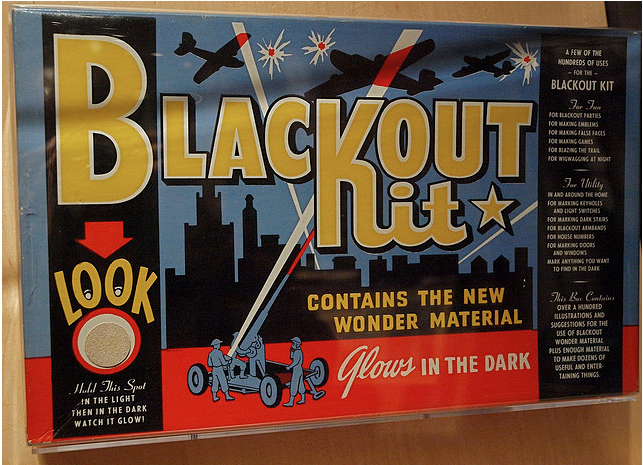
I do not believe he had access to these fancy blackout kits, but they sure would have made his job easier.  The joiner, by the name, was called Swimmer back then.  You will meet him in my book, some day.

Chapter 1

Now that we have settled into our temporary, snowy home I have begun my second novel, again.  I was about 25K in to the last draft when I went back to rewrite the first one again, then came back, looked at what I had and that – nope, that’s not it.  Scrapped.  Now, with an updated Scrivener programme and a new outlook, mainly onto a snow-covered Edinburgh street, I am ready to write.  Today I finished the first chapter and have hit 5K.  Whoopee or big deal?  It’s not a novel yet, but I know, roughly, where I’m going.  And for me only knowing where I’m going gets me going, even if I change my route as I write.  My next target is 10K and if I hit it I will take myself to see a Czech animated “Alice” that has been on my to-see list for a long, long time.  Maybe that will get me through Chapter 2?  My first novel has really short chapters because I’m bouncing around in different heads and time periods.  Maybe this one will be different.

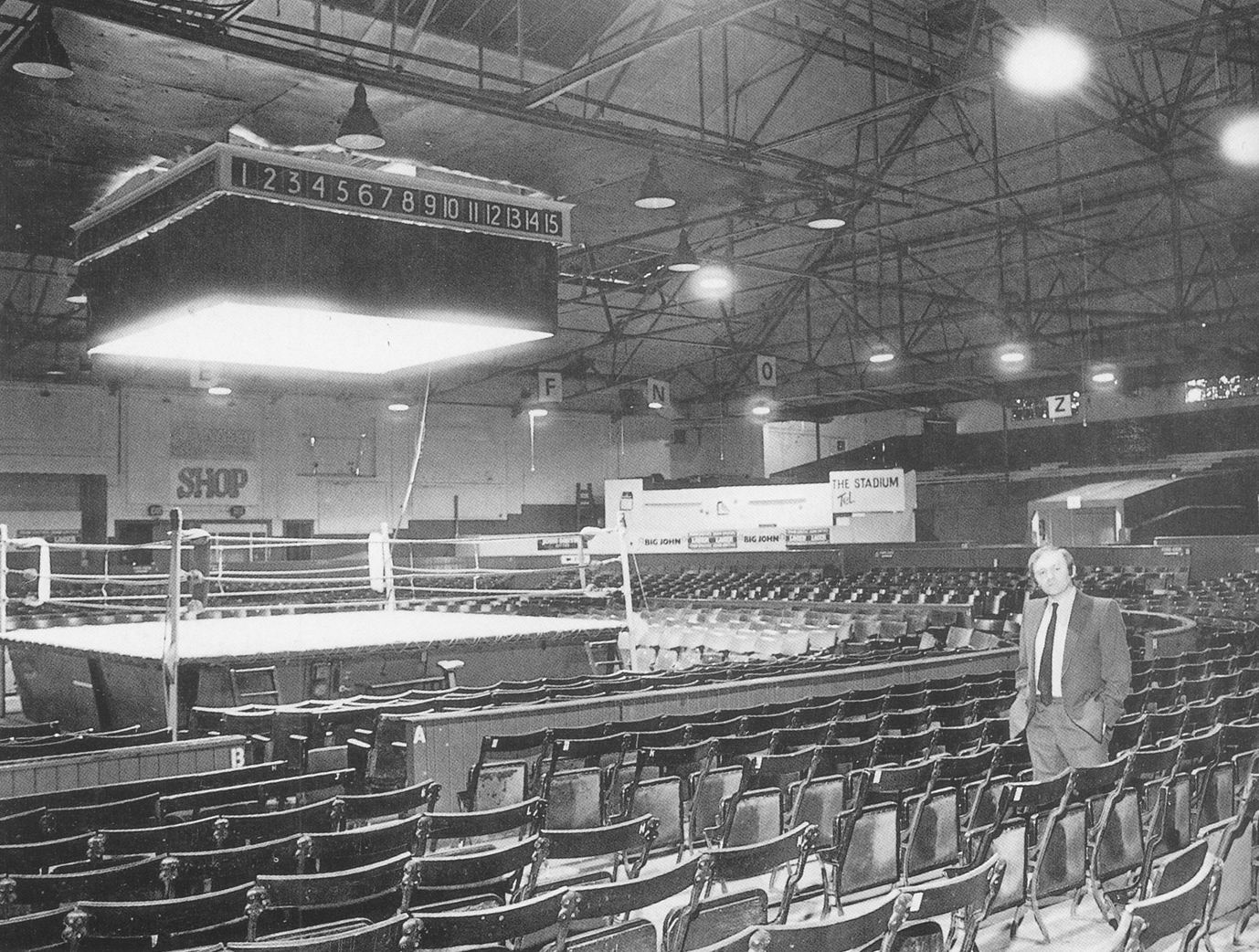
This picture is a location for my first chapter.  Maybe the best part about writing is the researching, and certainly when you’re telling a story that is “true.”  Today I got my main character from a police cell to the locked compartment of the toy steam train in the Isle of Man, via police-lined streets and the Liverpool Stadium, where thousands of women were kept awaiting ferries in May 1940.  The Stadium was opened in 1932, became a famous rock venue in the 1970s and was demolished in the 1980s.  I wonder what it will have been like, entirely filled with frightened, exhausted women and no men there to thump one another or cheer?  But then, that wondering is the other best part of writing.