If I were reading…

I am not reading much these days.  Which is a pity.  I would imagine that most writers are writers because they so love to read.  But sometimes, the writing gets in the way.  I’m reading plenty of research.  I’m reading blogs and, it must be said, Twitter.  I am reading far too much of my own writing, while I edit.  None of that reading is really for pleasure.

So, it was a pleasure to find today, on Twitter, that November is German Literature Month, a terrific initiative by @BeautyandtheCat via today’s blog, 14 German Women Writers You Shouldn’t Miss.  I’ll say.  This post is a whistle-stop tour through the history of German women writers and a terrific introduction to many new names – at least for me.  If I were reading, I would be adding Anna SeghersIrmgard Keun, and Judith Hermann  straightaway.  I am a devoted fan of Hans Fallada, Heinrich Boll and Jenny Erpenbeck, but I know that I don’t read enough German writers – especially women.  Three cheers to German Literature Month’s initiative to get us all reading.  Maybe, even me.

Click here to visit more German Literature Month participants and to get involved in some of their group reads.

Who’s your audience?

I am a bit of a social media junkie.

I say a bit, as I’m not as connected/compulsive as many.  After all, I’m not on Facebook, I don’t have a Tumblr, and I’ve stopped using my Blogger site.  I only maintain three websites, two active blogs, and two Twitter streams.  I’m on a number of Nings and the like.  I am on Google+ but I honestly couldn’t tell you why.  Recently, my list has stretched to include Pinterest.

Have you seen Pinterest?  It is like a digital pin board, like the peg board of your dreams beside the tidy desk of your dreams in your spic-n-span work space of your dreams, the one that doesn’t seem to have to store documents or bulk boxes of stationery supplies or random bits of furniture that don’t fit in the house.  (Wait, that’s my work space)  It is a place where beautiful things live and get “repinned”, meaning people who see the beautiful pictures pin them onto their own boards.  They are all images that have been found on the internet and pinned onto boards you create – it’s like using scissors and a glue stick on the world wide web with Pinterest’s little widget “Pin It” that magically inserts itself into your browser bar.

I have four boards on Pinterest, because I’m still trying to figure out what it’s for and how I want to use it.  There’s one for Stuff, because I like beautiful things, too.  There’s one called Writing Spaces that are gorgeous pictures of seriously fantastic desks in the forest or cupboards that become tiny libraries.  There is one called I Could Write About This because I love photography and it seems a nice place to put shots that are filled with characters and stories.  The last one is called Work in Progress, and this is where I got into trouble.

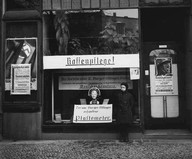
My second novel is dealing with some pretty dark themes.  Right now, I’m writing about racial hygiene and all that is abhorrent about that from the points of view of people who do not think it’s abhorrent, because it’s only in the 20s.  The much-worse that it’s going to get hasn’t happened yet and I have to stay in the present of that time and risk any temptation to foreshadow.  So, Googling about, as you do, you find images and click Pin It and it seems a nice place to put an image I can use, especially if Scrivener isn’t open and I don’t want to just drag another jpg onto my desktop.  So, I click Pin It and this photo pops onto my board.  It might be hard to see, but it is a small girl posing before a shop window that is selling callipers used to measure heads, when Nazi phrenology sought to sort us all out by our shapes and sizes and colours.  I liked that this abhorrent tool was sitting up in a window, bold as brass.  I liked the little girl standing by it, as if she had placed herself beside a doll house and had no idea somebody had swapped it.  The picture made me think of Kristallnacht, when so many shop fronts like these, albeit without the callipers, would be smashed and paint-daubed.  But it probably didn’t belong on Pinterest, the home of beautiful images.

I don’t edit myself through social media.  I think you have to be yourself on your blog and on Twitter – unless you’re writing in character, of course, as so many writers choose to do.  I certainly wouldn’t limit my interests or fascinations out of worry I might offend a reader or follower.  Yet, I watched my fingers press the delete button over the image in Pinterest.  And I think it is because the audience there is looking at things, beautiful things, and this image is not that.  This image might make them wonder about the pinner, not understanding the context of my writing or of me.  So, I deleted the image because I’d forgotten who the audience is there and what they’re looking for.  So, I’ve decided to put those images here, on my blog, where they belong.  In case this is what you’re looking for.

Nazi Fairy Tales

If one is to write about Germany, there are two things one cannot avoid.  If one is Nazis, the second must be fairy tales.  The two of them are entwined in a number of strange and surprising ways.

The Brothers Grimm published their first book of folklore, collected from the villages and farms around the centre of the uncollected states that would become a unified Germany, in 1812.  “Children’s and Household Tales” contained the fairy tales we all grew up with:  Cinderella, Sleeping Beauty, Snow White, Little Red Riding Hood, Rapunzel, Hansel and Gretel – plus a whole lot more that haven’t made it into a Disney film, and probably won’t.  The brothers saw themselves as “patriotic folklorists”, intent on preserving the oral tradition and culture of rural Germany.  They did not see themselves as children’s writers and it was only the Victorian advent of childhood that popularised – and sanitised – the tales.

But the Brothers Grimm aren’t the only game in town.  And as my story begins in 1880s Berlin, I wanted to know what influence fairy tales might have on my characters, as they move from colonial Germany to Weimar to the Third Reich.  There is a “Fairy Tale Road”, one of the oldest tourist routes in Germany, should you wish to visit the castles and woods that inspired the brothers, from the turrets and climbing roses of Sleeping Beauty’s Sababurg Castle to any number of wolf-filled woods.  I haven’t visited them and neither would my characters.  They are only in my mind’s eye and imagination, same as theirs.  They belong to newly industrial cities and to the Germany of its colonies, where surely the education of the idea of Germany would have been very important for children.  I can find no references to books on culture for German colonial children, but I would be very surprised if the Brothers Grimm hadn’t been tucked into many a trunk.  Either way, the Grimm Brothers set the stage for the fairy tale format for children around the world – especially German children.

After WWI the rapid changes to society and culture of the Weimar period brought a change to the fairy tale as well.  If the Grimm’s tales had “helped children to develop full personalities” through stories of good and evil, post-war fairy tales were anti-social and anti-family, in such collections as Hermann Hesse’s “Marchen”, in modern settings that were a world away from a fairy tale wood.  Where traditional fairy tales often saw children endangered by parents due to hunger, adversity, envy or coercion, post-war and Weimar tales see family itself as the enemy, the bourgeois and conservative force that must be pushed against and escaped.  Hesse’s tales continued to be romantic, with the all the idealism of the individual who triumphs against all odds due to curiosity and wit, while later Weimar tales were overtly pessimistic, dealing with the breakdown of society and family in a fast-moving world.  Collections such as Zur Muhlen’s “Fairy Tales for Worker’s Children” pointed at injustice, discrimination, and exploitation among the modern world’s economies and races.   With the rise of the Nazi party, both this romanticism and this pessimism would be crushed and the “innocent” folktale become an ideological weapon.  As one party official declared, “The German folktale shall become a most valuable means for us in the racial and political education of the young.”  For more information on Weimar fairy tales, read Jack Zipes’ marvellous “Fairy Tales and the Art of Subversion.”  In fact, read any Zipes you can get your hands on.

Nazi stories were folktales, not fairy tales; they removed the literary “fairy” to focus on the Volk, marching together in solidarity behind one Fuhrer.  Dr. Albert Krebs wrote books for use in Nazi Germany’s schools.  He wrote that folk tales had a “healthy and organic” view of the world, while fairy tales were “artificial and decadent”, a leftover from “early Romantic writers … the product of a baroque and distorted view of reality … and should be kept off the children’s bookshelves.”  This didn’t stop the Nazis from appropriating classic fairy tales and rewriting them, however.  Googling about, I find numerous references to a Nazi “Cinderella” where the prince rejects the wicked step-mother for racial impurity and chooses the Nordic Cinderella as his bride, but I cannot find the source itself.  There are also numerous references to a swastika covered Little Red Riding Hood and the Nazi officer who knifes the wolf.

The Nazi party sought to invade every facet of a German life, altering history, culture, taste and language.  There was Nazi wallpaper for dollhouses, as above.  There were anti-semitic bedtime storybooks.  Nazi propaganda was itself a fairy tale told to a desperate Volk.  No happy endings there.  But, I suppose the good news is how little of it remains.  Germans can see through the Nazi invention of language.  It has made us all more suspicious of political jargon and words that seek to take the sting out of the situation.  None of the work created by Nazis is in circulation except for in museum collections, like the wonderful Deutsches Historisches Museum in Berlin.  Nazis are only even rarely villains now and, more often, they are the butts of our jokes.  They have become their own fairy tale, perhaps, and haven’t remained the big bad wolf they hoped to be.  Is it because we have more wolves or worse wolves now?  Or is it because the story has been told so many times that we no longer fear it?  In the telling of Nazi tales, it must not do to be complacent.  There is much horror here.  One need only read the truth, not the fairy tales.  One must continue to look for all that was not left behind and know why it is gone.  One must always remember that this is not simply a story, even as one is writing it.  Of course.

What are you looking for?

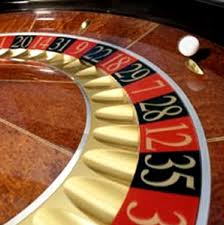
And really, that is the question to ask yourself when you are researching your way through a day, putting random combinations of words into the great roulette wheel of Google, to see where you land – even if you have no idea what the answer is.  Today, my desk is covered with maps of Berlin, a variety of German history books, various and sundry notebooks, and a dirty mug of tea.  But my Google cookies betray my online interests, from the history of Germany trains to the construction of railways in German colonies, to electrotherapy and mass nervousness in pre WWI Berlin.  Honestly.  What do I hope to stitch out of all of that?

A book, of course.  In this run-up to the rewrite of my second novel, I am looking for some more information.  There are things that didn’t get sketched out or made clear in the first draft.  The first draft, for me, is always very present-tense-y, it’s the now of the novel and not a lot of before.  In case the characters want to tell me something about themselves before I have to go and find it.  As the last rewrite of the first novel was spent in addressing some “befores” this seems a sensible approach this time round.  And all the digging around is leading me to think about the characters I have in new and surprising ways – which is, precisely, the point of research.  For me, mind.  It isn’t to show off facts and figures – thank goodness, for I can never read the notes I take.  I don’t even know if it’s to add local colour, because those kinds of details always feel like tick boxes for me, particularly in Germany.  I think the research is to inform why characters do what they do or did what they did, specifically.  It is a way to set them not only into a place but into their time on their timeline, to make them a part of it in a way that suits them, and to create a web of characters around them for them to exist with or push against.  All this stumbling around has made it a scrappy kind of day, but I can feel that I am filling in the black and white outlines I made in the first draft; I am putting flesh onto bones.  I am trusting that this endless spinning will lead to some kind of payoff.

Morning Practice

What’s your morning practice?  If you’re like me, it involves drinking buckets of tea and stumbling around, tripping over newspapers and an old cat.  On retreat, it is easy to spring from a bed and vault into a yurt for yoga.  At home, there is all this – well – home to deal with.  How can you keep that retreat feeling going with a sink full of dishes and an empty fridge?

My mornings begin with Morning Pages, an old idea that I first came across in Natalie Goldberg’s Writing Down the Bones, though it was probably Julia Cameron who coined the phrase in her iconic The Artist’s Way.  Natalie talks about timed exercises and writing to fill that time until the bell rings.  This is, perhaps, an offshoot of how she sees her meditation practice.  For her, meditation and free writing go hand-in-hand.  Julia prefers to fill pages rather than an amount of time.  As a writer, this works for me, too.  What, after all, are we trying to do other than fill pages?  I have been filling lined notebooks for much more than a decade.  On those lines, I have celebrated, whined, mourned and worked through things.  I have also found the first nuggets of ideas emerging, from a series of unconnected and random thoughts while in “write dump” mode.  That is the big idea behind Morning Pages or any kind of free writing.  Don’t think.  Don’t analyse.  Don’t try to connect thoughts or ideas.  Just write.

But that’s just how I use it.  There aren’t any rules.  Does it have to be morning?  No, especially if mornings aren’t your friends.  Does it have to be pages?  No.  And thank goodness for that.  My many years of filling notebooks are unreadable, unintelligible, indecipherable.  Like so many chickens having a scratch.  But the good people at 750words have come to my rescue, creating an online place for morning pages, for fingers more accustomed to keys now than pens.  And what’s really fun about 750words is that you can use meta tags on your writing, to find things later and refer back to them, and that the site reflects back your keywords after your writing, giving you a glimpse into your preoccupations and your states of mind, as well as placing them in context with writers around the world, as in the picture above, which appeals to my Inner Geek.  If you’ve tried morning paper pages and found them not to your liking, give online a try.  Couldn’t hurt, anyway.  You only have to try and see what works for you.  And then to practice and practice and practice.

It is a practice, like yoga or meditation.  It is like a full-body stretch for the mind.  It is a wake-up call or a place of stillness.  It is a place for lists and petty fears.  It is a place to write mindful detail of what is around you, what happened yesterday, what you want to happen today.  For me, it is a way to tame my monkey mind.  After morning pages, the brain says “OK, you’ve heard me, I’ll get out of your way and let you write.”  And sometimes, it actually does.

What is your morning practice?  What rituals or states of mind leave you ready to write?

A Retreat of One’s Own

What are the places that make your heart lift?  What do they look like?  What do they require, if one is to write?  It was Virginia Woolf, of course, who said that, “A woman must have money and a room of her own if she is to write.”  On retreat, you might not be guaranteed a room all to yourself (and you will most certainly require money, for these things must be paid for) but the best places for retreat offer themselves up to you, allow you to find your “room of your own”, a place you can return to, to puzzle out your words.

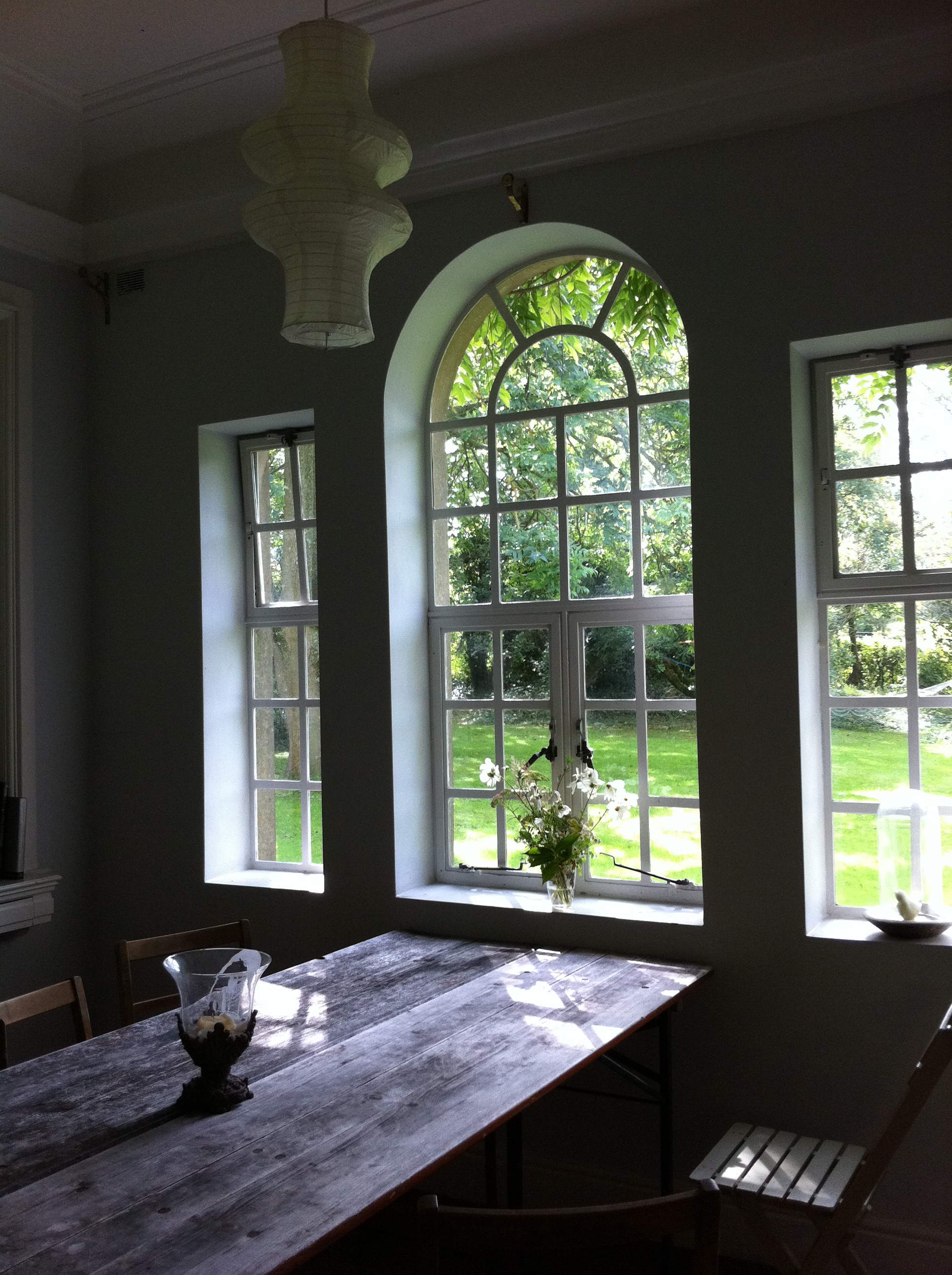
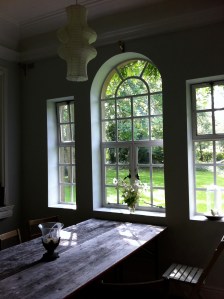
For me, it must have a view.  How about this one?  It should not have a mirror that you have to face while writing.  I have assaulted many a hotel room mirror with a towel, lest I catch myself gurning mid-sentence.  It should have a table, or at least a wonderful chair with arms wide enough to support a laptop on crossed legs.  It might have books and candles and, if you are lucky, a place to build a fire.

My new favourite place for a writing retreat is Tilton House, in the South Downs, nestled in Bloomsbury-on-Sussex.  (It is the former Georgian country house of economist Maynard Keynes and his Russian ballerina wife, who was not taken into the chilly bosom of Virginia’s sister’s circle.)  Keynes said of Tilton House, “There is no better air than here for work.”  Who will disagree with him?  Not I.

This is a picture of Keynes’ study, now the library, the room I found to work in, though I did have to occasionally share it, and gladly, with other writers who were collected together by New Writing South to work with Vanessa Gebbie.  You cannot see the walls of books or the wood stove fire that burst into triumphant life an hour and a half after building it and giving up.  Over 6 short workshops, guided visualisations, walks and suppers, we were all encouraged to look at our work in new ways and to challenge the assumptions we had made about our work thus far.  It was a weekend of laughter, insight, and tremendous vegan fare.
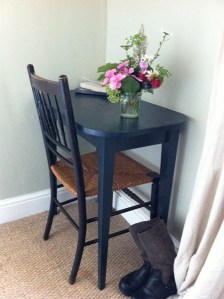
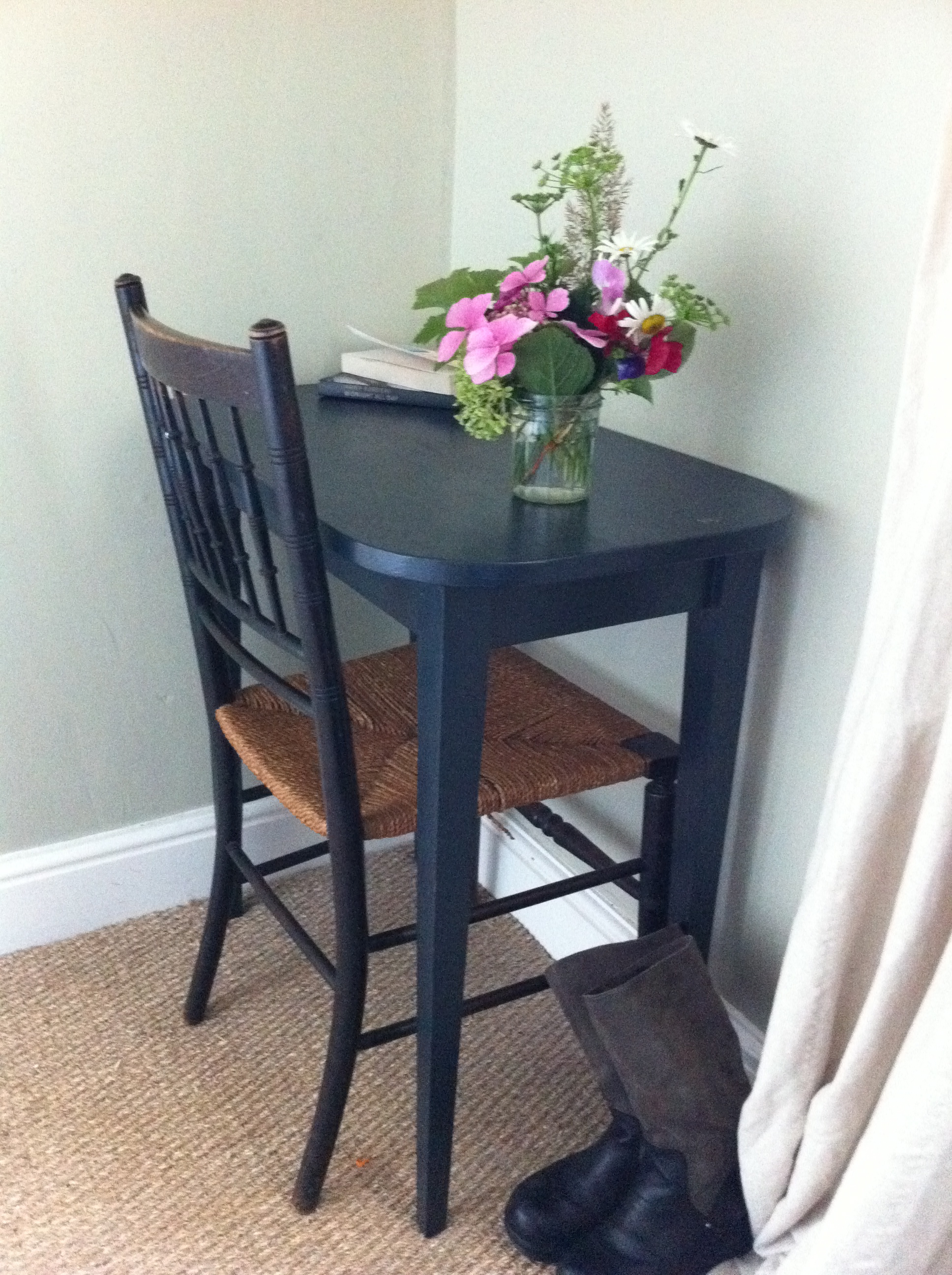
I was lucky enough to have a room of my own, but I did not write at the adorable desk.  I did write, huddled under the covers, listening to Radio 4 and pheasants.  But most often, I padded down, back to the library.  Nearer the kettle, to be sure – another retreat necessity – but probably also to be nearer the glow of others’ writing, the cats and dog, the warmth of a circle of people with shared interests and desires.  If the Bloomsbury set lived together to share their interests in beauty, truth, and friendship, so do writers seek out writers for conversation, confirmation, affinity.

Now, back in my own room, I am struck by what I have.  I have a view out of three small windows, to the house and to the neighbour’s allotment-style garden and a sky broken only by an ash tree.  I have a broad desk and walls of books.  I have candles and if I do not have a fire, I do have a Calor gas heater, which I have just rolled, grunting, out of the way so that I can squeeze in space for a yoga mat, inspired by Tilton House’s heart-lifting yurt to make a greater commitment to the practice and shirk yoga no more.  If the vegan fare will not continue, I have at least committed to having lunch.  I tend to write until I fall over, but I can now see the value of eating midday.

Most of all, I have got my groove back.  I have been labouring the last few weeks to empty the last book from my head and work space, while others read it and decide what they will make of it.  I have cleaned my desk, but still I have not written.  I was hoping the retreat would allow me to transition to the second book that is ready to be rewritten, and find I am now ready to rewrite it.  If you find yourself stuck, or in need of a heart lift, find a place where you can retreat, whether it’s Anam Cara, Arvon, Yaddo, Tilton House – or even if it is just in your own room and the circle of writers you find is on Twitter.  But if you have that bit of money, it is a wonderful investment in yourself and your work.  My retreat was paid for with winnings from the recent Mslexia contest, and I am very grateful to it, and that I didn’t have to spend that money on groceries – which are also very essential for writing.  Speaking of which, I’m off for a digestive.  Even though it’s lunch time.

The Power of Blurbs

Michel Faber made me do it. Such is the power of blurbs.

The cover of Jenny Erpenbeck’s “Visitation” says, courtesy of Mr. Faber: “Extraordinarily strong… Erpenbeck is one of the finest, most exciting authors alive.”  He stops just short of an exclamation mark.  So far, so blurby.  But it wasn’t the blurb that caught my attention, it was his spiky review in the Guardian.  His opening made me sit up: “At its worst, the British literary scene behaves like a community of nerdy parochialists who imagine themselves to be cosmopolitans, fretting about whether there can be any great novels any more now that Amis is past it and Updike has died. The ongoing story of literature in foreign languages is barely noticed, a background pixel in the all-important anglophone display.”  He derides the appearance of a book that can only be Freedom, and wonders why the British “struggle” to understand, say, middle class American nuance, but seem to be disinterested in any works in translation – and particularly German ones.

As someone actively looking for German work in translation, I was grateful to Faber for pointing the book out to me.  As I had never seen it in a bookshop – and have yet to see it – I ordered in on line and was delighted that, when it arrived, slim in its cardboard sleeve, it was only 150 pages.  I do like a short book, especially when it is tackling 24,000 years of history on one piece of land.  (This, in and of itself is not remarkable. James Michner made it his speciality, and if there is a better history of one place from prehistory to the present than Centennial, I would take some convincing.)  But Centennial is a big book. A proper door stop. At page 150 in Michener’s, you might still be wandering around with dinosaurs.

The rest of this blog could go on to be a standard review of Erpenbeck’s book, which I thoroughly enjoyed.  I would tell you that I admired the device of the Gardener character who links the chapters that move through the history of a house, from inhabitant to inhabitant.  He never speaks.  We watch the land change through his eyes; we see the circumstances of the house change through his chores, which mark his eventual decline.  I would tell you that Erpenbeck is able to create fully realised characters in what might look to be quick sketches, but are actually careful and specific wood cuts, deep and dark.  But I’m no fiction critic.  I am a wholly selfish reader, looking only for what I want.  It limits my reading to be sure, at least the pleasure of reading, reading as I am through that filter or, perhaps, those cross hairs.

I am looking for German writers to tell me what I do not know about how it is to be German.  Nothing more.  Nothing less.  It is a great expectation.  Do I really expect a writer to deal with the whole of their cultural history in any one book?  Sadly, for me, yes.  For me, a really good book is not only a window on a world but a lift shaft, going down.  I want to understand how the world of the book is affected by the history of the people and the place, and also to see how the world of the book will affect the future, whenever that is.  I do not want a book that is relentlessly “present”.  And I mean not only the back stories of characters and their parents, grandparents, but also their ancestors, their ghosts, their culture’s failures and race’s migrations.  I want to know how the uses of land have changed.  I want to know where the graves are.  The problem for me – you will have seen this one coming – is that I’m American.  I have no German ancestors.  Not a one.  My second book is a history that is not “mine”, and it makes me afraid, just a little, to write it.

Of course, I have written it.  I have a finished first draft.  I will begin the second draft on Monday.  And I will begin my rewrite without reading the first draft.  I don’t need to.  I already know what I wrote and that it is not “right”.  I have written a draft of what happens in the book, as if it is the story I would tell you in a pub.  It is all plot and story and characters doing what it is that they do and, sometimes, why.  What I don’t have is a history for them or their worlds that is deep enough, rich enough, to satisfy.  What I know and have written is “correct” but I know it is not – right, not enough.  I know who it is to be those characters, living in those moments.  But I don’t have the weight of their histories in me.  A marvellous exemplar of this kind of work is Louise Erdrich.  No doubt, she deserves a blog of her own. That will be for next time.

Suffice to say, I still have books of war that I am ploughing through.  I am still making sure my history is “correct”.  But I am also looking for – something else.  Something richer, deeper, darker.  Something I don’t yet know.  Erpenbeck got me some of the way there.  But I’m greedy. It wasn’t far enough.

I’m an App

My recent story, performed by White Rabbit in Ashford, has been accepted for Ether Books, a mobile publisher, “providing the very best short content direct to your mobile phone.”  They say, “We publish short fiction, articles, poetry and serials from both bestselling and emerging contemporary writers.”  Hurrah!

Reauthoring

In my other life, I’m a live lit producer.  Or was.  As that job has ended, I find myself a live lit artist.  So, what is live lit?

Live literature is a funding strand and a way to explain spoken word or text-based installation/multimedia work.  As that is a bit unwieldy, live lit has come to stand for many things for many people.  It is spoken word work and performance poetry; it is an author in a room with readers doing something more dynamic than simply opening her book and reading from it.  It is a process of engaging audiences with text – with words – in a way that brings the words their writer to life.  Which is still rather unwieldy.

Maybe the easiest way to explain it is to invite you to see it.  I am part of The Reauthoring Project happening at the upcoming Herne Bay Festival.  There you will see the work of 5 Kent writers, including me and my new piece “Post”, a promenade journey through a life.  You’ll be able to read Post here once I’ve done the piece live.  But you wouldn’t want me to spoil it for you, would you?  See you in Herne Bay!

Herne Bay Poster

Letting Go

So, I’m at that awkward in-between stage when I’m done with a rewrite, but my brain isn’t.  It keeps ticking over the story I’ve written.  It keeps asking me questions and demanding I check scenes and strands, again, again.  It woke me up last night to nag me about a minor character.  My brain wants to be sure that I’m as done as my fingers think I am.  It’s annoying – and exhausting – but this is part of the writing process. This is part of how you let go.

I stack the last printed draft onto the precarious pile of earliers.  I dust my desk, wondering who could have strewn all these digestive crumbs here?  I put away the project’s reference books: Culpeper’s Herbal, The Grapes of Wrath, The Ways of my Grandmothers, my dog-eared Harper Study Bible, given to me back when I joined a church as a teenager.  It didn’t last long, but I still have the Bible and I love all the things I tucked into it back then, tiny epiphanies on offering envelopes and prayer slips, all that earnest highlighting.

I change playlists, retiring the soundtracks that I have played ad nauseum, the sounds of this particular book.  Characters have specific soundtracks per chunk of text.  It helps me recapture what it is I want them to feel; it helps me get back into the book when I step away to work on other things.  They are, perhaps, a form of self-hypnosis.  Do you do that?

Amity, the youngest character, is mostly Mark Isham’s soundtrack to Nell.  I don’t even know why I have this soundtrack, but I could hum the whole of it right now for you.  The main character has several soundtracks for past and present portions of the book.  To her, I have worn out two Rachel Portman soundtracks,  The Lake House and Never Let Me Go.  But recently, I had to put her through a scene that I was having trouble writing.  All her music was too gentle for that; another soundtrack to the rescue!  I turned to Javier Navarrete’s terrifying Pan’s Labyrinth.  Again, I have no idea why I bought this soundtrack, but I was grateful to turn to it.  When you Google writers and what they listen to, it is astonishing the variety of things we use to inspire us.  I found a writer who can only write to ABBA.  Really.

In putting these things away, I am telling my brain that I am in charge of it, that I know what “done” is.  I am telling my brain to trust me and the writing.  I guess I am telling my brain to let go, so that we both can move on…