When done means done

A few moments ago I typed what is the last sentence in the first draft of my second novel.  That tipped me over the 128k mark.  Does that mean I’m done?  No.

Finishing the first draft of the first novel, a couple years ago, was an overwhelming feeling.  I couldn’t wait to print the sucker out.  In fact, I did print it out and carried the wad of paper around with me, just to feel the weight of it.  I’m sure I caused amusement at the first writing workshop I did immediately afterward, slapping its bulk onto tables just to prove I finished it.  And – don’t get me wrong.  Finishing feels great.  But maybe it’s just that I know how unfinished finished really is.

I had no idea how much my first novel would change with every reader’s report and every rewrite.  Points of view changed.  Tenses changed and changed again.  Whole characters were created or deleted.  I didn’t want to believe it, but the first draft was just a floor plan.  It was a map of what the story was and how the characters would be changed by the story and the choices they made throughout it.  It was the story in its rawest form, sure, but it wasn’t writing yet.  It wasn’t good writing, at any rate.  It was only the ghost of the novel I would end up with – a novel I am about to rewrite again, now that I’ve finished this second one.

So, finishing the first draft of this second novel feels epic on the one hand.  Blimey, those are a lot of words in a relatively short time for a recovering playwright.  So many of them will simply have to go.  Realistically, all of them will go and be replaced by better words that more accurately tells the story that I’ve just laid down.  Like Arthur Murray’s footprints, I know where I’m going and I know where to put my feet.  But is that dancing?  Probably not.  The fancy footwork and the flourishes belong to later drafts, now that I have found the dance floor and put my shoes on the right feet.

I’ve left a few holes in the narrative.  Some places are just bullets or questions, places where I could feel the story changing but I knew I had to keep trudging forward.  If I looked backward, I might never be able to turn myself around again.  And a lot of the writing is just telling the story.  Not telling in an opposed-to-showing way, because I not a very “telly” kind of writer, but I mean just showing what happens, like when you tell someone a story in a bar, if you do such things, this happened then this happened, and not knowing myself how moments would lead to moments and how characters would reveal themselves through what they said and did.  Having finished this draft, at least I know what and who I’m dealing with.

So – hurrah!  Yippee!  Woot woot!  But tomorrow, it’s another sit down, to have a look at the holes and see what needs plugging now.  To tidy up my Scrivener files.  See what I can throw away.  And then I put the whole thing away for a while and turn back to the first novel, the one that is screaming out for work, the one that knows what it is now and is just waiting for me to make it so.  And after the first draft of the second novel has composted a bit and, hopefully, I’ve forgotten about it for a while, it will be time to crank up the printer and carry around another few reams of paper.  Sorry, trees!

Distractions

With a title like that, one would expect a post to follow that complained of all the distractions of the world, conspiring to pry our curled fingers off the keyboard, wrench us from our work.  But this is not that post.  For not all distractions are bad ones.

I am currently on a coaching training course.  I am learning techniques which might enable me to offer coaching to writers in the future, or to add coaching techniques to the professional development I already deliver.  Either way, it is giving me time to focus on where my head is as a writer and to be reminded of how writers share universal concerns and questions.  Our thoughts and feelings happen, unsurprisingly, in shared metaphors.  I may blog about this training once I’ve completed it, but I will just say, for right now, that is a welcome and nourishing distraction.

There are also welcome distractions in writing.  I was distracted away from my novel while on holiday in January and I wrote a short story.  I submitted it to a contest via email and thought nothing of it.  When I heard back about the story, I was dead chuffed.  Here is where it will soon appear on paper, and where you can read it electronically, if you have a moment.  But only if you do have a moment.  Don’t let me be your distraction.

Writing backwards

Sometimes the writing goes so slowly, you might as well be writing backwards.  The word count goes mysteriously down, rather than up, even though you are trying to write forwards, you are going through the motions of it.  You feel sleepy at your desk.  You feel suddenly that whatever it was that you and your story had, it has been lost somewhere.  You know that something is – wrong.  Now, there are 2 responses to such a predicament.

Option 1 is to panic.  Balk, fret, run and hide.  Be convinced of your own failure.  Know suddenly, in your bones, that the fragile craft into which you loaded all your hopes and words is no longer seaworthy.  Perhaps it never was.  Complain bitterly on Twitter that you cannot write and it is officially the end of the world.  After all, watching TV only confirms our hopelessness, the tragic awareness that writing cannot save us.  Worry and wallow.  Consider scrapping the whole of the thing.  What other fear-based reactions have I missed?  No matter.  Friends, do not choose Option 1.

Option 2 is to wait.  Simply wait.  Sit with the writing.  Look closely at the moment that despair set in.  Look at what it is that you were attempting to write when your house of cards collapsed.  Somewhere in those lines, in that scene, on that page is a moment of opportunity.  It is the writing asserting itself to tell you that you do not know where you are going, or that there is somewhere else you should go.

I have had a few days of rough writing.  I can blame a lack of sleep, an injury, a barking dog next door.  Or I can sit with the moment I am trying to write and realise that something needs to change in the work.  I sat with the moment and saw a sequence I could not write toward or across, because it wasn’t true.  It didn’t work.  Instead of trying to write myself out of the mess, I went back to my plan for the book and I could see, right there, that I was trying to write across a hole that had no foundations.  I was trying to fill up that hole with words and with activity, but the writing knew better.  So, the writing stopped.  The writing stopped me.

I worked on the plan instead of aimless writing and learned some things about the story and the characters.  I moved a lot of text and action forwards and backwards in the draft – easily done in Scrivener.  Best of all, I simplified my plan and I simplified the story.  Emma Darwin, in her blog, spoke of an early draft being a scaffolding, and that has stuck with me.  That is what it feels like for me, too.  I know that I can’t bolt on details and strands until I know that the shape of the thing is true, is sound.  I won’t know if I’ve repaired my craft until the writing is happening again and telling me that it will float, but I know that at least I can see the way ahead again.  I know where I am going.

So, if the writing makes you stop, just stop.  Something is still happening.  The writing only looks like it is going backwards, like a planet in retrograde.  Really, it is still moving forward.  You are still moving forward.  At least, that’s what I tell myself.  Now, Peggy, back to work.

A new milestone

Another big hinge for a first draft is hitting the magic 85.  85k worth of words.  At this point, you officially have enough words to just stop.  You’re long enough for a novel. Hurrah!  But, of course, you don’t stop, because at 85k you’re probably nowhere near the end of the story.  You are dealing with volume of words in novel writing, but you are also telling a story and I never know how long a story will take to tell, though I’m sure other writers do.  So here, at 85k, I can pause again, look up from my desk and my appalling cup of tea and be assured that I have story enough for my novel.  At 85k I’m roughly 2/3 through my story and there’s no stopping me now!

While I am still mindful of word count, to make sure I’m being productive at my desk rather than just noodling around, my new goal is to get to 1944 and Berlin by the time I leave this desk in Toronto and head back for my own desk in Whitstable.  The countdown begins.

Can I do it?  Why not?  You have to set a goal if you have any hope of reaching it.  And if I don’t reach it, only I will know.  Except, now I’ve told you, too.  Oh dear.

New desk

So, we’ve arrived in Toronto, which you’ll know if you also follow me on Twitter.  We arrived after a “big chill” of minus 27 and we are promised the next “big chill” is on its way.  I am watching snow race diagonally across large picture windows and watching the man across the street spill salt from a little rolling cart onto the pavement.  So that’s how they keep their sidewalks clear!

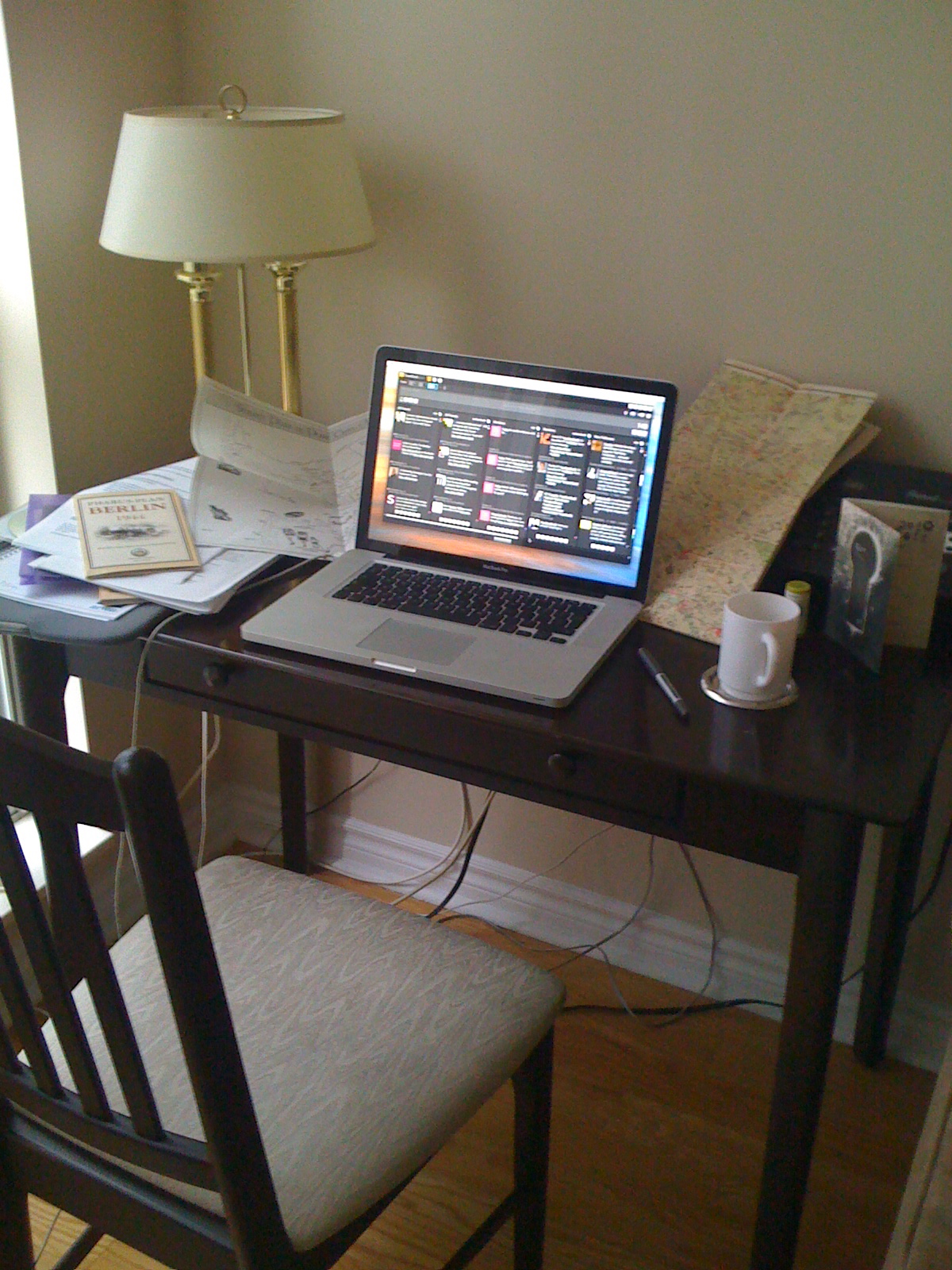
I’ve already had a good old moan about not being able to pack books and so far it hasn’t mattered.  I really have all I need here.  A good solid desk with a lamp and a chair.  My maps of Berlin at 1930 and 1940, and my handmade map of the Isle of Man in 1940, open and at the ready.  A mug of tea, shamefully small.  A pen.  There is also a fax machine here, which is reassuring in an old-fashioned way.  If a fax ever comes I’ll surely fly out this picture window beside me.

I have written for the last 2 days here and cracked 56K this morning.  55K is a big hinge in a novel, it’s the first place where you can look up from your writing, take a breath and say to yourself, OK, what I’m dealing with here is a novel.  If, in fact, you are at 55K and you have plenty of story left to tell, you know you have enough material to be book-length.  It doesn’t mean it will work or that you won’t get lost somewhere and lose track of where you’re going, but it just means that you have enough to write with.  And really, halfway through a book, that is enough.  Husband is off today, so we go off to explore, me with a tiny little bubble of accomplishment percolating under goose pimples.  And tomorrow?  To write the book past 56K – after all, there’s still another 50K to go, or so, and then all those drafts ahead…

Blackout

Well, here in Edinburgh it’s been more of a whiteout, as snow and ice have kept the faint-of-heart indoors.  I emerged like some premature gopher yesterday after two days inside.  I watched men holding ski poles fall on their heads on thick slabs of ice that covered any footpath not salted or gritted.  I walked home, knees bent, hunched as an old woman, skidding my way down to Canongate.  So, you’d think I would be getting plenty of writing done?

I am, actually, thanks.  Up to 15K since arriving here and taking up residence at a small table beside a radiator.  It’s pretty fast writing statistically, I suppose, but it feels slow to me, if only because the research for this book has been with me so long, and because I currently have so much time in which to do it.  You will have seen my earlier pictures of research materials I was bringing up with me.  They are all now unpacked and waiting for me to read them.  But there are a couple of things I forgot… yes, I forgot my own research: transcripts, interviews, maps – all the research I have already done.  Why, oh why?  I’ve spent much of this morning in a tailspin of looking and looking in the same file folders to convince myself that I hadn’t looked hard enough.  I had.  They are not here and I cannot go home to get them.  Does this mean the end of my progress?  Shall I give it all up and go shopping?

Of course not.  The fact of the matter is that I know my story.  I know the research I’ve already done and my fingers remember the transcripts I’ve already typed.  I know I have internalised the research and am changing it and shifting it into new bits of story to make one that is truly my own.  I know this – and yet I want the safety blanket of this paper, this proof that I know my stuff as a kind of signpost for when I get lost in my narrative.  For when I can’t see where I’m going.

Research is a really important part of writing, whatever it is you’re writing.  When dealing with history it is all the more important, though there are plenty of writers who will say they just write and factcheck later.  I guess I have to put a blackout on my desire for my research – I have to stop looking outward for what I’m worried I can’t remember or will get wrong and trust that it’s all already inside, glowing.  I don’t need more of what I already know – but that won’t stop me looking for all I still have yet to learn!

I couldn’t remember when blackouts went up, and many fine websites told me they went in 2 days before the war started, September 1939.  That doesn’t work for my story, so I need to know the history – know the truth – and then write why something different is happening in mine.  In my case, I’m writing about hundreds of empty bedrooms on the Isle of Man.  No blackouts have gone in, I say, because there are no people there to switch the lights on.  Is it true?  Does it matter?  Only if it makes a reader stop in their tracks and think, no, that doesn’t ring true – or if it stops a writer in her tracks, trying to justify a scene.  Either way, in 2005 I met a man who was a joiner in 1940 on the Isle of Man and he remembered putting up blackouts, and that really is good enough for me – even if I can’t find the transcript I did of our interview.

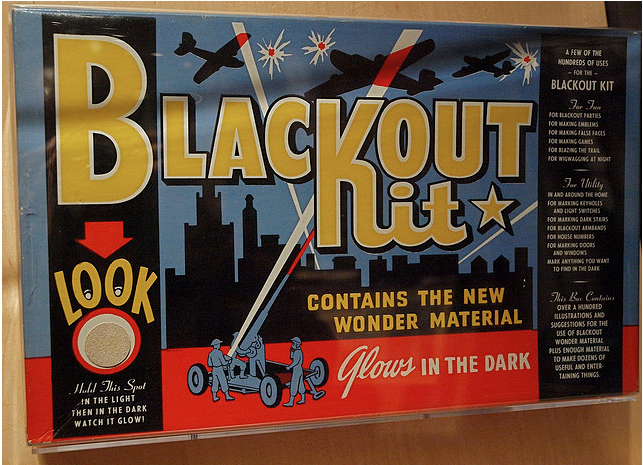
I do not believe he had access to these fancy blackout kits, but they sure would have made his job easier.  The joiner, by the name, was called Swimmer back then.  You will meet him in my book, some day.

Writing for a new world…

And so Writers’ Toolkit 2010 comes to a close, as writers straggle into the auditorium clutching cups of tea and an expectant hush descends.  Jonathan Davidson introduces writer Graham Joyce to give a talk mysteriously titled “The Writer’s Smoking Jacket.” Soon, all becomes clear.

Graham holds a book up.  “Look,” he says, “it’s a Tardis.  Bigger on the inside than the outside, it is a portal allowing you to travel far and wide.”  A book is the most astonishing piece of technology ever, due to its simplicity.  “But,” says Graham, “they made a better Tardis.”  And so he sweeps us into a passionate argument for the Digital Age and how, rather than be a spectre of fear for modern writers, it will ultimately be saved by story.

Just as during the Bronze Age, when ancient man carried on with stone, so people will read on paper in this advent of e-readers.  An iron sword wasn’t necessarily better than a bronze age, but iron technology unlocked the ability for everyone to have iron, not only wealthy men.  Iron was more accessible than bronze, just as paper was more accessible than papyrus.  “The Digital Age is here,” says Graham, “and writers either face it or fossilize.”

If publishers are all doom and gloom about changes in their workplace, Graham offers 9 surefire ways for writers to survive and thrive, principally through employing diversity in their workplace to have a sustainable career that cannot be shaken by trends.  The idea is to look at “micro-streams of work” for a writer to make her living, and each writer should aim for a presence in 3 or 4 of the following areas:

  • The “old school” advance.  It is the prime income source for a writer, but cannot be counted on. Advances have been shrinking across the board over the last few years. However, new kinds of writing, particularly the young adult market, have grown beyond all expectation.  Rather than making advances, writers may be looking toward retaining a higher percentage of the royalty per sale, particularly in e-book downloads.
  • Teaching:  As publishing becomes more accessible, more people will want to publish their work.  Experienced writers can share craft and best practice with aspiring writers to supplement their income, while helping writers to polish their work, wherever it is.
  • Spoken Word: Graham cites the successful Book Slam model – “hip, lively, absolutely not high-brow.”  Find new ways to share your work.  Why not in performance?  And if you don’t live near London’s Book Slam, start your own.
  • Lectures and Talks:  Many writers offer talks and lectures in schools; if you’re particularly entertaining you can work the after-dinner and lunch speaking circuit.  People find writers interesting.  Turn up in the proverbial smoking jacket worn by the “successful writer” and perpetuate the myth that writers are interesting.
  • Non-fiction writing:  a writer’s fictional techniques are very portable talents.  All the skills that make your fiction effective can be employed in non-fiction and creative non-fiction for other avenues.
  • Screen development:  getting a film or play actually produced is hard, but getting it developed is easier.  Too often the projects in development are weak in narrative and have been put together by people who are really directors or producers.  Put your projects in front of people.  The option you get will be low, but try to get fee to write a draft or two, even if it never gets made.  Graham told us that options kept “the wolf from the door on many a lean year.”
  • On-line drama:  develop, write and produce your own on-line show.  He references Kate Modern, a young adult series that achieved 66 million hits in a year through Bebo. All those teenagers are still hungry for narrative and they will find it when it is offered through social networking.
  • Games writing:  Software development has made graphics exceptional on computers, but the games are identical as developers copy successful games.  Narrative is crucial, if only to keep gamers playing, to see what happens next.  Graham mentioned his experiences working on Doom 4 and his particular interest in adding emotional content, to make experiences that will make players laugh, cry or just emote, rather than shoot or shop.  Again, the link to social networking is key.

“Diversify,” Graham says, “not just to make money but so that ‘they’ can’t break your writer’s heart.”  Throughout the auditorium, heads began to nod.  “It doesn’t’ matter how long you’ve been writing, rejection still pierces the heart.  It embeds in the psyche like a poison dart and it makes you want to give up, it can make you ill.  Why hand over your beating heart to any one person? You must protect yourself – with the medicine of optimism,” because any single rejection won’t mean an end to your career or your ability to write.

His final words sought to leave us with hope for the publishing industry and for our own spirit of independence.  Follow your own road and aim to get publishers to join you on it.  But if they do not, publish on your own; the Internet allows you to create and maintain an on-line presence and to communicate with readers on your own terms.  “We will continue to need editors and agents, supporters and champions for advice and to help us be better writers.  We’re pretty poor at managing the business end of things,” he says.  “As writers we walk our road as a creative individual.  We take nothing from the earth. We take everything from the sky – that’s the meaning of inspiration.”

The Future of Theatre Writing

From The Writers Toolkit for Writing West Midlands.  THE FUTURE OF THEATRE WRITING:  The panel included Caroline Jester, Dramaturg for The Birmingham Rep; James Grieve, Joint Artistic Director for Paines Plough; Kate Chapman, Artistic Director for the Theatre Writing Partnership and playwright David Edgar.  Chaired Jonathan Davidson, Executive Director of Writing West Midlands.

David Edgar began by introducing us to his ACE-funded report on the state of new writing in theatre, Writ Large, undertaken by the British Theatre Consortium to look at RFOs (regularly funded organizations):  how much new writing they produced and how tickets had sold.  He brought us up to speed with earlier ACE reports on new writing in theatre. A report on the years 1970 – 1990 suggested that 15 – 20% of a theatre’s repertory was new plays.  I recall this report and that an astonishing 6% of new plays produced were by Alan Ayckbourn.  “That isn’t enough,” said Edgar.  Worse for statistics was the trend in 2001 for theatres to stop differentiating between new writing and classic plays in their reports, so that all writing was viewed the same.  Of course, new writing is more expensive to stage than royalty-free Shakespeare or indeed any existing play that didn’t need to be commissioned or developed.  Without a tracking system there was no incentive or imperative to invest in new writing.  “Anyway,” said Edgar, “all theatre writing, from Sophocles onward, was on the way out.  The future was in devised work, put together by actors, site-specific.”

For Writ Large the Consortium sent out a questionnaire to 89 RFO theatres.  65 replied, 73%.  “The result was staggering,” Edgar said.  “An increase from 20 to 40% of the repertoire was now new writing.”  And these plays were doing well at the box office if compared with other straight plays, though not compared to musicals and Christmas shows.  Furthermore, “New writing had broken out of ‘studio ghetto’”, meaning less than 200 seats.  The questionnaires showed that 9 out of 10 tickets to see a new play were for a theatre over 200 seats and the new writing was spreading into areas where it hadn’t existed, like translations, adaptations and writing for children, now increasingly commissioned rather than taken off the shelf.  The only downside, Edgar joked, is that writers are “still pissed off”; the culture of literary managers and dramaturgs and the financial risk of staging new work in big spaces puts additional pressure on writers who feel they are being “told how and what to write.”

Next, Caroline Jester told us about Birmingham Rep’s upcoming period of great change while the theatre is redeveloped until 2013, during which they will be working site-specifically and in partnership with libraries and galleries.  They will also be offering writers to respond to briefs for new commissions for community plays, adaptations, multi-media, collaborations and work for youth and children, rather than creating work for the studio space as has traditionally been the case.  Birmingham Rep will continue to offer training and masterclasses, but will be looking at new areas of work, with spoken word and physical theatre artists.  “We have to look constantly at how we work with writers, because how we tell stories is constantly changing.”  Birmingham Rep also noticed a gap in theatre writing for audiences aged 10 – 14 and a new joint attachment programme will invite writers to submit ideas for writing for younger audiences, in partnership with Unicorn Theatre.  They will also be launching a digital playwriting zone, an interactive tool for writers to use and theatre to develop projects.  Lastly, with the demise of Script, they will be providing a new unsolicited process for writers to submit their work.

James Grieve said Paines Plough was “fascinated and thrilled by Writ Large report.”  Paines Plough has invested in writers’ development for the last 36 years, traditionally offering a broad range of workshops for writers in addition to producing a couple plays a year.  Then they realized that “the best way to help writers is to put their play on.”  Now, Paines Plough invests 100% of their funding to producing work, so that they can do 9 productions a year instead of 2-3.  “Still,” he said, “that’s only 9 plays.”  James took a poll of the room asking how many were actively writing plays and how many had unproduced plays that had been rejected by a number of theatres.  Mine was not the only hand in the air. “Don’t wait for a theatre to do your play,” he charged, contentiously, “do it yourself.  The spirit of entrepreneurship is going to be more and more important in this economic climate.  To get ahead, you have to disinvest the people with money of the power to make decisions.”  Producing your own work reduces the power of the “gatekeepers” of theatres who pass and produce work, he commented.

Kate Chapman said that the role of The Theatre Writing Partnership is to connect writers with producers in the East Midlands.  “We should be the niggling, nagging, lobbying force for writers to theatres, so that they are aware of them, to avoid regular patterns of commissioning,” whereby the same pool of writers are called upon for new plays because they are already being produced.  “It’s important to enable writers to be connected to a greater theatre-making community.  Writers are part of theatre-making, not separate to it.  We want to keep doors open for writers, to create a space where useful and targeted development for writers can happen, perhaps residential weeks, melting pots with writers, actors and directors working together to help new plays be created.”

At this point, discussion was opened to the audience.  I posed the first question, challenging James’ assertion that we should expect to produce our own work as playwrights.  We were not a young audience.  I suggested that playwrights had always produced their own work at the beginning of their career but that at a certain point you realize that, unless you have founded a theatre company, that you want to work in strong teams with theatres investing in your development as a writer.  Producing your own work limits your ability to see it or to improve it; producing your own work means your time is likely spent on marketing and admin.  How many writers really want to be producers?  Shouldn’t we be investing in producers’ development as well, rather than encouraging writers to take on more jobs?  James was insistent that writers could be effective producers of their work and should seek to build their own teams, perhaps through funding opportunities like Grants for the Arts, or by identifying which skills they do not have and simply asking others to help.

Birmingham Rep said that they could offer space for artists who have grants for the arts, to help their grant money go further through providing support for casting, marketing and publicity.  “There are different ways that theatres can help if you have a grant,” she suggested.  She also reminded us to invite theatres to come and see plays when we put them on, to see if they will help to move them on to other, larger space.

David Edgar had the last word on the spirit of entrepreneurship for writers by saying that we were “talking around a donut.”  Writers, he said, want their work produced in large, union houses, with proper contracts and a wage they can live on.  “They want to touch large audiences and change lives through theatre.  I’m of the view that one of the really good things you can do as a playwright is to be able to have your work seen by large audiences and by being able to live off the fee.”  British theatre is thriving because of last decade’s investment in “bricks and mortar”, but people do not, by and large, buy tickets to see buildings.  They come to see new work and, hopefully, they come to see new writing.  “The theatre won’t survive without large enough audiences,” David said.  “You can’t sustain an industry on small numbers, like live art or political theatre.”

I’m certain that those forms fell out of favour not only due to a lack of audiences but due to a lack of funding and support.  “Can do” forms like live art and specialist theatre have always relied on being untraditional and feeling a bit “improvised, and have thrived in the gaps between other venues and programming. But there is no growth where there is no development and investment, and artists move on.  And when there is development funding available, must it ask theatre writers to collaborate with other art forms to make hybrid and fusion projects?  Isn’t theatre writing, already a collaborative art form, simply enough?  But that’s just my opinion.  What do you think? To read Writ Large in full, click here:

Jim Crace on writing and its humanity

In novelist Jim Crace’s keynote address for the 2010 Writers’ Toolkit in Birmingham with Writing West Midlands he shares with us his origins as a writer and inspires us to see how connected all writers are through their shared, solitary practice:

It all began with Christmas, when Crace was age 11 and his father announced, for the first time ever, that he was going to buy his son a present. The big day came and Crace unwrapped the rather disappointing parcel, revealing a copy of Roget’s Thesaurus.  His father had decided that his son could become a writer and that this was a writer’s essential tool.

Crace didn’t know why his father decided that he could be a writer, other than he was “quite a little liar” as a boy.  “Ours was a household of 25 – 30 books, all of them socialist classics:  Steinbeck, Hemingway, Shaw, Orwell.  That was an immensely bookish amount of books on an estate, but now it is a tiny sum comparatively.”  Crace described how illness had kept his father from school and from learning how to read.  As an adult, his father was finally discovering books and literature and narrative; through his son, he could live the writer’s life vicariously while, through his father, Crace fell in love with the idea of being a writer, a romantic notion peopled with Jack London and his huskies, Orwell in the trenches.

The true life of a writer, the solitary life, is, says Crace, a “terrifying way of earning a living.”  Being freelance, writers are in charge of their own work, the structures of their days.  “The truth of the matter is, there is no need for you to write. There is no shortage of books or plays on the radio.  The urgency is not being applied at your back.  It can only be applied from within.  But you can’t complain about this because you are a volunteer.  If it makes you unhappy, stop. No one will mind.  But will the unhappiness go away?”  Crace knows it will not, and the only outcome to writing unhappily is bitterness: the rejection of a novel that takes you 4 years to write, the novel that comes out but nobody reads it, the first novel that is a success and the second a failure, the aging writer who no one will read anymore but is writing better than ever.  “A pretty grim picture of the profession that we are all engaged in.  A career in which there are few rewards.  And still the page is blank.”

To write, says Crace,”you have to face every day the tyranny of the blank page.”  Unlike the romantic notion of a writer, good writing does not come at the first attempt.  “If you think you can get it right first time, you are kidding yourself. You will never write a word. The writing is in the rewriting.   You have to splash on, not caring about mistakes.  Put the undercoat on so the gloss will hold.  You have to have something to edit.  You have to be prepared to write bad paragraphs before you can write good ones.  It’s hard work and it’s depressing and there’s nobody you can tell.  You are on your own.”

Except, says Crace, we are not alone when we write.  We are part of a shared human consciousness as creatures of narrative.  “Narrative gives humans advantage: the ability to encounter death, see grief, plan the battle, rehearse the argument, reinvent the past.”  When we write well, Crace says enter a state of ecstasy, and narrative comes to our aid, narrative itself suggests the way you should write, the narrative that has lived in us since the days of cave stories.  “You have to abandon yourself to the spirit of narrative, but you have to stay in control of the skills that you take to your desk.”  He has found a way to make the struggle suddenly epic and ancient – we are warriors with pens fighting millennia-old battles.

If writing, when it’s hard, feels like rolling a boulder uphill, writing well makes it “turn instead to a balloon that you must chase to follow.  Then you are writing for the sake of the thing itself, not for yourself.”  And so we charge from our seats, ready to face a day of writers, for writers, feeling connected and part of something older and greater than our own small successes and failures at the page.

On coaching and mentoring

What is coaching?  What is mentoring? And which is right for writers – and for you?

At the recent NAWE conference, I attended a brief session on coaching for writers.  Session leaders Philippa Johnston, director of the Writers Compass, and Anne Caldwell introduced us to the idea of coaching, and how it differs from mentoring.  The two words and roles are often used interchangeably and draw from similar backgrounds and bodies of work.  The difference is on focus.

Coaching is for helping an individual go through a period of change that is self-directed but supported.  It is not about advising.  It is about helping someone to look at their own decision-making processes, so it is very goal oriented.  Mentoring is like a helicopter view, looking at the whole career of the writer, often done by another writer who is further along in their career, walking the path that you hope to walk.  A mentor is someone who has gone through what you are going through, and can guide you through the process.  While a mentor is work-specific, an effective coach can come from any field.  A coach helps you focus, asks the right questions, but supplies few answers.

A new course for coaches and writers, a pilot accredited course with Arvon, is being offered next year by NAWE.  “There is a need for writers to work with other writers in this developmental role”, said Anne, who also noted that the first course is already booked.   There is currently a waiting list for cancellations and future courses.

What is coaching for writers, then?  Coaching looks at a 4 step process for examining the structure of your creativity, writing, or work life, within a specific time frame:

  • GOAL
  • REALITY
  • OPTIONS/OBSTACLES
  • WILL

Opening these up a bit, the questions would be asked by the coach as follows:

  • What is your GOAL for the next 3 months or years?  (The writer and the coach set the time frame to look at) This question can also be asked as What do you want?
  • What is your REALITY right now?
  • What is the gap between your GOAL and REALITY?
  • What OPTIONS do you have in planning how to bridge this gap?  What OBSTACLES are in place to hinder your bridging this gap?  (Do you require training or education, for example?)

Following the brief introduction, we partnered up and had a go at coaching, asking our partners questions on the next 3 months.  And I’ll tell you, it was hard going.  A coach works as an active listener, prompting thought with the set of questions and reflecting answers back without leading or advising, much as a counselor would.  A coach is not a counselor, however.  A coach is looking at goals and realities and strategies; a coach is not looking at the past or seeking to heal it.  Partners shared their progress with the group, and the discussion opened up more questions for me.  You see, I have done some one-to-one sessions at writing events, and now I wasn’t sure if the work I had done there was “right” in that they were short meetings with specific questions asked and I was there to supply quick and efficient answers – wasn’t I?  Was I, then, acting as a coach or a mini-mentor or as – something else?

Eager to learn more, I booked a one-to-one for myself with Philippa, to see how coaching felt by being coached.  This was a real stretch for me.  It is my job to support and encourage other people’s writing.  When it is my writing on the coach, my instinct is to run, tutting, “I’m fine, I’m fine!”

Philippa sat me down in a quiet room off the lobby of our Cheltenham hotel.  Already, I was feeling nervous.  As with the coaching workshop, she asked me to define and prioritize my goals for the next 3 years by looking at where I was now, where I wanted to go, and the steps between to achieve them.  The task of the session was to set a realistic but ambitious plan of action, but to help me, the writer, to find my own solutions while the coach signposts resources available as choices are being made.

The first task is to define what I want to achieve in 3 years.  It won’t surprise you to hear that in 3 years I would hope that my first novel exists in paper-form somehow and that my second book is finished and ready to publish.  I also have a goal of moving my workshop leading on, to begin to work with other writers on the form as opposed to the more general creative learning workshops I run now.  My goal is to provide more rigour, both to my work and my workshops.

The next step, looking at where my writing life is right now, brought me up short.  The gap is wide, wide.  But the process stops you from wallowing in it and to focus on the gap itself and which steps can move you from reality to goal, as if it really is as simple as that.  An examination of the gap between is also meant to get you to focus on whether you need resources (time, money, training, education, contacts, a lucky break!) or if you need to change your mindset to move forward.

Philippa offered a number of handouts and practical workbooks to let me look at how I use my time and what training is on offer to me, to read at my leisure.  She took notes on my conclusions and decisions as I was increasingly unable to type through our meeting.  Of course, I found it quite emotional to talk about my work, to talk about how I feel about it, to talk about my own ambition.  I felt quite nude and it is to Philippa’s credit that she brought me back to the task at hand.  I now await a report of our session, a kind of contract between me and – me.   She believed that the gap was more influenced by mindset than reality, which is hard to hear.  But I am listening.  If you’d like to know more about NAWE, the Writers Compass, or how coaching might work for you, visit the NAWE website.