In search of Weimar

Friends, today I went in search of Weimar.  I was on the hunt for decadence, depravity and degenerate art in Berlin.  And where better than Charlottenberg and Tiergarten, Berlin’s pre-Nazi playgrounds?

It started off very badly with a whiz round a fantastic community market and the beautifully restored Catholic St. Matthaiskirche in Schoneberg.  Badly, in that there was very little decadence to be found round Winterfeldplatz – only handmade woolen goods, the world’s most beautiful cheeses, happy families and a man pressing fresh seed oils.  I hunted and pecked to find a link to the church, so that you could see some of the 45 subtle, exquisite stained glass windows – solid blocks of colour, expressionistic forms.  No dice.  On the way to the market I did pass by Christopher Isherwood’s old digs on Nollendorfstrasse – that must be good for half a point in decadence bingo – as well as the new dance hall, Goya, that was once a haunt of Hitler’s, to watch UFA star Zara Leander, and the home of experimental epic theatre director Erwin Piscator, The Piscator-Buhne, during Weimar.  Am I getting warmer?

The search began in earnest, moving swiftly toward Charlottenberg, home of Zoo Station, the Erotik-Museum (which I did not visit), and KaDeWe, the second largest department store in Europe, after Harrods.  A Jewish-owned business, KaDeWe suffered under Hitler’s race laws and the store became “Aryanized” then bombed and ruined.  It was completely rebuilt just in time for the Wall to go up.  With a history like that, you think I’d like it, you’d think I’d root for its prosperity.  But I found it a place of incredible decadence.  Maybe it’s because I had a hole in my trousers, but it was the least friendliest place I’ve visited.  Women stopped short of grabbing top-Euro leather boots out of one another’s clutches, but only just.  I was lucky to get through the WC queue and get out alive.  I haven’t seen such a collection of solely expensive goods for a long time; it goes without saying that there were beggars outside, red-faced men opening breakfast beers, Roma women flapping their accordions while their men looked on.  It seems mean of me to point it out, but there it is – decadent spending back then, decadent spending now.

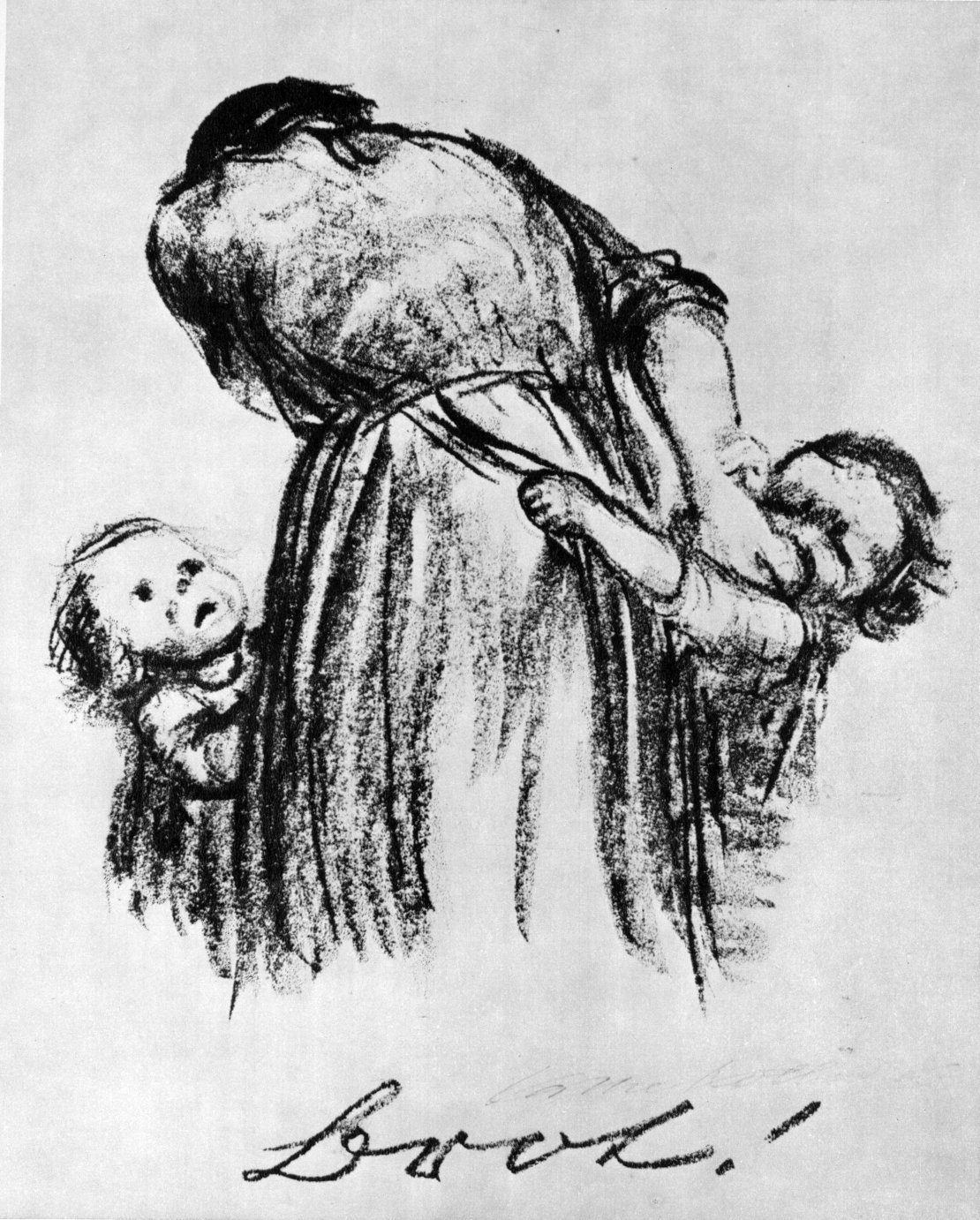
Next stop, and first art museum of the day, was the wonderful Kathe Kollwitz Museum.  Kollwitz is known for her “War Series” of drawings, “The Weavers”, and her anti-war propaganda pieces such as “Brot!”   I have long been a fan of her work, and it was marvelous to see the original pencil and ink drawings that I have only seen as jpegs, as well as some of her woodcuts.  As the wife of a doctor who tended the poor of Berlin, Kollwitz was best placed to see how the government was failing its people in the period between the wars.  She found the means to say something meaningful and accessible at the same time.    Unsurprisingly, her work was banned by the Nazis from their first “art purges” in 1933; they threatened her with deportation to a concentration camp in 1936.  She was not deported, in fact – her international standing kept her safe – but she died just before the end of the war at 77.  Her work is the most moral “degenerate art” I have ever seen.
Next stop on the decadence trail led to Tiergarten’s Bauhaus Archiv.  Alongside expressionist painters and creators of the avant-garde, Bauhaus designers and designs were banned by the Nazis.  Work was scattered across the globe until the creation of the Berlin Archive in 1960.  It is, as you would expect, a clean, white place: well-proportioned, everything just so.  And still the moratorium on big bags.  I don’t know.  I wanted to feel for the plight of the Bauhaus designers, but I suppose they’ve had the last laugh in the end.  The world has fallen in love with their furniture.  We’ve all gone mesh and tubular.  Even the Nazis were inspired by their proportions.  In a contentious posting on Haaretz.com there is a claim that a Bauhaus designer became similarly inspired by the Nazis.  Depraved, indeed!  Even I could not escape the insidious lure of its design.  Reader, I left with my big bag bulging.  And so, on to the day’s third museum, Neue Nationalgalerie, home to more of my favourite “degenerate artists”, particularly Otto Dix and Hannah Hoch, as well as a few I didn’t know.  You can also watch a wonderful film celebrating the full-speed-ahead techno-culture of Berlin circa 1927, “Berlin, Symphony of a Great City” by Walter Ruttmann.  They dance and type and eat, not knowing the end is just around the corner… This might not sound near-degenerate-enough for you, but to read there the lists of the works destroyed by the Nazis is chilling.  It is, of course, not as bad as destroying people.  But it is very, very bad to destroy things simply because you do not like them or do not understand them.

By now, the dark is coming.  I am on Potsdamer Strasse on a Saturday night and the world is my oyster.  Did I run for the nearest fetish bar?  I did not.  (Please, my mother’s reading this blog!)  Instead I hied me to The Wintergarden, Berlin’s home for variety entertainment since 1888.  This may not be the Tingle Tangle Club, but that doesn’t exist anymore and any re-creations will be filled with tourists like me looking vainly for authenticity.  Nein, it will not do.  I decided to see what Germans were seeing – what brought them out for a Saturday night in a tourist-free place.  I found it was The Tiger Lillies, “the world’s foremost Death Oompah band, and their Freak Show.  I myself could never resist the promise of a freak.

The Wintergarden is a joy to visit, crystal chandeliers in the lobby, a goodish size small stage with cabaret seating downstairs and traditional theatre seating up.  There are stars on the ceiling and a mirror ball.  You can order dinner and eat while you watch a large, strange man with demented Kabuki make-up sing about Flipper Boy and how he wants to start fires.  At the interval a lovely girl offers pretzels and Eis when once she would have sold cigarettes from that box around her neck.  Everyone is feeling very jolly.  Every up-tempo song, they clap along.  Every quiet moment, they listen to with the utmost quiet, only the odd punctuation of fork on plate.  During one particularly jaunty song everyone is clapping overtime – until the lyric mentions Hitler.  Now, this is a crowd who didn’t flinch at the song “There’s a Death Train Comin'”, but a throwaway lyric of Hitler brings the clapping to a stop.  It isn’t a stop of protest.  It is simply that they have been taken out of this moment, this dark carnival with the two dwarves who cannot dance and pull small train carriages relentlessly around the stage, and into another, much darker carnival.  They falter, but the show goes on.  By the show’s end everyone is clapping in time, demanding more, lusty on their feet.  They have forgotten it already.  And so it goes.  Here is a picture of The Tiger Lillies tonight, and the moment when the dwarves attacked one of the band, just because they could:
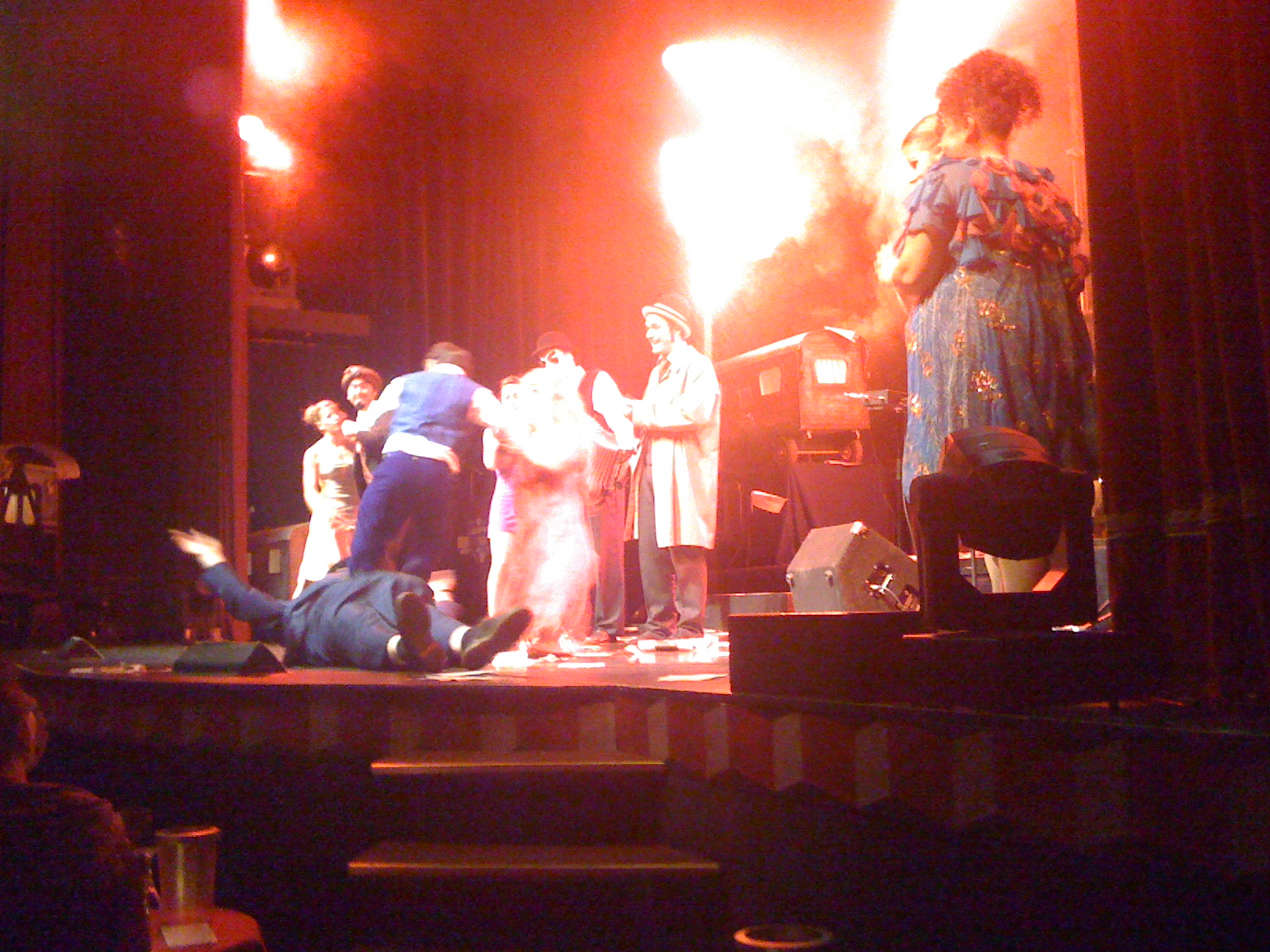
The last time I saw The Tiger Lillies they were doing Shockheaded Peter in London.  That was a long time ago, but I remember the show so well.  I have already forgotten much of Freak Show.  Never mind.  But it did make me think that I haven’t shared my favourite book purchase of the trip so far.  Here, in homage to The Tiger Lillies, it’s Shockheaded Hitler.  

Get comfortable and I’ll read you a little bedtime story:
“Just look at him! There he stands
with his nasty hair and hands.
See!  The horrid blood drops drip
from each dirty finger tip:
And the sloven, I declare,
never once has combed his hair;
Piecrust never could be brittler
than the word of Adolf Hitler.

And if you can find a better rhyme for old Adolf than that, I’ll read you another story from the wonderful Struwwelhitler.  Good night.
A tale of two museums

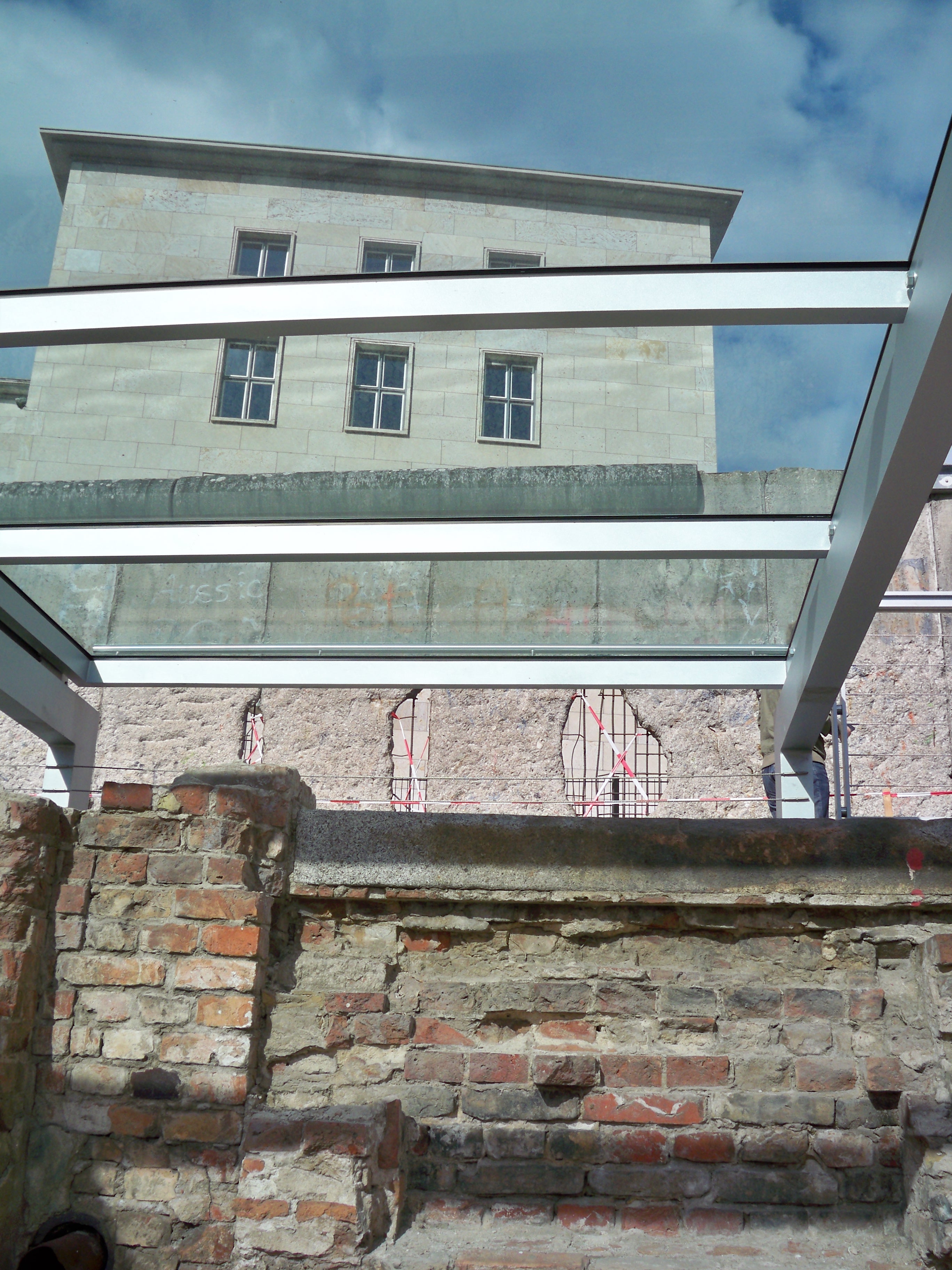
I went to two very different museums today – very different in that they had different content and themes, obviously, but also different in that one was western and modern and ruthlessly contemporary and the other was in an east that had not been updated at all.  Perhaps no one’s told them about that wall.  This is a picture of the outdoor installation of the second museum, The Topography of Terror, which makes it sound a bit of a funfair ride.  I can assure you it is not.

But first up was the State Museum of Childhood and Youth.  The first challenge was to find it.  Having consulted a variety of maps and walking the same two blocks back and forth, I found it.  On the top floor of a block of flats, perhaps?  There was no signage whatsoever.  I did feel like I was breaking and entering, but there didn’t seem much to take.  Then I could hear the shouting of small children.  This might have put another traveller off, but I was promised Nazi and DDR classrooms from a guidebook.  Push on, push on!  At the top of four flights of stairs was a clump of thirty amazingly well-behaved German children, spending their Euros on children’s toys from yesteryear: wooden tops with sticks and strings, coloured feathers.  The prices were not from yesteryear, however – really, one Euro for a coloured feather?  I think the children felt they had to buy something, to be polite.  They were exceedingly polite.  The white-haired woman serving them raised her eyebrows at me, gave a shrug.  Yes, I would wait my turn to enter – this was the children’s museum after all.  I had a half-chat with another woman with carefully drawn on eyebrows who found it odd I should be wearing flip flops.  I suppose it is odd, now that Oktoberfest is beginning below my window.  I didn’t know the German for “feet hurt” and I thought that sharing the big phrase I can remember, “Ich habe grosse kopfschmerzen” wouldn’t leave her any the wiser.  She took my coat and bag.  My bag is simply too big for Germany.  So I stripped down to “museum mode” with essentials: passports, camera, iPhone, notebook, pen.  (Honestly, if I decide to research in the wild, I will be the first to be knocked down and eaten due to excess luggage.)  The white-haired woman was ready for me now; she took my 2 Euros and all my excess baggage, shrugging again and pointing at a locker.  Clearly I did look like I was up to no good.  I kept the notebook stuffed in my pants – I do have my priorities – but I didn’t write anything down after all, nor did I long for my absent camera.  There were 4 rooms with vague artifacts of childhoods from 1900 to 1970-something.  There was not a lot of labeling and what there was defeated my high school German.  It felt like a museum from my own childhood, actually – from anyone’s old childhood spent visiting dubious museums celebrating pencils or the world’s biggest thermometer.  (You can actually visit those sites in California.  I digress.)  I gazed about each of the rooms with the politeness of a German child, then retrieved my belongings.  Eyebrow Lady told me I was quick.  I shrugged.  I left without a feather.

I rocked up to the Topography of Terror (hold on tight!) expecting very little.  Perhaps it is the low-key entries in guidebooks.  Perhaps it is the faintly ridiculous name for an exhibition on the filled-in ruins of SS buildings.  But I was completely unprepared.  The picture above shows the foundations of one such SS building, with the former Reich Aviation Ministry in the distance, now the Federal Ministry of Finance, and a long stretch of the Wall between.  Behind are gravel tracks and small plaques indicating what lies beneath.  People read slowly and carefully.  Inside the Documentation Centre, which leads me to believe it will be a place to collect flyers and have a wee, is an exquisitely detailed exhibition of the history of National Socialism, from Hitler’s Chancellory to the post-war trials.  Several young Germans give tours to dazed visitors, but my ears cannot keep up.  I must be content to read, and read, and read.  Maybe the guidebooks think people won’t come if they know what’s here.  Frankly, I was impressed and overwhelmed by the amount of information on offer: police transcripts, arrest files, newspaper articles, photographs more graphic than I have ever seen – and I’ve seen a lot.  I bought a piece of spinach quiche and couldn’t eat much of it.  When the clerk followed me back into the exhibit to ask if there was something wrong with it, I said no, no, of course not, “zu gross” etc. and then burst into tears as he left.  Warum?  His random kindness and concern, his small pink hearing aids, or the fact that we were having this little exchange before a line of black and white men swinging from hooks?

I thought that the Germans wouldn’t want to talk about the war.  I remember when a young German offender, years ago, asked me why people still cared about “that war – it was so long ago – we have moved on.”  I was prepared for coyness about the Nazi years.  I was struck by the even handling of the facts and figures at the History Museum yesterday, but here is full-throttle, in-yer-face reckoning in this stark stone and glass box.  Not only are Germans looking history in the face, they are staring it down, staring into the dark centre of its eye, refusing to blink.  There is something incredibly moving just in that – that ability, that willingness to look.  Just to look.

Lest you think I’ve gone all serious, I will continue to be as glib about Nazism as I can be.  That’s where my character is, at least until the bitter end.  It’s how they all were, I suppose, until the bitter end, those who had not been taken, of course.  Those who passed their tests.  Here is my favourite photo from the exhibit.  I didn’t take many.  Here is a Nazi couple, catching a few rays.  This is where my character is, for a little while, at least.

Hodge-podge of history

I don’t have an itinerary for Berlin in the way that I don’t really know what reference materials I need.  I expect them to find me in bookshops, to come tumbling off shelves in libraries.  I have vague lists of things I think I should see and have circled and underlined streets on maps, but really, I’m just stumbling along like usual.  So, to have found that today actually encompassed the whole of German and Berlin history is surprisingly organized!

Marienkirche was either having a service or was closed for cleaning – my German is too slight to decipher the sign propping the door open.  The crocodile of children in matching yellow caps surrounding the door, pointing inside, was another deterrent.  The Rathaus, next intended port of call, was closed due to the expansion of the Ubahn.  Clearly, today was not the day for plans.  I followed the lure of a verdigris tower which was, in fact, two (one behind the other, upright as devil horns or Churchill’s fingers).  Nikolaikirche. The Church of St. Nicholas, patron saint of merchants and sailors, is Berlin’s oldest church and exists now only after painstaking reparations since reunification.  Original foundations show ancient footings and brown-boned skeletons from Berlin’s pre-capital days as a trading post.  The church itself was damaged and rebuilt countless times, let alone the “damage” done by the reformation which saw side altars turned into burial chambers and saints removed for memento mori.  Nikolaikirche held its last service in November 1939, celebrating 400 years of Reformation, and put itself into safe keeping for reparations; then the war started.  Bombing in 1944 and 1945 led to destruction and ruin, until finally the spires and roof collapsed.  Nikolaikirche was a shell for decades and its redevelopment, as well as the surrounding Nikolaivierte, is a triumph.  If you should be passing, do go in.  Don’t worry about the workmen winching ancient paintings up on scraping chains or women by barriers who look like they could eat you alive.  Give them 5 euros and go in.

I then flew past a number of museums, but couldn’t seem to settle into them.  I had a lovely piece of cake at the Alte Museum; here is its lovely dome as proof.  I saw the lovely Berliner Dom on the way, but didn’t feel I could do justice to another church so quickly, and certainly not one about to start service with the guard making a gesture of folded hands and bent knees.  I walked by the Neues Museum and intend to return to it, and the Altes, too – they are “must sees” in Berlin, and I take my guidebooks as seriously as the next tourist.  But no.  I could delay a visit to the Deutsches Historisches Museum no longer.  I dutifully bought my entrance sticker and then couldn’t figure out how to get in.  Then I was detained by a guard earning his keep who decided that my handbag was too big to be trusted in such a marvelous new museum.  I thought that whapping him with said bag might write me into history, so I handed it in, camera, iPhone, wallet, pens, notebook stuffed into jeans.  Not a good look.

And so the 2000 year tour of German history begins!  I won’t recount it for you.  You probably already know it.  It is only I who is still catching up.  I will simply tell you some things that I found strange and intriguing.

1. Romans coined the name for the Germanic peoples.  We don’t know what they called themselves because they had no tradition of writing.  Was I not paying attention in World Civilization as a teenager or what?

2. In a painting of Pope Gregory, Christ pops out of a box, both bleeding hands in the air as if to say – Gotcha! – and so prove transubstantiation to a waiting crowd of monks, who watch in astonishment.  One appears to vomit.  Also, I did not know about Christ’s grandmother, Saint Anne.  Was I not paying attention at Arcadia Presbyterian or what?  There is a wooden figurine of Anne holding both the pregnant Mary and the baby Jesus in her lap.  Truly bizarre.

3. 1815 – 1848 is a period of peace.  The culture of the time is named Biedermeier, stressing refinement, self-identity, the life of the family, the education of children. Bourgeois.  The bourgeois will pop up again.  Here is a lovely doll from the Biedermeier period, that I must give to an ancestor of my character:

3. The Ruhr is the essential area for hard coal that will allow German industrialization to develop and finally overtake Britain after 1841.  The Ruhr will pop up again.  I am working on the ancestry of my character, clearly.

4. But who am I kidding?  I’m really here to research Weimar and Nazis.  But really, for an overview of Germany history you could do worse than stumble around the history museum with the flash removed from your camera and a pen and notebook stuffed in your pants.  This and an excellent salad in the cafe’ make for the perfect day.  Here are some other things that astonished me, once I finally reached the rooms I had come for:

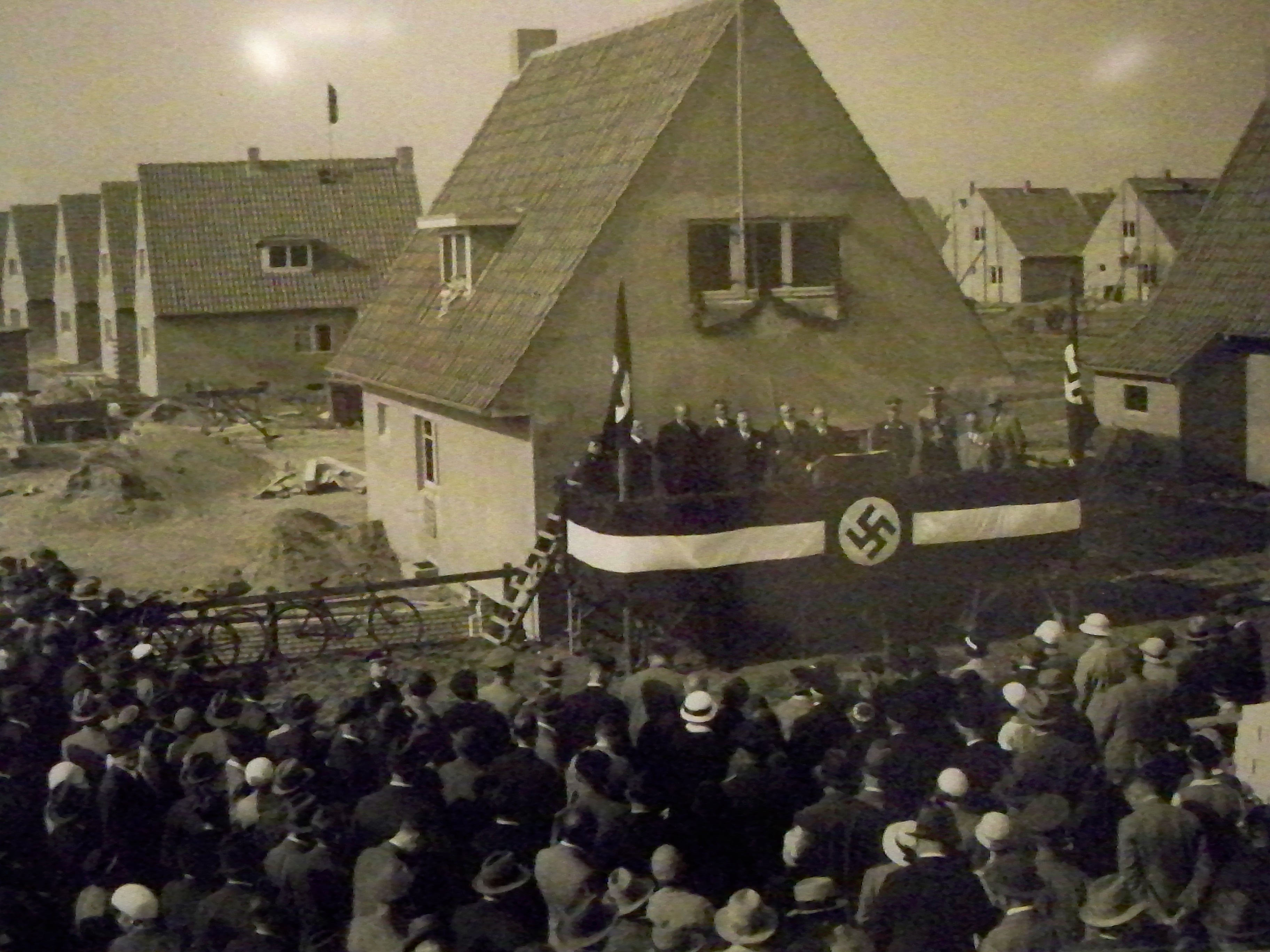
Nazi planned housing, to address the housing shortage that even evacuating Jews couldn’t fix.  You lived in a house based on how many children you had, and they gave you a trial period before it was actually yours.

I love this woman’s face during the election of 1923.  It is very rare to see faces do anything other than be polite.  Even newsreel footage taken of the invasion of Poland sees groups of young men staring into the camera, giving only vague, shy smiles as their world is being pulled up around them.  What are they thinking that they can smile?  Or is that what human faces do on instinct when truly, truly  bewildered?


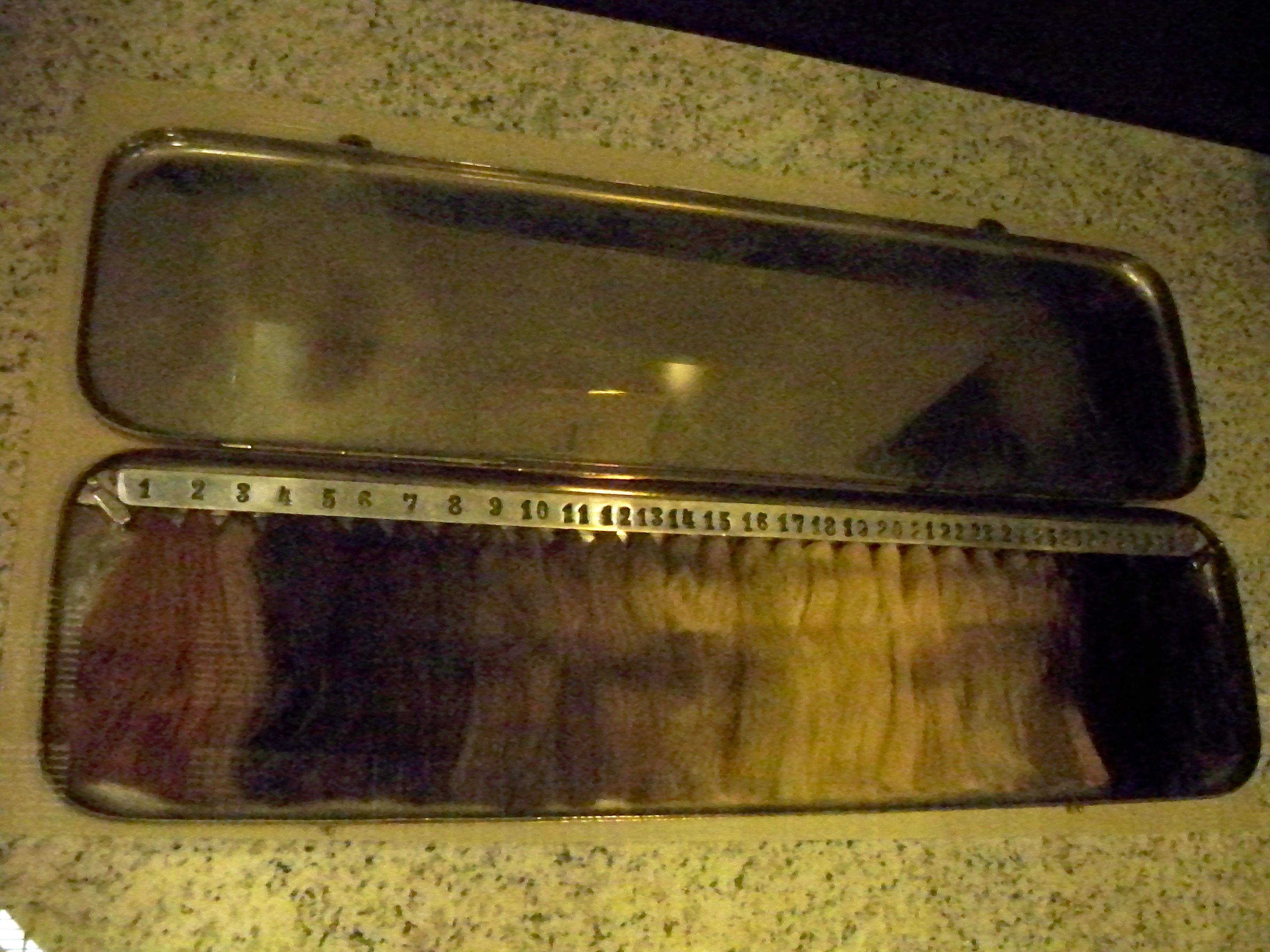
Here is the hair care kit for testing Aryan hair.  There is also a set of calipers nearby, for those other essential measurements.  You read about these things, but to see the tools and the instruction booklets…

I could go on and on, but it’s probably time to go to bed.  I could show you Nazi bedtime stories, propaganda posters, photographs and artifacts – I have a camera full of them – but I will leave you with this Nazi doll house.  You probably cannot see the Hitler Youth wallpaper on the walls.  Dark rooms, lots of glass.  As usual, I didn’t know what I was looking for, but I knew I would know when I found it.  Boy, did I know.

Sleepy in Berlin

The night train leaves Paris Est at 2020.  Already, it is too dark to see much of anything through the cabin-size picture window at the foot of the bed made up for one. And luckily so.  In cabins beside me, women and men are stacked up to the ceilings; I hope and assume they know each other – or will do, come morning.  The toilets are blocked.  It may be a long night.  The Man in Seat 61 recommends the night train and reserving a cabin.  Indeed, it is why I have booked.  I am little-kid excited.  I flit around my coffin-sized room, touching buttons, turning things off and on.  Empty platforms, wildly lit, whiz by.  The tall, bare backsides of houses.  The most constant view is myself reflected in the window, relentlessly chewing small packets of M&S cheese, waiting.  A large-fronted man with a tiny gold hoop earring serves beer and wine from his little kitchen, and he is popular with the travellers; I hear them ask for “a bottle” again and again until it is late.  They are avoiding their cabins, no doubt.  But I am not.

I have a little sink, a little pocket on the wall to hold headphones and iPod, water and warm white wine.  The distances between stations increases, leaving flat, dark terrain and the occasional lights of steeples, war memorials.  You cannot help but think of war – or perhaps that is just me.  We stop and wait at Mannheim at 2:30 am.  I did not think I was asleep but realize, upon awaking, that I was.  But that is the end of sleep.  It is no smooth ride, this.  The train groans on tracks, the folded-up bed above me rattles and threatens to open.  Doors shimmy and shake.  But then, perhaps it is also the anticipation of it, the Christmas-morning-feel of it. When was the last time you went somewhere all on your own, just because you wanted to go?  I spent much of my 20s travelling, going places just because I could.  Then all those jobs start.  My last trip for no good reason was years ago, an overnight train stopping in Portland.  (Is this a theme emerging?)  Travel is for business, for family, for sun.  How lucky am I that travel is also for writing.

Dawn breaks pink in the east, toward Berlin.  We stop in Hamburg, let sleepy-eyed travellers off.  The little kitchen serves teas and coffees, crusty white rolls and cheese paste.  One toilet remains unblocked.  Mist hugs the fields.  Pale cows bend to eat.  Clumps of dark woods, ripe with fairy tales, run along the tracks, trunks thin and twisted as a witch’s finger.  Suddenly the woods and fields give way to suburbs, and we are in Berlin Spandau then Berlin Haupbahnhof, the “largest crossing station of Europe.”  Adolf would have been so proud.  The lockers are big enough to accommodate massive suitcases.  5 euros means I’m free to wander until my room in Alexanderplatz might be ready.  I stagger, stinging eyed, to the Reichstag, the bird cage glass dome peeking out from behind the battle-scarred building.  Crews dismantle a stage from Sunday’s marathon and tourists queue.  I push on for Brandenburger Tor, the verdigris Quadriga, once stolen by Napoleon, facing East again in the spirit of reunification.  To my shame, I go to Starbucks.

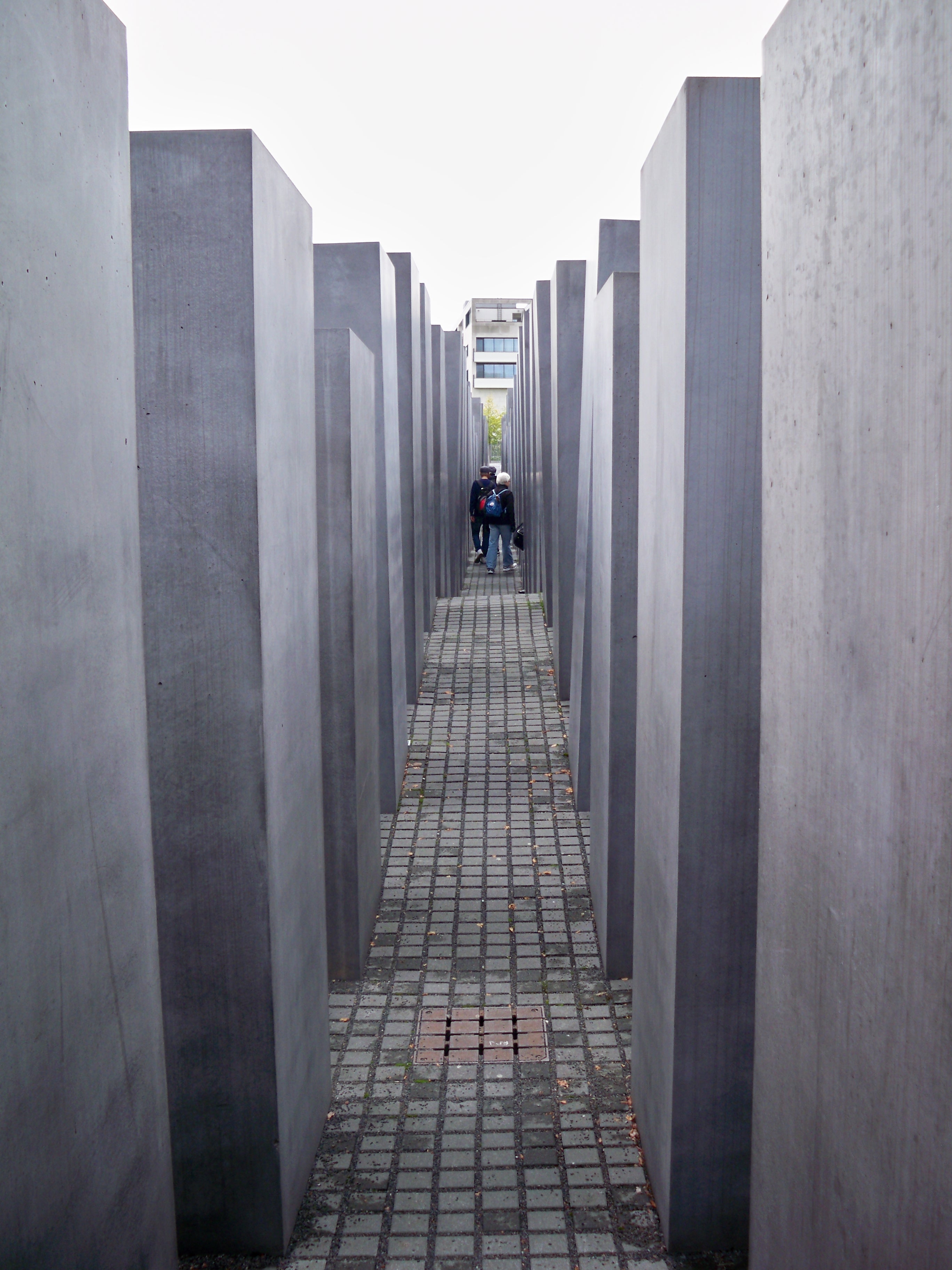
Tea encourages me onward, toward Denkmal fur die ermordeten Juden Europas, “Peter Eisenmann’s field of stelae”, the 2711 undulating concrete blocks that range in size from sarcophagi to slabs to walls.  They pitch and jut across a city block.  It would probably be quite a moving memorial, but I am in the midst of a massive game of hide and seek.  The players seem surprised to keep finding me, when they are giggling and intent on finding each other.  It is probably a good and life-affirming use of the space for bus-bored teens “seeing Europe.”  What good are these references for them?  What use are physical metaphors?

You cannot see how the ground dips and ripples in the photo – it is disconcerting, disorienting.  You cannot see how each concrete pillar has its own level and angle.  You cannot hear how they scream and laugh here.

Potsdamer Platz, remnants of the wall, the brand-spanking new Sony Centre and the Film Museum, with rooms of Marlene Dietrich, Metropolis and Expressionism, Leni and the Nazi films.  Under a broad glass atrium there are preserved portions of The Grand Hotel Esplanade, preserved behind glass.

It is as if a life-sized dollhouse has been tacked onto a hi-tech wonderland.  It is as surreal as anything here, a city that is constantly referencing its history while trying not to let it stand in its way.  I have come in search of this history.  I have no idea what I will see here or how it will matter to my story.  I only know that I am watching and waiting.  As I type this, the sky has turned black.  Bright green neon from a shop next door glows beneath the mighty Fernsehturm that rises its 1207 feet beside me.  I am glad to be in a hotel beside it – I will always be able to navigate my way back.  Now that it is dark I will go to the 37th floor casino and peer out at the night lights of Berlin.  Lucky, lucky me.

Taucher – Jews Underground in Berlin

The Wiener Library is a truly wonderful resource, even if it is in hiding.  I have used the reading room before, and still I could not find it.  Google Maps had me blocks away, the glowing blue dot saying “You are here,” when you can see, very clearly, that you are not.  Or can you?  The library can be found by disregarding the numbering of buildings, mounting stairs to peer at discreet gold plaques, then squinting at the call buttons on the entry phone.  It is hidden in plain sight – a useful metaphor for the nature of historian and author Roger Moorhouse’s talk:  Eye of the Storm – Jews Underground in Hitler’s Berlin, 2 September 2010.

He starts by giving us Berliners’ name for Jews who chose to hide “in plain sight” in Berlin through the war.  Known as die Taucher, the divers, they were also referred to as U-Boats.  11,000 Jews went underground in Berlin during the war years of 1939 – 1945.  1400 survived the war.  There are no maths or statistics to explain odds which meant fewer than 10% would survive capture, hunger, illness or bombs.  Perhaps 50% died due to “betrayal.”  But Moorhouse did suggest some methods to increase the odds.
HOW TO SURVIVE AS A FUGITIVE:
1. Remove your star
2. Destroy your deportation order
3. Learn to live on the run.  Be prepared to lie, cheap and steal.
4. Avoid your past.  Forget your family, forget your friends.  Avoid entire areas of the city, where you may be recognized.  Forget you ever were a Jew.
5. Change your appearance.  Commit visual sleights of hand if you “look Jewish” through hair dye, clothing, stolen uniforms.  Do not allow yourself to appear unkempt, even if you have nowhere to live.  Disarray, even in wartime, will attract attention in Berlin.
6. Find somewhere to live.  Available accommodation can include lofts, basements, trams, parks, houseboats, bordellos.  Find someone who will hide you for money, or for love.  Be open: the tomb of Josef Schwarz in the Jewish Cemetary in Weissensee, which remained open throughout the war, provides a hiding place to sleep in the dome of its mausoleum.
7. Have an accident, injury or illness and get yourself admitted to the Jewish Hospital, which kept patients from being deported through a variety of radical “operations.”
8. You are nothing without paperwork.  Whatever you do, find the right paperwork with the right stamps. Hope for a sympathizer to drop them before you, present yourself as a victim of bombing to receive a “bomb certificate as refugee”.  Search fresh corpses in air raids.

Moorhouse pointed out that the decision to go on the run was contrary to a Berliner’s way of life, a culture which prided itself on belief in the law and civic duty.  That was often the reason given for the “betrayals” that would find Aryan Berliners hiding, and then denouncing, local Jews.  Another risk were die Greifer, “the catchers”, particularly the “Aryan-look Jew” Stella Kubler, known as “the blonde poison”, who betrayed others to keep herself and her parents from deportation.  But Berlin was also a particularly good city in which to go underground.  There was a strong and proud Jewish tradition and Berlin had never naturally been Nazi.  Both the church and the communists provided havens and networks.

There was a lively question and answer session to follow, and a number of attendees who wanted to tell their own stories of hiding and escape.  I felt very young in the room, and I felt every inch a shiksa.  While Moorhouse spoke of the “imagination gap” between what Berliners and Jews felt was happening to deportees and what they would know following 1945, I am trying to fill my own “ignorance gaps” with all that I do not know as well as remember the imagination and information gaps that my characters would surely have.  When dealing with WWII it is nigh impossible not to reference the end.  There are things that you see that you cannot unsee, even as there are things that you learn that no one could know, let alone fathom, in 1933, 1939, or 1943.

Roger Moorhouse’s book is unusual in its coverage of Berlin at War:  Life and Death in Hitler’s Capital 1939 – 1945; it is the first of its kind, says the author, to give a “Berlin eye view” of the war.  In my discovery of the history of Berlin, it is a book I am very much looking forward to reading.  To read The Telegraph’s review of the book, visit their site:

Alexanderplatz

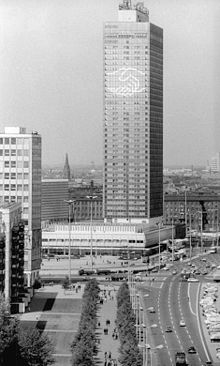
This is the Park Inn Berlin at Alexanderplatz.  This is where I am going to spend a week’s researching, writing, and staring out the window.  Warum?

When you’re planning to do research in a city you don’t know, you have to start somewhere, especially if you’re planning to research a city that has been destroyed by war.  I’m looking for history, here.  So, why have I ended up in a hotel built from 1967 – 1970?  To learn more about this particular building, and its claims for being ” the tallest building and the eleventh tallest structure in Berlin and the 29th tallest building and tallest hotel-only building in Germany” click here:

Alexanderplatz was originally a cattle market outside the city and was named in honour of the visit of Alexander I in 1805.  It was the heart of decadent Berlin, alongside Potsdamer Platz, in the 20s, inspiring Doblin’s novel and Fassbinder’s adaptation, Berlin Alexanderplatz, and a place to board trains.  It was also the site for the notorious police station that features in books and films, such as Hans Fallada’s Alone in Berlin, and served as a Nazi prison during the war.   Now, it features a Burger King and a new department store.  Less glibly, it is also the location of the Alexanderplatz demonstrations in 1989, which spoke out for the democratization of East Berlin and ultimately led to reunification.  Demonstrators wore yellow sashes saying “No violence.”  From cattle market to cabaret, from transport hub to prison, Alexanderplatz sounds like my kind of place.  I travel in 34 days.  But – who’s counting?

The Good Nazi

Sitting beneath a convalescing cat, held fast by his bulk, I was kept still long enough to finish The Kindly Ones.  At last!  What a rich and strange text, one that has divided reviewers since its appearance in France in 2006 and its English translation in 2009.  It will come as no surprise that I googled reviews of the book – if only to decipher the meaning of the book’s last line and title.  The Kindly Ones.  The New York Times Book Review cited its reference to the third play in Aeschylus’ Trilogy, “the kindly ones” being the dreadful Furies turned house-cat by Athenian law.  The book does end with a state of law, but I couldn’t tell you who became domesticated in the process; there is no happy ending here, for anyone.

Even if it is perceived that Dr. Max Aue has “got away with murder”, he is clearly tormented by his own Furies, even when he claims forgetfulness.  The Furies eat their way out of him.  They consume him from within.  There is, ultimately, no redemption for Dr. Aue – and should there be?  Though “The Good Nazi” was given to Albert Speer’s biography, I would have thought this would be a more fitting title.  But, to be fair, titles are not my strong suit.  Check my CV.  But surely, rather than the taming of inner demons through adherence to state law, this book is about how good men can do evil things.  Which leads to the next question, of course.  Is Dr. Aue a good man?  Can you be a good Nazi?

Dr. Aue was certainly an effective Nazi.  He was good at being a Nazi.  Which is not the same thing as being good.  Dr. Aue loves classical music, which serves as shorthand for his culture, his refinement, his class.  But even his love of music abandons him in the end, when he destroys a musician for reminding him of beauty.  So, it is not that he is a good man; in fact, he commits a catalogue of sins.

But by Nazi standards, then, as a good Nazi he also believes himself to be a good man, because he cares more than most.  The last third of the book finds him investigating the camps, from their “hey dey” to their evacuations.  He cares more than most by expressing his concerns about overcrowding, diets, hygiene, hypothermia.  But still, he does nothing.  He is no hero in this tale, but he believes, to the end, that he is redeemed by his own commitment to the Nazi cause, a commitment that only abandons him at the very end.

Aue disdains men who do the work of Nazis without the philosophy.  This is summed up in an encounter with Doll, “a good family man who wanted to feed his children, and who obeyed his government, even though in his innermost being he didn’t entirely agree?  If he had been born in France or America, he’d have been called a pillar of society and a patriot; but he was born in Germany, and so he is a criminal.  Necessity, as the Greeks knew already, is not only a blind goddess, but a cruel one too.”  He explains his belief that man is neither naturally good nor naturally evil, ill-equipped to judge the heart of man.  “Doll killed people or had them killed, so he’s Evil; but within himself, he was a good man to those close to him, indifferent to all others, and, what’s more, one who respected the law.   What more do we ask of the individual in our civilized, democratic cities?”  Aue is aware that law began with God, that Thou Shalt Not Kill is always set aside in times of war, as it is “just to kill the enemy of one’s people.”  “So for a German, to be a good German means to obey the laws and thus the Fuhrer: there can be no other morality since there would be nothing to support it.”  (And Dr. Aue needs a lot of support – staff, privilege, beds, liquor.  All that he wants and needs he is furnished with – but it is never, never enough.)  “What man alone, of his own free will, can come to a decision and say, This is good, that is evil?  How outrageous that would be, and how chaotic too, if everyone dared to act that way: if every man lived according to his private Law.”  Thus, he sets up the argument that no good Nazi can be tried alone.  All of Germany must be tried in total, for all of Germany followed the same law, uniformed or no.

This really is a most fascinating book.  Nearly every third page is folded down for reference.  You could open the book anywhere and start a blog post.  But I return to my initial query, lest my blog run the length of The Kindly Ones.  I want to get under the skin of fascism, to understand how it is made acceptable to a smart individual and a smart culture to so wholeheartedly embrace and enact a very bad idea.  I’m less convinced in the book’s writing than in the book’s ideas; if you are interested in the philosophy and practice of Nazism, I can’t think of a better place to start.

And so, back to the history books.  For I have a trip to Berlin planned, to place my Good Nazi into her own landscape, to see for myself what does -and does not – remain of her world.

The Kindly Ones marches on…

A supervisor on one of my first ever jobs told me I had trouble with transitioning.  That may sound a fair comment, but I need to point out that the workplace was a fast food counter in Disneyland and the supervisor was commenting on my inability to move from pouring sodas to scooping fries with sufficient speed or good humour.  I think, considering I was a teenager, that I was not nearly sulky enough.  However, this woman (who perhaps, even now, is supervising the serving of fat and salt in a theme park near you) and her words are with me.  Was she right?

Do I have trouble transitioning – where my writing is concerned?  How do you make your brain and your heart big enough for two books at once?  I can’t even read more than one book at a time.  Rewrites are stalled, holiday books are read, and so I return to my favourite Nazi, Dr. Max Aue, who shares his war in The Kindly Ones, which I last spoke of here: The next chunk of the book is titled Courante, meaning a baroque running dance that typically follows the Allemandes.

Courante finds Aue on a fast train and transfer from the Eastern Front to Stalingrad.  It is also a much faster chapter, driving Max through a variety of horrors that leaves him mad and hallucinating, as the relationship with his twin sister comes forward and is addressed directly in Sarabande, meaning a baroque suite featuring slow triple crotchets.  The sarabande might not be seen as a passionate music form, sayeth Wikipedia, but there is passion-aplenty once Aue is removed, convalescing, to Berlin.  (Spoiler alert)  The hallucinations of the siege in Stalingrad are revealed to be a near-death experience  – and thank goodness for that, I say, as the hallucinations were even getting to me!

Aue happily shows off his head wound throughout Sarabande, but what of his heart-wound?  Only the arrival of his twin reveals the extent of this damage, but she is unwilling – or unable – to do anything about it.  She has married and moved on; she has left him stuck in their shared childhood, emotionally infantile.  This explains some of the more bizarre fetishes and interests that Dr. Aue exhibits, but really, so far, so Nazi.  Meanwhile, cracks are beginning to show in the usually impeccable Max, whose Weltschmerz finds him threatening to shoot party guests in a hotel for daring to celebrate while, “the whole world was twisted in pain, and people should not be having fun, not right away in any case, they should wait a little while, a decent amount of time should go by.”  It is this rationale, of course, that makes the character fascinating.  We read about perpetrators of evil to learn how they justify their own actions, how they explain their decisions to make them acceptable.  We all do that, don’t we, evil or not?  It is the “not right away in any case,” that makes the statement so spooky – the appearance, the seemliness, is more important than the belief.

There is a particularly fascinating passage on whether Nazism arose from Zionism; the crafty Dr. Mandelbrod tells Aue that “the very term National Socialism was coined by a Jew… what’s more volkisch than Zionism?  Like us, they realized there there can be no Volk or Blut without Boden, without land, and so the Jews must be brought back to the land, Eretz Israel, purified of any other race.  Of course, those are ancient Jewish ideas.  The Jews were the first genuine National Socialists… ever since Moses gave them a Law to separate them forever from the other peoples.  All our great ideas come from the Jews, and we must have the lucidity to recognize it…the notion of the Chosen People, the concept of the purity of blood.”  Dr. Aue is more interested in the laws that will have to be rewritten following war, but his natural curiosity in the “Jewish Question,” as well as an inability to get a posting that he likes, finds him in a job where he must survey a number of death camps, as the book rolls into Meneut.  He believes it is his job to make them more “efficient”, which means to Max that fewer “workers” die unnecessarily.  It is hard to know if Max is being coy or ignorant at this point; he is kept in the dark by most of his superiors, including the mysterious Dr. Mandelbrot.  But that is also the point about the Nazis  – they all said, and perhaps believed, that they didn’t know anything.  That nobody joined up the dots.

Meanwhile, the hallucination/head traumas continue, and Aue spots a prayer shawl around the shoulders of Hitler, a tefillin on his forehead, the little tallith beneath his jacket.  Is this his “pineal eye” in overdrive?  Only time – and reading – will tell.

On not writing

I have not written a post in ages.  Ages!  What can I say? It is due to the finishing of many things.

I say finishing.  It is, of course, only a furlough.  The furlough, being, a bit of a holiday from obligation.  A week of sloth and sun, reading the juicy books that feel too long for home: Byatt’s The Children’s Book, Faber’s The Crimson Petal and the White, Mantel’s Wolf Hall, now at the beginning of Kingsolver’s The Lacuna.  Rich, epic journeys all, and my holiday was/is much the richer for them.  But Monday will find me back at my desk, back at the research and the writing.

The editing and rewriting of the first novel that I hope are done are not, of course, really done and the “work” I had and finished will begin again, then increase in earnest when the schools reopen.  There are autumn events to plan, a schedule to make for the rest of this year, the beginning of next.

There is a hope that I can go back to where I left the second novel, when the rewriting took over, and find something there…but I probably will simply begin again.  I probably will have to. I imagine I will read what I have left and think – no, that’s not it at all.  The first scratchings away at character and voice are so tentative – like parting clouds, like shaping mist.  What will I find when I read what I left?

But that’s for Monday.  Today it is raining in Liverpool. There is a book to be read, there are catch-ups of Masterchef to be watched.  It is still a holiday, even as “real life” reminds you it is waiting for you…

Little darlings

I think it’s a strange phrase, that, that you should kill your darlings in your writing.  Maybe I don’t know darling when I see it – I wouldn’t know what to slaughter first.  When I’m editing, I’m just trying to hone the story, trying to chip away at the other roads I might have taken, roads whose destination signs have been left as small hooked snags, unresolved meanderings, or descriptions that have no purpose whatsoever.  And then there is, simply, the pursuit of elegance…

But there is not enough time for this editing.  I am working with other people’s darlings, namely their children.  As is the way, nearing the end of term there are not enough days to fill with all of the workshops that want doing.  I finished a large poetry and science project yesterday, that featured some splendid site-specific installations and POV writing for insects, and am off today to continue the crafting of an alien invasion in Sittingbourne.  Future workshops over the next two weeks will feature a film with 200 Year 9s on the 3 Ages of Ramsgate, with some lovely poems about journeys to the famous bathing town from the points of view of Georgians, Victorians, and modern-day students, as well as days spent creating new games with business studies students and how to produce a festival with grammar school girls.  On the last day of term, the aliens will arrive and be sent, all things being well, back into space and I will contemplate a lie down and a stack of books, secure that we may live to eat a few more days.

So, that is not an excuse for shoddy workmanship.  The first book has been redrafted and I am playing hide and seek with typos and wrong words that don’t “tool” as typos, and have been sending first pages out.  Terrifically exciting.  Meanwhile, this book – the book for this blog – languishes.  It’s time will come, but not soon enough for me.