Setting your share

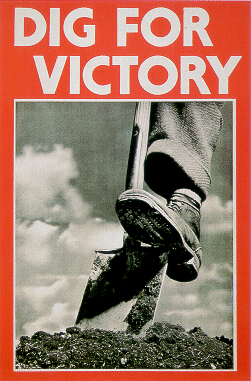
When you set your share, you change the depth of the cutter on the moldboard of your plough, to cut more deeply into the soil.  It is also an old title for my first novel, which I am rewriting.

I am still rewriting.  I am 10K from the end, but I am still rewriting.  How is it possible that I am still rewriting this novel?  You might well ask.  Last week I wrote past a big hinge in the book, one of those pacy climaxy scenes where much is revealed and resolved and the plot swivels round to run in a different direction, pellmell toward the end.  Well, that’s the plan, anyway.

So why, this morning, have I gone backward into two short scenes before these big climaxy scenes that I’m happy with?  In looking at them, I realized I needed to set my share lower.  I needed to dig deeper.  I had set some situations up and then, somehow, let my character off the hook.  No pleasure can come from that.  This forever going backward does nothing for my word count, but it does mean that I am digging as deeply as I can into this story and these characters.  I am ripping into the situations I have set up and laying them open, as bare as I can.  I am preparing the soil, I suppose, for the end of the book, of what I hope will grow for the characters, for their lives when I stop writing.

Or is this all just a tactic to delay my finishing?  Am I so in love with these characters and their strange world that I cannot – gulp – let go of them?  I have heard it said that you are not finished with a book until you are sick to death at the sight and thought of it.  I cannot imagine feeling that, ever, so that must mean I’m nowhere near done.  Still, I’m on track to finish my rewrite in 2 weeks time and hand it back to a couple of lovely readers.  Check back and see if I’m on track, won’t you?

What I’m learning about rewrites

I am 65K into my rewrite.  I woke up this morning, thinking about what I am learning about myself and my writing as I rewrite.

1.  Why am I rewriting this?  Knowing the purpose of the rewrite helps me to focus on what it is that I am trying to fix, so as not to make fresh muddles.  Every rewrite you are just trying to make it “better”, of course, whatever better is.  Better, faster, funnier, whatever.  I mean, know what you are trying to improve. You’re not polishing or editing, after all, you’re rewriting.   My first rewrite was mostly working on point of view, who was telling the story, how many characters and when; I was working on how the backstory would be revealed and worked through in the present tense story, because I wanted everyone to feel somehow haunted, but I didn’t want big monologues of memories.  My second big rewrite was specifically looking at narrative arc, at how the story was structured and delivered, so that it was a better read.  Both rewrites created very different feeling books, so it’s also probably helpful to know what it is you are trying to write as well, so you don’t lose track of yourself.  This rewrite?  I am going deeper into characters, reordering and sorting story elements, and cutting a lot of back story scenes, so that I have more “room” in the present tense story, and more ghosts that you can feel than scenes that you can read, if that makes sense.  I’m reminding myself what my themes are and trying to tell a better story. That’s all.

2.  Give it time.  Leaving a big gap between rewrites helps you see what you’ve got.  Nothing novel in that.  But going away and writing something else in the gap – in my case, the first draft of a new piece, helps you shift your obsessions.  With something new and different in your head, you really can see what you wrote when you get back to it, because you’re somehow a little less invested in it.  You’ve already started the process of letting it go and leaving it alone.  I don’t know if you can ever see it “with fresh eyes”, but perhaps you can see what it was that you meant to write before you did all that writing, and you can see the gap between them.  Whether you want to tackle that disparity in the rewrite or not is up to you.  Maybe you carry that old obsession of what it was you were trying to write into the next novel, and you let this novel be what it is.

3.  What am I rewriting?  In other words, how do drafts evolve from first drafts?  Perhaps the real question is – what kinds of first drafts do we write?  Do you write big soggy drafts that will need to be cut and shaped and made sense of?  That’s what I thought all first drafts were supposed to be like.  But my first drafts (all two of them, so far) tend to be an account of what characters do and say.  The draft puzzles out why they’re doing it, who they are, and what they will do next.  I’m sure this comes from being a playwright, but I just want to get characters in a room and talking, so that I can see who they are and what they want and what they’ll do to get it.  I have a broad stroke of structure and what I think will happen, so that they can actually get into other rooms, but it’s only broad.  I have rough character plans and lists, but they aren’t hard and fast.  Any new character could walk in at any time and take over.  In any draft, anything is possible, but with a big white page and no fixed map or floor plan, anything might happen at any moment.  And that is thrilling, even if you write yourself off a cliff.  Go down the cliff.  See what happens.  In later rewrites, I impose myself more on the story, I suppose.  I try to go deeper into the story and the themes and what I’m trying to leave a reader with in the reading.  I’m trying to ask the story and the characters essential questions, and pushing the what-ifs and the consequences further than the characters themselves might like, if they were solely in charge.  There is no right or wrong about it – it’s just a process.  But if you know what your process is, it might stop you panicking and reaching for a how-to book.

4.  I can’t read.  Oh, I can read blogs and blather.  Books, I can only pick up and start, toss down again.  They aren’t what I’m looking for.  What I’m looking for is what I’m writing, of course, and while you can’t physically rewrite all day every day, your mind can.  And will.  If you could find something to read that would reinforce the jangle in your head and keep you in the feeling of what you are rewriting, that would be a comfort, I would imagine.

5.  Every time you rewrite something, you have changed.  You are changed by the writing and the rewriting, of course, but you are also changed, in and of yourself, especially if there is life happening in these gaps between rewrites.  You bring that changed self to the rewriting.  It’s up to you whether or not you let those changes into your writing or if you try to keep the “feel” of it as it was when you started, or something somewhere in between.

6.  You probably can rewrite something too many times.  But as I am rewriting my first novel, I have had a huge journey to make on it.  The learning on a first novel is huge.  You can read all the how-to books they can throw at you, but ultimately you are learning how YOU write a novel.  There’s nobody else in the room with you. I think you have to rewrite something until you know that it is the best way that you have of telling that story through those characters.  If you keep looking at it and thinking – no, that’s not quite it – then it isn’t.

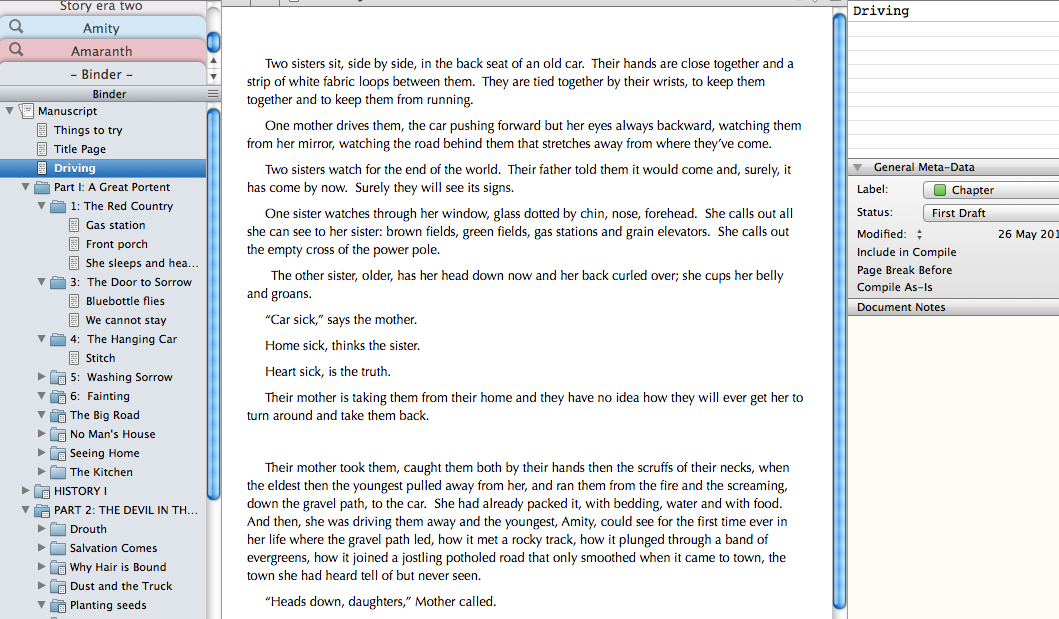
7.  Scrivener is amazing.  I wrote my first novel before I knew about Scrivener.  I wrote my second novel straight onto Scrivener, and I know that in the rewrite I will be grateful for it.  It’s a brilliant tool for organising raggedy bits of text and not losing anything.  It makes the moving around of scenes – which I do quite a bit – so easy.  In Word, you have to cut and paste, and, invariably, you will cut twice and paste once and lose something and not know you’ve lost it.  Scrivener makes that impossible.  Everything you throw away is sitting in there in a little trash folder, ready to be pulled out and used.  And things that you write that you don’t know what to do with can go into an “unplaced scenes” folder, which was David Hewson’s marvellous idea.  You can download his Scrivener template from his site, as well as buy an e-book download to learn more about how he uses Scrivener.  We Mac folk used to be all smug about Scrivener, but there’s a version for Windows now, too.

8.  There are no short cuts.  If I wanted to work on my first novel in Scrivener, I was going to have to type it in.  88K of typing.  There was nothing to do but do it.  I knew that if I just imported the whole thing and spent all my time cutting and pasting and ordering, I would, eventually, stop seeing what I was working on.  The typing of it, each word again from scratch, means that no sentence is escaping me.  We all have bits that we glaze over, we say, ooh that’s fine, but at some point we do stop reading it.  Typing it again makes you look at everything.  And it means that, now that it’s in Scrivener, I can move all my backstory and present tense chapters around with great ease.  I feel like this is the first draft of the book that I can really SEE, if you see what I mean, and that’s all due to how it’s laid out in Scrivener.  Sales pitch over.

9.  You can rewrite a play in a day, but not a novel.  Darn it.  You really can rewrite a whole play in a day – a long day – but it can be done.  And I thought, well, I’ll never be able to hold a whole novel in my head like I can hold a play, and turn it around and look at it and rethink it.  But the more time you spend on a book, the more you can hold it up and turn it around and see it, to tease out its possibilities, to look at its themes and metaphors and see what it was that you were trying to do with it in the first place.  You might not be able to rewrite it all at once, but you can rewrite with the whole of the book in your head so that you are working on the ending and the beginning and all the beats of the novel at the same time.

10.  I’m not good company.  Sorry about that.  I’m not much interested or interesting.  I’m listening, but I’m really somewhere else.  I’m in the back of my head, turning things over, digging things up, and moving things around.  But, no worries.  I’ll be done soon.

10 Things I Love

Well, this isn’t the kind of thing I blog about at all.  But when @52Betty challenged me, I felt compelled to answer with my list.  Here is her list, so that you can check that I didn’t just copy hers.

1. Red Vine Licorice.  It must be Red Vine; Twizzlers will not do. Red Vine Licorice isn’t even really licorice, in that there is no licorice flavour to it at all.  It comes in a trim cardboard box, wrapped in cellophane.  It tastes of sugar and wax and my childhood.  It is the first thing I buy when I land in Los Angeles and it is often the last thing I buy at LAX when I leave.

2. Chipotle peppers.  Smoke-dried jalapeno peppers.  When I open my last bag, procured from some Mexican grocery store, I begin to worry.  They can be crumbled into food or soaked and chopped.  They can be put in a blender with olive oil to make a lovely, smoky, chile paste.  They are essential for enchiladas.

3. White sweet peas.  Every year I put them in too late and every year I am disappointed when I get no blooms.  But this year, I am feeling smug.  This year I found two flats of them on-sale at a garden centre, about to be dumped for being “past their sell-by date”.  Since when did plants have those?  I put them in on time and I am rewarded, even as I type, with twenty-seven flowers.  I feel invincible.

4.  Old maps.  Who can resist them?  I came back from Berlin with a suitcase full.  I love how names change, roads move, empty spaces fill up with people and buildings, then empty again.  I do not love Google maps, however.

5.  Sun salutations.  I should do more of them.  They stretch everything in you, in turns and all at once.  They start slowly and mindfully, with stillness, and lead you to downward facing dog, which is a name that anyone could love.  I currently have a sprained rotator cuff, and it finds downward facing dog rather a challenge.  But soon, I will be back to it, saluting the sun with reckless abandon.

6.  Louise Erdrich.  Bookseller, poet, artist, German-Chippewa novelist.  I don’t keep fiction in the Blue House, but I do keep Louise Erdrich there, sandwiched in and around the research books of the American west and the fundamentalist Mormons.  Her books are what I turn to when I require comfort, on a tough day’s write.  Her books are filled with people who love one another but do not understand one another.  Her stories are filled with grace, humour, compassion, as well as ghosts and history and tiny bits of magic. I couldn’t possibly single one out, but start with Antelope Wife, if you don’t know her yet.

7.  Sleeper trains.  When I was little, we took sleeper trains to Albuquerque.  I don’t remember much about them, but they must have seeped into me, because I adore them.  I never sleep well on them, but sleeper trains aren’t designed for sleeping.  They are designed to help you transition from place to place, slowly, moving between states of mind.  I would much rather arrive somewhere new by sleeper train, dazed and scratchy-eyed, having prepared myself for it through many hours of darkness in a gently rocking room.  On Amtrak, lovely men unhook and make your bed up for you while you sit in the dining car, rolling your way toward Portland or Sandpoint, Idaho.  When planning my trip to Berlin, I knew I should have to arrive by sleeper train.  The Man in Seat 61 made it possible.

8.  Fleetwood Mac.  I love the feel and the sound of them.  I never tire of Second Hand News or The Chain.  I love their tragic love stories, how they played them out through their soft rock, their bohemian costumery.  I love everything about them except for Tusk.  No Tusk, thank you.

9.  Summerdown Peppermint Tea.  I didn’t know that the English were historically famous mint producers, and Summerdown assures me that they still are.  Black Mitcham peppermint tea is farmed in Hampshire and brewed daily, here in my kitchen.

10.  Turquoise.  Really, I could have had a lot of Number 10s.  What of clogs?  What of folk music?  What of Morris dancers, stopping traffic, stomping down high streets with their painted faces and trailing ribbons?  Arbitrarily, I plump for turquoise.  I wear a lot of turquoise, handed down by grandmothers.  I am often told in airports that it is good luck for travel and that it protects the throat chakra.  I like its weight and solidity, its age, its pits and pockets.  Here’s me with my favourite stone.

Thank you for giving me time to think about things and love, Betty.  If you want to share the things you love, why not add them here?  Or add them to your own blog?  Or tell Betty – she’d like to know, too, I’m sure she would.

Back up

Back up has a lot of connotations for a writer.  I might mean – back up your work!  And it’s certainly good advice.  Scrivener automatically saves and backs up to Dropbox every time I close it, so I don’t even have to remember to take this advice.  But if you don’t have a back up system, do get one.

It could mean – back up from the screen.  You’re sitting too close and you’re all hunched over.  This is probably good advice, too, but I don’t take it.  I really only push back from the computer to stumble to the dictionary or the kettle.  I do try to sit up straight and I don’t have carpal tunnel syndrome yet, which must surely mean something.  It could mean – back up and start over, which I’m currently doing, writing what I hope will be the final draft of my first novel.  So I am backing up now, going back and back, over and over.  But what I really mean today, and how I started this morning, was to back up from my characters, back up and look over the top of my story.

For beginning fiction writers (and as a recovering playwright I still include myself in this category) the thorny issue of point of view must be grasped.  In drama, every character is equal.  It could be anyone’s play, anyone’s story, at any time.  At any moment, a character can charge downstage and say something so remarkable and so personal that the play spins on its axis and moves off in an entirely new direction.  This can happen in fiction as well, of course, but someone will only say that your point of view is inconsistent.  And that’s after you’ve made the initial decisions in the first place:  whose book is it?  do they speak first person from “I” or third person from “she”?  Is there a narrator who is also a character or not and how much do they know?

As I was figuring out the structure of my first novel, I tried every tense and point of view going, every draft.  I learned a lot.  I learned I’m much more comfortable writing third person looking through a character’s eyes, in present tense.  Not everyone’s cup of tea, but it is mine, and writing this way helps me stay out of my own way so that I can just get the words down, just tell the story.  First person makes me feel like I’m writing monologues, and a narrator felt too – I don’t know – omniscient.  I kept thinking, who is that person talking if they aren’t a character?  Who is that and how do they know so much and why is she just talking to the reader – does she know the reader is there?  Was it as basic as asking if a play has a fourth wall or not?  Are they aware of the audience or not?  Does a book tell its own story, over and over if no one is reading it?  And then I felt I had to understand who individual characters were talking to when they were in scenes or chapters.  Were they aware of the reader so that the reader became a character for them, either in their story or in a sense of needing to explain or justify or apologise to them?  And this was problematic because the intent changes what they say and how they say it, as in drama.  In a book, I suddenly realised, it makes every character slightly unreliable.  As Laurence Olivier might say, “Perhaps you should just try writing, dear.”

I knew my characters had a stranglehold over me, in terms of what they were doing and saying.  By writing and looking through their eyes, they were each constantly justifying themselves.  It was very hard to get any information that was “clean.”  By backing up from them and allowing myself to sometimes use a third person voice that was not looking through them, but rather looking at them, I feel I have found a way to see them better and show them better, and allow the reader to make up her own mind about what the truth of the story is and who’s “the good guy.”

That’s today’s revelation anyway.  I’m quite looking forward to writing tomorrow, actually.

Going back to the start

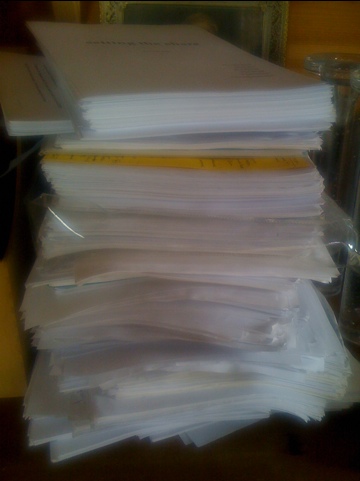
20110516-174832.jpg

Having finished the first draft of the second novel, I now return to the last draft of the first. Having felled copious trees and emptied two ink cartridges, I add the latest draft to the pile of drafts I have written, to be read tomorrow and pulled apart, rewritten and reassembled. When I’m finished reading and finish rewriting, no doubt I will ask myself the same question I asked last post. Am I done yet?

The answer will still be no.  There will still be drafts and rewrites ahead of me, drafts that come from the comments of readers or editors.  There will still be many drafts ahead.  But the thing of it is, I know I’m getting closer to seeing the story I mean to write.  It is clear now, even if my photo is blurry.  I can picture any moment in the book like a still or moving image.  I can move forward or backward from that moment.  I can change perspective, change point of view.  The story itself and the characters who live in it are as clear to me and dear to me as flesh.  And after the wading through a first draft of a new project, that surety is a comfort.  It is like sitting down with an old friend after a long absence.  An old friend who you can see more clearly, perhaps, after spending time with new people.  You can see, perhaps, how you both have changed.  It is somehow, a little like going home.

When done means done

A few moments ago I typed what is the last sentence in the first draft of my second novel.  That tipped me over the 128k mark.  Does that mean I’m done?  No.

Finishing the first draft of the first novel, a couple years ago, was an overwhelming feeling.  I couldn’t wait to print the sucker out.  In fact, I did print it out and carried the wad of paper around with me, just to feel the weight of it.  I’m sure I caused amusement at the first writing workshop I did immediately afterward, slapping its bulk onto tables just to prove I finished it.  And – don’t get me wrong.  Finishing feels great.  But maybe it’s just that I know how unfinished finished really is.

I had no idea how much my first novel would change with every reader’s report and every rewrite.  Points of view changed.  Tenses changed and changed again.  Whole characters were created or deleted.  I didn’t want to believe it, but the first draft was just a floor plan.  It was a map of what the story was and how the characters would be changed by the story and the choices they made throughout it.  It was the story in its rawest form, sure, but it wasn’t writing yet.  It wasn’t good writing, at any rate.  It was only the ghost of the novel I would end up with – a novel I am about to rewrite again, now that I’ve finished this second one.

So, finishing the first draft of this second novel feels epic on the one hand.  Blimey, those are a lot of words in a relatively short time for a recovering playwright.  So many of them will simply have to go.  Realistically, all of them will go and be replaced by better words that more accurately tells the story that I’ve just laid down.  Like Arthur Murray’s footprints, I know where I’m going and I know where to put my feet.  But is that dancing?  Probably not.  The fancy footwork and the flourishes belong to later drafts, now that I have found the dance floor and put my shoes on the right feet.

I’ve left a few holes in the narrative.  Some places are just bullets or questions, places where I could feel the story changing but I knew I had to keep trudging forward.  If I looked backward, I might never be able to turn myself around again.  And a lot of the writing is just telling the story.  Not telling in an opposed-to-showing way, because I not a very “telly” kind of writer, but I mean just showing what happens, like when you tell someone a story in a bar, if you do such things, this happened then this happened, and not knowing myself how moments would lead to moments and how characters would reveal themselves through what they said and did.  Having finished this draft, at least I know what and who I’m dealing with.

So – hurrah!  Yippee!  Woot woot!  But tomorrow, it’s another sit down, to have a look at the holes and see what needs plugging now.  To tidy up my Scrivener files.  See what I can throw away.  And then I put the whole thing away for a while and turn back to the first novel, the one that is screaming out for work, the one that knows what it is now and is just waiting for me to make it so.  And after the first draft of the second novel has composted a bit and, hopefully, I’ve forgotten about it for a while, it will be time to crank up the printer and carry around another few reams of paper.  Sorry, trees!

Thingspiele

Today I am starting a new phase of research, as my novel moves from the Isle of Man and back to Germany.  My knowledge is having to move on as well from where I left it, in 1939.  Now, it is 1944.  There has been a lot of water under a lot of damaged bridges while I’ve been beavering away, writing about kippers and barbed wire.

My character is currently on a repatriation ship, the SS Drottningholm, which worked throughout the war trying very hard to get people where they wanted to be or where they would have been, were it not for war.  When female internees left the Isle of Man in 1944, they sailed to Gothenberg and then to the Isle of Rugen, northernmost point of Germany.  The island is a very popular beach destination with Germans and has been throughout its history; it is also where Nazis of the future were meant to have their “paid vacations”.  The two-and-a-half-mile long resort now rots in Prora.  It was unfinished, due to the war, and even the Russians couldn’t make a dent in all the concrete.  Nazi architecture, unlike their politics, were designed to last.  You can see some wonderfully evocative photos on Martin van den Bogaerdt’s Panoramio site:

I am interested in architecture and how buildings are destroyed by war, but also in how the uses of buildings change as a consequence of war or party politics.  I have written before about Nazi pageantry, but I was interested today to find references to Thingplatze, newly-built outdoor amphitheatres designed to simulate/recreate ancient Nordic pagan gatherings called Things.  This project was the brainchild of Nazi propaganda minister Joseph Goebbels, but Hitler wasn’t a huge fan of it.  That is probably why only 40 were built out of the 1200 planned.  There is one such Thingplatz on the Isle of Rugen, at the capital, Bergen, according to the marvelous Third Reich Ruins site.  (The photo comes from their site, too.)  It was used primarily by Hitler Youth groups and still exists.  There is also one in Berlin, where my character is ultimately headed.  I have seen it before, of course, as it was used as an amphitheatre during the 1936 Olympics.  The Dietrich-Eckart-Buhne is now called the Waldbuhne and is used primarily for rock concerts, which might be yet another attempt to simulate and recreate an ancient pagan gathering.  Unless they’re showing David Hassellhof.

One mustn’t be a slave to research, and really, you can’t cram in everything you stumble across unless you’re aiming at a travel guide.  And I never know what I am looking for until it shouts at me, makes me see it.  Somewhere in these ruins, these creations, these pageants is the palpable, beating soul of a people who both intrigue and horrify me.  I am trying to look right at them, to see what I can see.

Winning ways with vegetables

My neighbour is a keen gardener.  I watch him through the windows of the Blue House when I come out first thing in the morning to write.  I watch him pass again, after work, inspecting the vegetables of his labour.  When it’s dark and my blinds are down, I hear him sometimes, pacing the path in his oversized wooden clogs, slug hunting.

As I’m writing about World War 2, my characters should be keen gardeners, too.  The Isle of Man didn’t turn into allotment-world like London seems to, when even the moat of the Tower of London was filled in, but the elders and internees do remember their constant searches for greens and their longings for fruit.

Today, I am reading “Bombers & Mash” by Raynes Minns, which has a big chapter on the pains taken by the Ministry of Food, who brought the war into the kitchen.  The book has brilliant tips for turning one pound of butter into two by stirring boiled milk into creamed butter and how to make cakes without eggs.  I read today about a woman who was fined ten pounds for throwing bread to the birds in the garden – a wasteful act of treachery.  I learned about two brilliant egg substitutes, besides Bird’s Egg Substitute Powder.  One asks us to cook tinned apricots in bacon fat and serve, “as egg-like as possible” on toast.  The other says that tomato halves can be cooked in bacon fat, cut side down, and served, whereupon it will “resemble the yoke” of an egg.  Tough times, those for vegetarians.  I could go on about the benefits of swede and how, when it is grated into seedless jam, becomes a treat that any child might enjoy.  I could offer recipes for “snoek piquante”, thrushes in paper, or sparrow pie, which “is not encouraged by the Ministry”, but I will, instead, offer up a recipe for Parsnip Wine, as one of my internees is usually thinking more about how to get a drink than an egg-less cake:

PARSNIP WINE:  To each gallon of water take 3lb parsnips cut into 1/2″ pieces, 2 lemons and 1 orange, both cut small.  (How they got those lemons and that orange is anyone’s guess)  Boil until the parnips are soft, then strain and pour over 3lb. white sugar.  (3 pounds of sugar? You could only get 2lb on the ration!) Stir until dissolved and bottle while warm, adding to each bottle a small piece of German yeast, about the size of a marble.  (Hang on a minute – German yeast?  In war time?  When in my own country we renamed cooked potatoes and called them Freedom Fries?)  Keep the bottle full while fermenting; after fermentation has ceased, cork and wire.  “This is an excellent imitation,” says Bombers & Mash, “of champagne.”  Cheers, then!  Or as my internees would say, Prost!

Distractions

With a title like that, one would expect a post to follow that complained of all the distractions of the world, conspiring to pry our curled fingers off the keyboard, wrench us from our work.  But this is not that post.  For not all distractions are bad ones.

I am currently on a coaching training course.  I am learning techniques which might enable me to offer coaching to writers in the future, or to add coaching techniques to the professional development I already deliver.  Either way, it is giving me time to focus on where my head is as a writer and to be reminded of how writers share universal concerns and questions.  Our thoughts and feelings happen, unsurprisingly, in shared metaphors.  I may blog about this training once I’ve completed it, but I will just say, for right now, that is a welcome and nourishing distraction.

There are also welcome distractions in writing.  I was distracted away from my novel while on holiday in January and I wrote a short story.  I submitted it to a contest via email and thought nothing of it.  When I heard back about the story, I was dead chuffed.  Here is where it will soon appear on paper, and where you can read it electronically, if you have a moment.  But only if you do have a moment.  Don’t let me be your distraction.

Writing backwards

Sometimes the writing goes so slowly, you might as well be writing backwards.  The word count goes mysteriously down, rather than up, even though you are trying to write forwards, you are going through the motions of it.  You feel sleepy at your desk.  You feel suddenly that whatever it was that you and your story had, it has been lost somewhere.  You know that something is – wrong.  Now, there are 2 responses to such a predicament.

Option 1 is to panic.  Balk, fret, run and hide.  Be convinced of your own failure.  Know suddenly, in your bones, that the fragile craft into which you loaded all your hopes and words is no longer seaworthy.  Perhaps it never was.  Complain bitterly on Twitter that you cannot write and it is officially the end of the world.  After all, watching TV only confirms our hopelessness, the tragic awareness that writing cannot save us.  Worry and wallow.  Consider scrapping the whole of the thing.  What other fear-based reactions have I missed?  No matter.  Friends, do not choose Option 1.

Option 2 is to wait.  Simply wait.  Sit with the writing.  Look closely at the moment that despair set in.  Look at what it is that you were attempting to write when your house of cards collapsed.  Somewhere in those lines, in that scene, on that page is a moment of opportunity.  It is the writing asserting itself to tell you that you do not know where you are going, or that there is somewhere else you should go.

I have had a few days of rough writing.  I can blame a lack of sleep, an injury, a barking dog next door.  Or I can sit with the moment I am trying to write and realise that something needs to change in the work.  I sat with the moment and saw a sequence I could not write toward or across, because it wasn’t true.  It didn’t work.  Instead of trying to write myself out of the mess, I went back to my plan for the book and I could see, right there, that I was trying to write across a hole that had no foundations.  I was trying to fill up that hole with words and with activity, but the writing knew better.  So, the writing stopped.  The writing stopped me.

I worked on the plan instead of aimless writing and learned some things about the story and the characters.  I moved a lot of text and action forwards and backwards in the draft – easily done in Scrivener.  Best of all, I simplified my plan and I simplified the story.  Emma Darwin, in her blog, spoke of an early draft being a scaffolding, and that has stuck with me.  That is what it feels like for me, too.  I know that I can’t bolt on details and strands until I know that the shape of the thing is true, is sound.  I won’t know if I’ve repaired my craft until the writing is happening again and telling me that it will float, but I know that at least I can see the way ahead again.  I know where I am going.

So, if the writing makes you stop, just stop.  Something is still happening.  The writing only looks like it is going backwards, like a planet in retrograde.  Really, it is still moving forward.  You are still moving forward.  At least, that’s what I tell myself.  Now, Peggy, back to work.